
用于拯救疾病小鼠模型的精准碱基编辑
precision base editing to rescue mouse models of disease.
作者信息
Schindeler Aaron, Chu Julian, Au-Yeung Christal, Kao Hsien-Yin, Ginn Samantha L, O'Donohue Alexandra K
机构信息
Bioengineering and Molecular Medicine Laboratory, The Children's Hospital at Westmead and the Westmead Institute for Medical Research, Westmead, NSW 2145, Australia.
School of Chemical & Biomolecular Engineering, Faculty of Engineering, The University of Sydney, Camperdown, NSW 2006, Australia.
出版信息
Mol Ther Nucleic Acids. 2025 Jul 1;36(3):102622. doi: 10.1016/j.omtn.2025.102622. eCollection 2025 Sep 9.
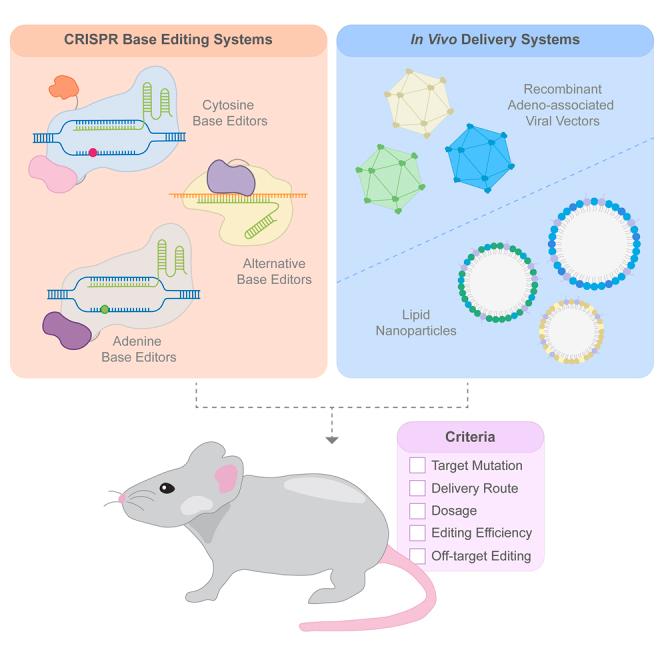
CRISPR base editing enables precise, irreversible base conversions without inducing double-stranded breaks (DSBs) and has gained significant attention in recent years. By converting cytosine to thymine (C→T) or adenine to guanine (A→G), base editors (BEs) efficiently correct pathogenic single-nucleotide variants (SNVs). This review examines mouse disease models-assessing editing efficiency, phenotypic rescue, and therapeutic potential across 66 studies. A key challenge in base editing is optimizing delivery. Most studies rely on split-intein dual adeno-associated virus (AAV) vectors due to BEs exceeding AAV packaging limits, though lipid nanoparticle (LNP) delivery is emerging. Editing efficiencies vary widely, influenced by enzyme design, delivery method, and sequence context. Many studies show significant functional gains, including extended survival in severe models such as FAH-deficient tyrosinemia type I and Hutchinson-Gilford progeria, restored dystrophin in Duchenne muscular dystrophy, and cognitive improvement in neurodegenerative models. Despite advantages such as reduced indels and increased precision, base editing is restricted to SNV correction and targets only a limited editing window relative to a protospacer adjacent motif (PAM) site. Advances in enzyme engineering, delivery strategies, and hybrid approaches incorporating prime editing could broaden its applications. As base editing evolves, its success in preclinical models positions it as a key player in next-generation gene therapies.
CRISPR碱基编辑能够实现精确、不可逆的碱基转换,而不会诱导双链断裂(DSB),近年来受到了广泛关注。通过将胞嘧啶转换为胸腺嘧啶(C→T)或腺嘌呤转换为鸟嘌呤(A→G),碱基编辑器(BE)能够有效地纠正致病性单核苷酸变体(SNV)。本综述研究了小鼠疾病模型——评估了66项研究中的编辑效率、表型挽救和治疗潜力。碱基编辑的一个关键挑战是优化递送。由于BE超过了腺相关病毒(AAV)的包装限制,大多数研究依赖于分裂内含肽双腺相关病毒(AAV)载体,不过脂质纳米颗粒(LNP)递送正在兴起。编辑效率差异很大,受到酶设计、递送方法和序列背景的影响。许多研究显示出显著的功能改善,包括在严重模型中延长生存期,如I型酪氨酸血症患者中缺乏FAH和哈钦森-吉尔福德早衰症,在杜兴氏肌营养不良症中恢复抗肌萎缩蛋白,以及在神经退行性模型中改善认知。尽管具有减少插入缺失和提高精度等优点,但碱基编辑仅限于SNV校正,并且相对于原间隔相邻基序(PAM)位点仅靶向有限的编辑窗口。酶工程、递送策略以及结合了先导编辑的混合方法的进展可能会拓宽其应用范围。随着碱基编辑的不断发展,其在临床前模型中的成功使其成为下一代基因治疗的关键参与者。


 Zotero 插件