
老年人肠道微生物群饮食指数与衰弱之间的关联:强调炎症指标的中介作用。
The association between a dietary index for the gut microbiota and frailty in older adults: emphasising the mediating role of inflammatory indicators.
作者信息
Yin Huangyi, Qiu Yue, Gan Chaomei, Zhou Yubo, Chen Tingting, Liang Min
机构信息
Geriatric Endocrinology, The First Affiliated Hospital of Guangxi Medical University, Nanning, China.
Osteoarticular Surgery, The First Affiliated Hospital of Guangxi Medical University, Nanning, China.
出版信息
Front Nutr. 2025 Jul 9;12:1562278. doi: 10.3389/fnut.2025.1562278. eCollection 2025.
BACKGROUND
The dietary index for the gut microbiota (DI-GM) is a novel indicator of gut microbiome health, and its association with frailty remains unknown.
METHODS
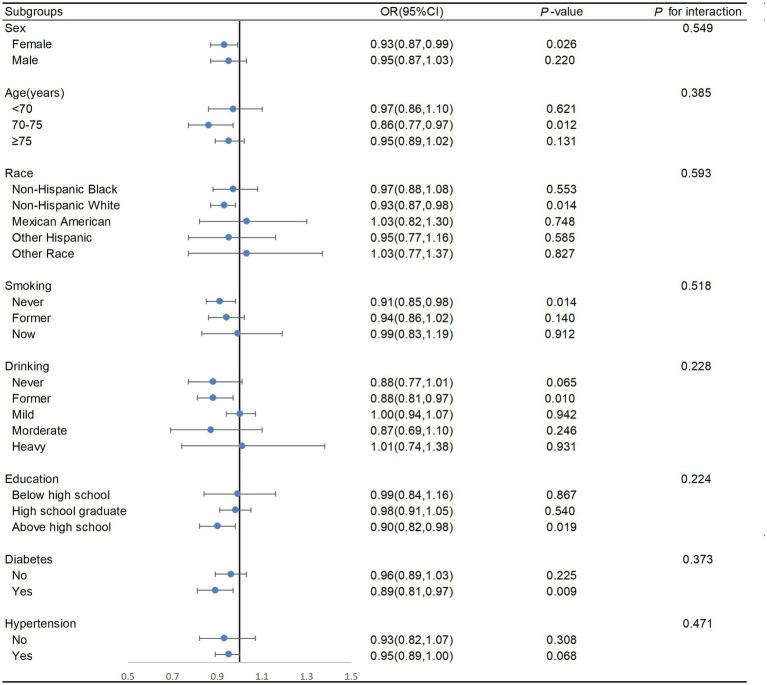
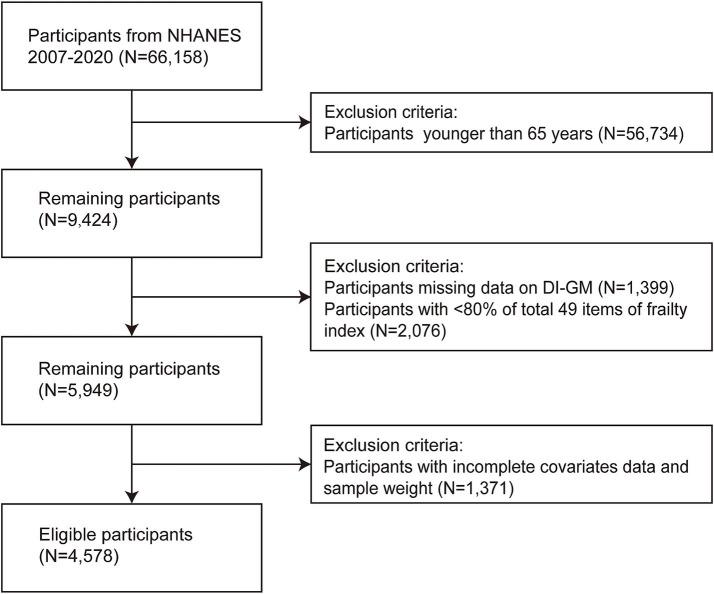
We recruited participants from the 2007-2020 National Health and Nutrition Examination Survey (NHANES). Restricted cubic splines (RCSs) and multifactorial logistic regression were employed to investigate the relationship between the DI-GM and frailty. A mediation analysis was conducted to evaluate the mediating role of inflammatory markers. Stratification and sensitivity analyses were performed to evaluate the consistency of this association.
RESULTS
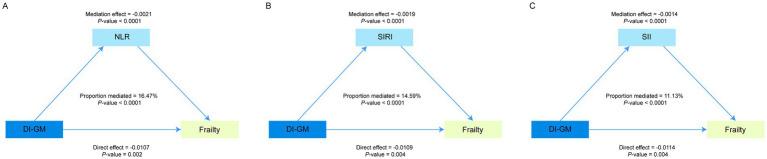
A total of 4,578 eligible individuals were screened, with a frailty prevalence of 35.50%. After adjusting for all of the covariates, each unit increase in the DI-GM was associated with a 6% decrease in the prevalence of frailty (OR = 0.94; 95% CI: 0.89, 0.99; = 0.020). Furthermore, participants in the highest tertile of the DI-GM were significantly less likely to be frail than were those in the lowest tertile (OR = 0.70; 95% CI: 0.53, 0.91; = 0.008). Mediation analysis revealed that inflammatory biomarkers significantly mediated the association between the DI-GM and frailty, with percentages of 16.47% for the neutrophil-to-lymphocyte ratio (NLR), 14.59% for the systemic inflammation response index (SIRI), and 11.13% for the systemic immune-inflammation index (SII). This negative relationship remained robust across subgroups and in the sensitivity analyses.
CONCLUSION
An elevated DI-GM, which reflects a healthier microbiota state, was associated with a reduced prevalence of frailty. This relationship was partially mediated through inflammatory biomarkers.
背景
肠道微生物群饮食指数(DI-GM)是肠道微生物组健康的一种新指标,其与衰弱的关联尚不清楚。
方法
我们从2007 - 2020年国家健康和营养检查调查(NHANES)中招募参与者。采用受限立方样条(RCS)和多因素逻辑回归来研究DI-GM与衰弱之间的关系。进行中介分析以评估炎症标志物的中介作用。进行分层和敏感性分析以评估这种关联的一致性。
结果
共筛选出4578名符合条件的个体,衰弱患病率为35.50%。在对所有协变量进行调整后,DI-GM每增加一个单位,衰弱患病率降低6%(OR = 0.94;95% CI:0.89,0.99;P = 0.020)。此外,DI-GM最高三分位数的参与者比最低三分位数的参与者衰弱的可能性显著降低(OR = 0.70;95% CI:0.53,0.91;P = 0.008)。中介分析显示,炎症生物标志物显著介导了DI-GM与衰弱之间的关联,中性粒细胞与淋巴细胞比值(NLR)的介导百分比为16.47%,全身炎症反应指数(SIRI)为14.59%,全身免疫炎症指数(SII)为11.13%。这种负相关关系在各亚组和敏感性分析中均保持稳健。
结论
升高的DI-GM反映了更健康的微生物群状态,与衰弱患病率降低相关。这种关系部分通过炎症生物标志物介导。

 Zotero 插件