
泛免疫炎症值评分在局部晚期直肠癌中的重要性
The Importance of Pan-Immune-Inflammation Value Score in Locally Advanced Rectal Cancer.
作者信息
Uçar Mahmut, Yılmaz Mukaddes, Erdiş Eda, Yücel Birsen
机构信息
Department of Medical Oncology, Faculty of Medicine, Sivas Cumhuriyet University, Sivas, Turkey.
Department of Radiation Oncology, Faculty of Medicine, Sivas Cumhuriyet University, Sivas, Turkey.
出版信息
Immun Inflamm Dis. 2025 Jul;13(7):e70227. doi: 10.1002/iid3.70227.
AIM
In this study, we aimed to observe the prognostic significance of the pan-immune-inflammation value (PIV) score calculated at the time of diagnosis in patients with locally advanced rectal cancer, as well as its effect on treatment response, survival, and prognosis.
MATERIAL AND METHOD
This retrospective, single-center observational study was designed to analyze patients with nonmetastatic (stages II-III) rectal cancer who received neoadjuvant treatment, categorized into two groups: PIV-L (n = 67, 50%) and PIV-H (n = 67, 50%). The median PIV score was used for cutoff determination. Survival analysis was applied. Univariate and multivariate Cox regression analyses were used to determine prognostic factors.
RESULTS
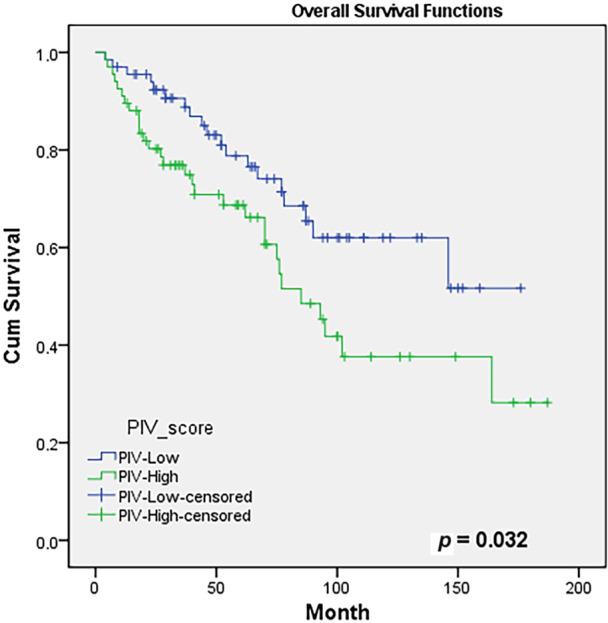
Preoperative clinical lymph node status (p = 0.011), liver metastasis (p = 0.028), carcinoembryonic antigen (CEA; p = 0.013), and cancer antigen 19.9 (CA19.9; p = 0.040) levels; pathological complete response (p = 0.035); tumor regression score (p = 0.030); postoperative lymph node status (p = 0.019); tumor deposits (p = 0.035); and budding (p = 0.043) were statistically different between the groups. The 5- and 10-year overall survival (OS) rates were 77% versus 69% and 62% versus 38% in the PIV-L and PIV-H groups, respectively (p = 0.032). While the PIV score was prognostic for OS in univariate analysis (HR: 1.85, 95% CI: 1.04-3.31, p = 0.035), a result of insignificance was obtained in multivariate analysis (HR: 1.76, 95% CI: 0.98-3.01 p = 0.056). The 5- and 10-year disease-free survival (DFS) rates were 67% versus 54% and 56% versus 39% in the PIV-L and PIV-H groups, respectively, with the PIV-H group showing a statistically significantly lower rate (p = 0.048). For DFS, the PIV score was found to be a statistically insignificant prognostic factor in univariate analysis (HR: 0.052, 95% CI: 0.99-2.86, p = 0.052) and recognized as an independent prognostic factor in multivariate analysis (HR: 1.87, 95% CI: 1.08-3.26, p = 0.026).
CONCLUSION
A higher pretreatment PIV score was associated with poorer clinicopathological features, a worse treatment response, lower survival rates, and a poor prognosis for DFS.
目的
在本研究中,我们旨在观察局部晚期直肠癌患者诊断时计算的全免疫炎症值(PIV)评分的预后意义,及其对治疗反应、生存率和预后的影响。
材料与方法
本回顾性、单中心观察性研究旨在分析接受新辅助治疗的非转移性(II - III期)直肠癌患者,分为两组:PIV - L组(n = 67,50%)和PIV - H组(n = 67,50%)。采用PIV评分中位数进行截断值确定。应用生存分析。采用单因素和多因素Cox回归分析确定预后因素。
结果
术前临床淋巴结状态(p = 0.011)、肝转移(p = 0.028)、癌胚抗原(CEA;p = 0.013)和癌抗原19.9(CA19.9;p = 0.040)水平;病理完全缓解(p = 0.035);肿瘤退缩评分(p = 0.030);术后淋巴结状态(p = 0.019);肿瘤结节(p = 0.035);以及芽生(p = 0.043)在两组间存在统计学差异。PIV - L组和PIV - H组的5年和10年总生存率(OS)分别为77%对69%和62%对38%(p = 0.032)。虽然PIV评分在单因素分析中对OS具有预后意义(HR:1.85,95%CI:1.04 - 3.31,p = 0.035),但在多因素分析中结果无统计学意义(HR:1.76,95%CI:0.98 - 3.01,p = 0.056)。PIV - L组和PIV - H组的5年和10年无病生存率(DFS)分别为67%对54%和56%对39%,PIV - H组的发生率在统计学上显著较低(p = 0.048)。对于DFS,PIV评分在单因素分析中被发现是无统计学意义的预后因素(HR:0.052,95%CI:0.99 - 2.86,p = 0.052),而在多因素分析中被确认为独立预后因素(HR:1.87,95%CI:1.08 - 3.26,p = 0.026)。
结论
较高的治疗前PIV评分与较差的临床病理特征、较差的治疗反应、较低的生存率以及DFS预后不良相关。

 Zotero 插件