
睾丸糖蛋白聚糖-1作为子宫蓄脓猫败血症生物标志物的评估
Evaluation of Testican-1 as a Sepsis Biomarker in Pyometra Cats.
作者信息
Yaprakci Ömer, Akkuş Tuğra
机构信息
Faculty of Veterinary Medicine, Department of Obstetrics and Gynaecology, Harran University, Sanliurfa, Türkiye.
出版信息
Vet Med Sci. 2025 Sep;11(5):e70514. doi: 10.1002/vms3.70514.
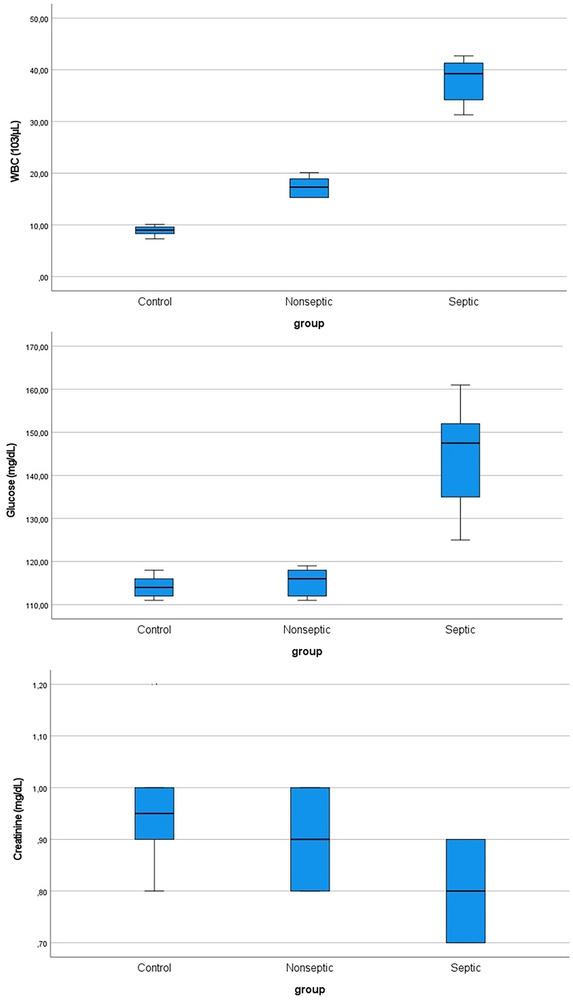
Testican-1 is a promising biomarker for sepsis, with potential applications in both diagnosis and treatment monitoring in human medicine. The aim of this study was to evaluate the potential of Testican-1 as a biomarker in feline sepsis, using pyometra as a model for naturally occurring sepsis. The study was conducted on a total of 30 cats from different breeds, aged between 1 and 8 years. The cats were divided into three groups on the basis of the owner's history, physical and gynaecological examination findings, diagnostic ultrasonography results and systemic inflammatory response syndrome (SIRS) criteria. The control group (Group 1, n = 10) consisted of healthy cats without pyometra symptoms, the non-septic pyometra group (Group 2, n = 10) included cats with pyometra but not meeting the SIRS criteria, and the septic pyometra group (Group 3, n = 10) included cats with pyometra that met the SIRS criteria. The obtained data were analysed using one-way ANOVA. It was found that body temperature and pulse values were significantly higher in the non-septic and septic pyometra groups compared to the control group (p < 0.001). Respiratory rate did not show a significant difference between the control group and the non-septic pyometra group (p > 0.05), but it was significantly higher in the septic pyometra group (p < 0.001). White blood cell (WBC) counts were significantly higher in the non-septic and septic pyometra groups compared to the control group (p < 0.001). Glucose, creatinine, and C-reactive protein (CRP) values did not show significant differences between the control group and the non-septic pyometra group (p > 0.05) but were significantly higher in the septic pyometra group (p < 0.001). Serum amyloid A (SAA) and Testican-1 levels were significantly higher in both non-septic and septic pyometra groups compared to the control group (p < 0.001). Correlation analysis showed a significant negative correlation between Testican-1 and heart rate (r = -0.864, p < 0.01) and creatinine (r = -0.584, p < 0.01). In contrast, significant positive correlations were found between Testican-1 and body temperature (r = 0.929, p < 0.01), respiratory rate (r = 0.844, p < 0.01), WBC (r = 0.955, p < 0.01), glucose (r = 0.865, p < 0.01), CRP (r = 0.993, p < 0.01) and SAA (r = 0.971, p < 0.01). In conclusion, it was concluded that Testican-1 could be used as a novel biomarker for the detection of sepsis in pyometra cats.
睾丸抑制素-1是脓毒症一种很有前景的生物标志物,在人类医学的诊断和治疗监测中都有潜在应用。本研究的目的是使用子宫蓄脓作为自然发生脓毒症的模型,评估睾丸抑制素-1作为猫脓毒症生物标志物的潜力。该研究共对30只不同品种、年龄在1至8岁之间的猫进行。根据主人的病史、体格和妇科检查结果、诊断性超声检查结果以及全身炎症反应综合征(SIRS)标准,将这些猫分为三组。对照组(第1组,n = 10)由无子宫蓄脓症状的健康猫组成,非脓毒性子宫蓄脓组(第2组,n = 10)包括有子宫蓄脓但不符合SIRS标准的猫,脓毒性子宫蓄脓组(第3组,n = 10)包括符合SIRS标准的子宫蓄脓猫。使用单因素方差分析对获得的数据进行分析。结果发现,与对照组相比,非脓毒性和脓毒性子宫蓄脓组的体温和脉搏值显著更高(p < 0.001)。对照组和非脓毒性子宫蓄脓组之间的呼吸频率没有显著差异(p > 0.05),但脓毒性子宫蓄脓组的呼吸频率显著更高(p < 0.001)。与对照组相比,非脓毒性和脓毒性子宫蓄脓组的白细胞(WBC)计数显著更高(p < 0.001)。血糖、肌酐和C反应蛋白(CRP)值在对照组和非脓毒性子宫蓄脓组之间没有显著差异(p > 0.05),但在脓毒性子宫蓄脓组中显著更高(p < 0.001)。与对照组相比,非脓毒性和脓毒性子宫蓄脓组的血清淀粉样蛋白A(SAA)和睾丸抑制素-1水平显著更高(p < 0.001)。相关性分析显示,睾丸抑制素-1与心率(r = -0.864,p < 0.01)和肌酐(r = -0.584,p < 0.01)之间存在显著负相关。相反,在睾丸抑制素-1与体温(r = 0.929,p < 0.01)、呼吸频率(r = 0.844,p < 0.01)、白细胞(r = 0.955,p < 0.01)、血糖(r = 0.865,p < 0.01)、CRP(r = 0.993,p < 0.01)和SAA(r = 0.971,p < 0.01)之间发现显著正相关。总之,得出的结论是,睾丸抑制素-1可作为检测子宫蓄脓猫脓毒症的一种新型生物标志物。


 Zotero 插件