
爱尔兰成年囊性纤维化患者饮食质量与健康相关生活质量之间的相互关系。
Interrelationships between diet quality and health-related quality of life in Irish adults living with cystic fibrosis.
作者信息
Greaney Cian, McCarthy Ellen, O'Brien Lauren, Tecklenborg Sarah, Howlett Ciara, Cronin Karen, Landers Clodagh, Connolly Mary, O'Sullivan Derbhla, Whiston Aoife, Robinson Katie, Tierney Audrey
机构信息
School of Allied Health, University of Limerick, Limerick, Ireland.
Health Research Institute, University of Limerick, Limerick, Ireland.
出版信息
Eur J Nutr. 2025 Jul 24;64(6):248. doi: 10.1007/s00394-025-03766-y.
PURPOSE
In the Cystic Fibrosis (CF) modulator era, focus for many has shifted from growth and survival to prevention of diet-related chronic diseases. In doing so, diet quality should be prioritised. However, factors influencing diet quality in CF have yet to be examined. This study aims to explore relationships between health-related quality of life (HRQoL), demographic and clinical characteristics, and diet quality in adults living with CF.
METHODS
Cross-sectional study of Irish adults with CF. Dietary intake was assessed using three-day food diaries and analysed using the Healthy Eating Index-2020 (HEI-2020) and Diet Quality Index-International (DQI-I), both scored 0–100, with higher scores indicating better diet quality. Patient-reported outcome measure questionnaires collected HRQoL data and symptom status. Data was statistically analysed in SPSS®.
RESULTS
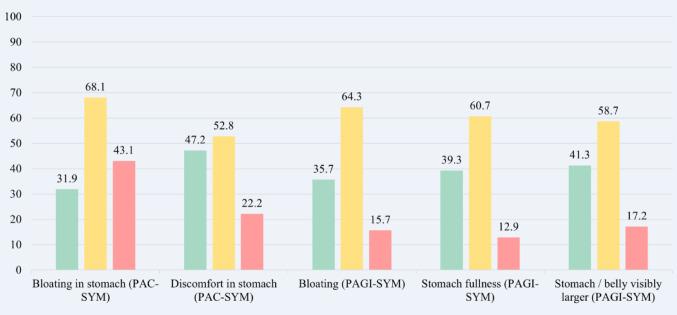
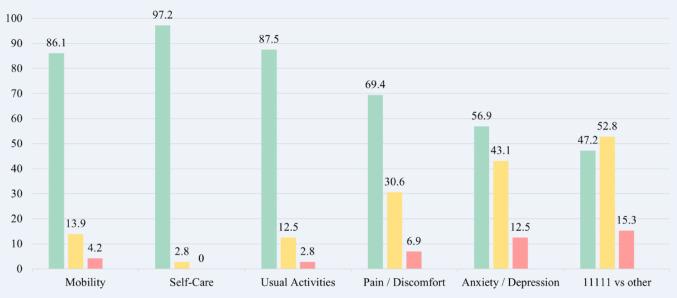
Among = 73 participants (female: 56.2%, age: 35.1 ± 10.3 years), 79.4% were taking CFTR modulators. Mean predicted percentage forced expiratory volume (FEV%) was 78.7 ± 24.9%, and median body mass index was 23.9 (4.2) kg/m. Mean HEI-2020 and DQI-I scores were 59.3 ± 12.4 and 51.2 ± 9.8, respectively. Anxiety/depression symptoms were reported by 43.1% of participants, and 30.6% reported the presence of pain/discomfort. Bloating in stomach was reported in 68.1% of participants, with 43.1% reporting moderate to severe symptoms. FEV% and digestive symptoms were independently positive significant predictors of HEI-2020 scores (Radj = 0.166, = 67, = 0.004).
CONCLUSION
In the modulator era, suboptimal vitality, anxiety / depression, and gut symptoms remain prevalent among adults living with CF. Future dietary interventions should aim to improve diet quality and consider incorporating dietary patterns that positively influence the gut microbiome.
SUPPLEMENTARY INFORMATION
The online version contains supplementary material available at 10.1007/s00394-025-03766-y.
目的
在囊性纤维化(CF)调节剂时代,许多人的关注点已从生长和生存转移到预防与饮食相关的慢性病。在此过程中,应优先考虑饮食质量。然而,影响CF患者饮食质量的因素尚未得到研究。本研究旨在探讨CF成年患者的健康相关生活质量(HRQoL)、人口统计学和临床特征与饮食质量之间的关系。
方法
对爱尔兰成年CF患者进行横断面研究。使用为期三天的食物日记评估饮食摄入量,并使用2020年健康饮食指数(HEI - 2020)和国际饮食质量指数(DQI - I)进行分析,两者得分均为0 - 100分,分数越高表明饮食质量越好。通过患者报告结局测量问卷收集HRQoL数据和症状状态。数据在SPSS®中进行统计分析。
结果
在73名参与者中(女性:56.2%,年龄:35.1±10.3岁),79.4%的人正在服用CFTR调节剂。平均预测用力呼气容积百分比(FEV%)为78.7±24.9%,体重指数中位数为23.9(4.2)kg/m²。HEI - 2020和DQI - I的平均得分分别为59.3±12.4和51.2±9.8。43.1%的参与者报告有焦虑/抑郁症状,30.6%的参与者报告有疼痛/不适。68.1%的参与者报告有胃部胀气,其中43.1%报告有中度至重度症状。FEV%和消化症状是HEI - 2020得分的独立正向显著预测因素(调整R² = 0.166,n = 67,p = 0.004)。
结论
在调节剂时代,CF成年患者中活力欠佳、焦虑/抑郁和肠道症状仍然普遍存在。未来的饮食干预应旨在改善饮食质量,并考虑纳入对肠道微生物群有积极影响的饮食模式。
补充信息
在线版本包含可在10.1007/s00394 - 025 - 03766 - y获取的补充材料。
 Zotero 插件