
环泊酚用于肥胖患者腹腔镜袖状胃切除术全麻诱导的有效性和安全性:一项双盲随机对照研究。
Efficacy and safety of ciprofol for the induction of general anesthesia in patients with obesity undergoing laparoscopic sleeve gastrectomy: A double-blind randomized, controlled study.
作者信息
Chi Xiaowei, Xu Yi, Li Qiang, Xia Keshu, Fu Qiang
机构信息
Department of Anesthesiology, The Third People's Hospital of Chengdu, Affiliated Hospital of Southwest Jiaotong University, Chengdu, Sichuan, China.
Department of Anesthesiology, The First Affiliated Hospital of Chongqing Medical University, Chongqing, China.
出版信息
PLoS One. 2025 Jul 24;20(7):e0329005. doi: 10.1371/journal.pone.0329005. eCollection 2025.
BACKGROUND
The selection of safe and effective anesthetic agents for patients undergoing bariatric surgery is vital. This study aimed to evaluate the efficacy and safety of ciprofol in inducing general anesthesia in patients with obesity undergoing laparoscopic sleeve gastrectomy.
METHODS
A total of 212 patients scheduled for laparoscopic sleeve gastrectomy were randomly allocated into two groups in a 1:1 ratio: the ciprofol (0.5 mg/kg, n = 106) and propofol (2.5 mg/kg, n = 106) groups. The primary endpoint was to assess the success rate of anesthesia induction. Secondary endpoints included evaluating the time of induction, loss of eyelash reflex, changes in bispectral index, and adverse event incidence.
RESULTS
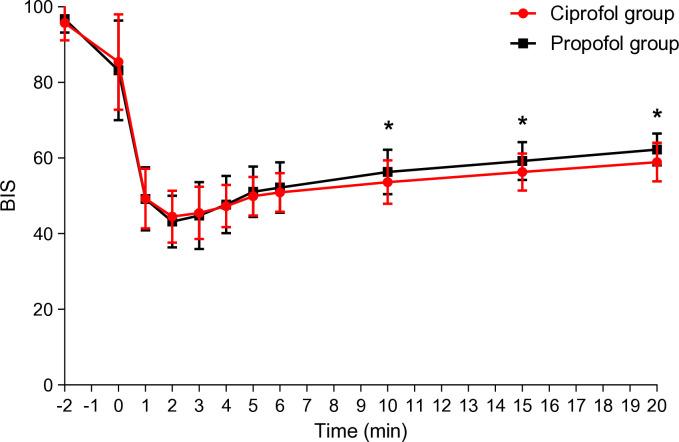
The success rates of anesthesia induction were 100% in both groups. Ciprofol demonstrated non-inferiority to propofol in induction success. The times to successful induction onset and eyelash reflex disappearance were significantly longer in the ciprofol group compared to those in the propofol group (39.38 ± 8.57 s vs. 36.74 ± 6.82 s, P = 0.014 and 40.36 ± 8.59 s vs. 37.77 ± 6.84 s, P = 0.016, respectively). The adverse events incidence was significantly lower in the ciprofol group compared to that in the propofol group (25.47% vs. 89.62%, P = 0.000). The number of patients requiring top-up doses was not statistically significant (3.77% vs. 7.55%, P = 0.235). Ciprofol demonstrated advantages in hemodynamic stability and maintaining a better sedation level post-induction. Ciprofol was associated with a significantly lower incidence of hypotension compared to propofol (14.15% vs. 37.74%, P < 0.001), and more patients maintained appropriate sedation depth (86.80% vs. 72.64%, P = 0.010, 40 ≤ bispectral index ≤ 60 within 10 min of intravenous administration).
CONCLUSION
Ciprofol offers a better sedative effect, fewer adverse events, and greater hemodynamic stability during general anesthesia induction in patients with obesity undergoing laparoscopic sleeve gastrectomy.
TRIAL REGISTRATION
ClinicalTrials.gov NCT05522998.
背景
为接受减重手术的患者选择安全有效的麻醉药物至关重要。本研究旨在评估环泊酚在肥胖患者行腹腔镜袖状胃切除术时诱导全身麻醉的有效性和安全性。
方法
总共212例计划行腹腔镜袖状胃切除术的患者按1:1比例随机分为两组:环泊酚组(0.5mg/kg,n = 106)和丙泊酚组(2.5mg/kg,n = 106)。主要终点是评估麻醉诱导成功率。次要终点包括评估诱导时间、睫毛反射消失时间、脑电双频指数变化及不良事件发生率。
结果
两组麻醉诱导成功率均为100%。环泊酚在诱导成功率方面不劣于丙泊酚。与丙泊酚组相比,环泊酚组成功诱导起效时间和睫毛反射消失时间显著更长(分别为39.38±8.57秒对36.74±6.82秒,P = 0.014;40.36±8.59秒对37.77±6.84秒,P = 0.016)。环泊酚组不良事件发生率显著低于丙泊酚组(25.47%对89.62%,P = 0.000)。需要追加剂量的患者数量无统计学差异(3.77%对7.55%,P = 0.235)。环泊酚在血流动力学稳定性和诱导后维持更好的镇静水平方面具有优势。与丙泊酚相比环泊酚低血压发生率显著更低(14.15%对37.74%,P < 0.),更多患者维持适当镇静深度(86.80%对72.64%,P = 0.010,静脉给药10分钟内脑电双频指数40≤脑电双频指数≤60)。
结论
在肥胖患者行腹腔镜袖状胃切除术的全身麻醉诱导过程中,环泊酚具有更好的镇静效果、更少的不良事件和更大的血流动力学稳定性。
试验注册
ClinicalTrials.gov NCT05522998


 Zotero 插件