
铁死亡:一把双刃剑,增强肿瘤的辐射敏感性并加剧辐射诱导的损伤。
Ferroptosis: a double-edged sword that enhances radiation sensitivity and facilitates radiation-induced injury in tumors.
作者信息
Liu Yang, Zhan Jianhao, Wang Jisheng, Zeng Xiaoping, Liu Shanshan, Huang Le, Niu Liyan, Sun Chengpeng, Ding Zijun, Xing Yan, Zhou Zhengyu, Li Xiaoying, Li Qing, Wang Hongmei
机构信息
Department of Oncology, The Second Affiliated Hospital of Nanchang University, Nanchang, Jiangxi, China.
The First School of Clinical Medicine of Nanchang University, Nanchang University, Nanchang, Jiangxi, China.
出版信息
Front Immunol. 2025 Jul 10;16:1591172. doi: 10.3389/fimmu.2025.1591172. eCollection 2025.
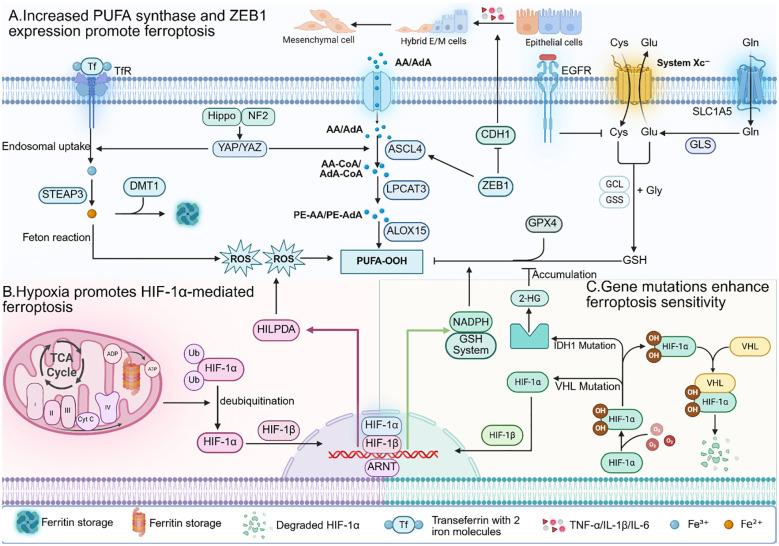
Cell death is a crucial mechanism by which radiotherapy eliminates tumor cells. Ferroptosis, characterized by intracellular iron overload and lipid peroxidation, represents a distinct form of programmed cell death. Recent research has demonstrated that numerous malignant tumors exhibit high sensitivity to ferroptosis. Therefore, the induction of ferroptosis in tumor cells has emerged as a promising approach to overcome apoptosis resistance and increase sensitivity to radiotherapy. In this review, we aim to shed light on ferroptosis and its dual roles in both enhancing radiation sensitivity in tumor cells and facilitating radiation-induced injury. Then we discussed the contradiction of ferroptosis between radiation sensitivity and radiation-induced injury, providing valuable insights and directions for the advancement of clinical tumor radiotherapy.
细胞死亡是放射治疗消除肿瘤细胞的关键机制。铁死亡以细胞内铁过载和脂质过氧化为特征,是一种独特的程序性细胞死亡形式。最近的研究表明,许多恶性肿瘤对铁死亡表现出高度敏感性。因此,诱导肿瘤细胞发生铁死亡已成为一种有前景的方法,可克服细胞凋亡抗性并提高放疗敏感性。在本综述中,我们旨在阐明铁死亡及其在增强肿瘤细胞放射敏感性和促进辐射诱导损伤方面的双重作用。然后我们讨论了铁死亡在放射敏感性和辐射诱导损伤之间的矛盾,为临床肿瘤放疗的进展提供了有价值的见解和方向。



 Zotero 插件