
青少年胰岛素抵抗预测模型及其对代谢功能障碍相关脂肪性肝病的意义:一种新型标志物——儿童胰岛素抵抗评估评分
Prediction Model for Insulin Resistance and Implications for MASLD in Youth: A Novel Marker, the Pediatric Insulin Resistance Assessment Score.
作者信息
Song Kyungchul, Lee Eunju, Youn Young Hoon, Baik Su Jung, Shin Hyun Joo, Lee Ji-Won, Chae Hyun Wook, Lee Hye Sun, Kwon Yu-Jin
机构信息
Department of Pediatrics, Gangnam Severance Hospital, Yonsei University College of Medicine, Seoul, Korea.
Biostatistics Collaboration Unit, Yonsei University College of Medicine, Seoul, Korea.
出版信息
Yonsei Med J. 2025 Aug;66(8):464-472. doi: 10.3349/ymj.2024.0442.
PURPOSE
Insulin resistance (IR) is a condition closely associated with cardiovascular risk factors and metabolic dysfunction-associated steatotic liver disease (MASLD) is emerging as a significant IR-related complication. We aimed to develop a predictive model for IR in youths and implicate this model for MASLD.
MATERIALS AND METHODS
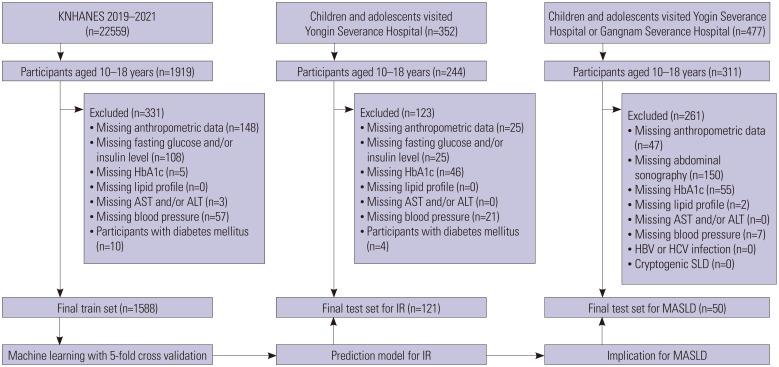
A total of 1588 youths from the population-based data were included in the training set. For the test sets, 121 participants were included for IR and 50 for MASLD from real-world clinic data. Logistic regression analysis, random forest, extreme gradient boosting (XGBoost), light gradient boosting machine (GBM), and deep neural network (DNN) were used to develop the models. A nomogram scoring system was constructed based on a model used to predict the probability of IR and MASLD.
RESULTS
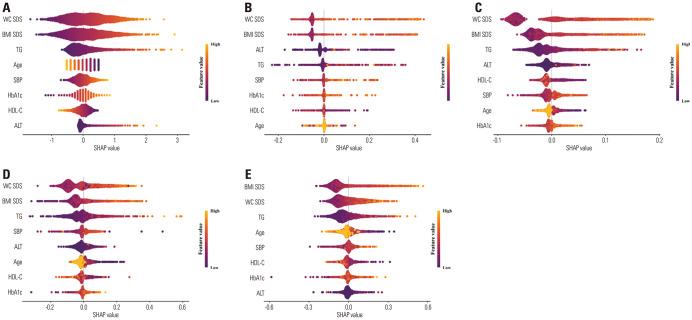
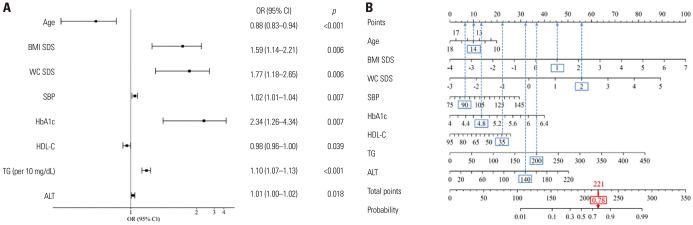
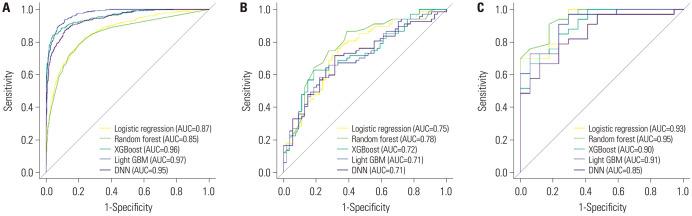
After stepwise selection, age, body mass index (BMI) standard deviation score (SDS), waist circumference (WC), systolic blood pressure, HbA1c, high-density lipoprotein cholesterol, triglyceride, and alanine aminotransferase levels were included in the model. A nomogram scoring system was constructed based on a multivariable logistic regression model. The areas under the curves (AUCs) of the models for IR prediction in external validation were 0.75 (logistic regression), 0.78 (random forest), 0.72 (XGBoost), 0.71 (light GBM), and 0.71 (DNN). For MASLD prediction, the AUCs were 0.93 (logistic regression), 0.95 (random forest), 0.90 (XGBoost), 0.91 (light GBM), and 0.85 (DNN). BMI SDS and WC SDS were the most important contributors to IR prediction in all models.
CONCLUSION
The Pediatric Insulin Resistance Assessment Score is a novel scoring system for predicting IR and MASLD in youths.
目的
胰岛素抵抗(IR)与心血管危险因素密切相关,代谢功能障碍相关脂肪性肝病(MASLD)正成为一种重要的与IR相关的并发症。我们旨在开发一种针对青少年IR的预测模型,并将该模型应用于MASLD。
材料与方法
来自基于人群数据的1588名青少年被纳入训练集。对于测试集,从真实世界临床数据中纳入121名IR参与者和50名MASLD参与者。采用逻辑回归分析、随机森林、极端梯度提升(XGBoost)、轻梯度提升机(GBM)和深度神经网络(DNN)来开发模型。基于用于预测IR和MASLD概率的模型构建了列线图评分系统。
结果
经过逐步选择,模型纳入了年龄、体重指数(BMI)标准差评分(SDS)、腰围(WC)、收缩压、糖化血红蛋白(HbA1c)、高密度脂蛋白胆固醇、甘油三酯和丙氨酸氨基转移酶水平。基于多变量逻辑回归模型构建了列线图评分系统。外部验证中IR预测模型的曲线下面积(AUC)分别为0.75(逻辑回归)、0.78(随机森林)、0.72(XGBoost)、0.71(轻GBM)和0.71(DNN)。对于MASLD预测,AUC分别为0.93(逻辑回归)、0.95(随机森林)、0.90(XGBoost)、0.91(轻GBM)和0.85(DNN)。在所有模型中,BMI SDS和WC SDS是IR预测的最重要因素。
结论
儿童胰岛素抵抗评估评分是一种用于预测青少年IR和MASLD的新型评分系统。
 Zotero 插件