
RhoGDIβ-Rac1-CARD9信号模块介导慢性高血糖状态下胰岛β细胞功能障碍。
The RhoGDIβ-Rac1-CARD9 Signaling Module Mediates Islet β-Cell Dysfunction Under Chronic Hyperglycemia.
作者信息
Kowluru Anjaneyulu, Wang Jie-Mei
机构信息
Biomedical Research Service, John D. Dingell VA Medical Center, Detroit, MI 48201, USA.
Department of Pharmaceutical Sciences, Eugene Applebaum College of Pharmacy and Health Sciences, Wayne State University, Detroit, MI 48201, USA.
出版信息
Cells. 2025 Jul 9;14(14):1046. doi: 10.3390/cells14141046.
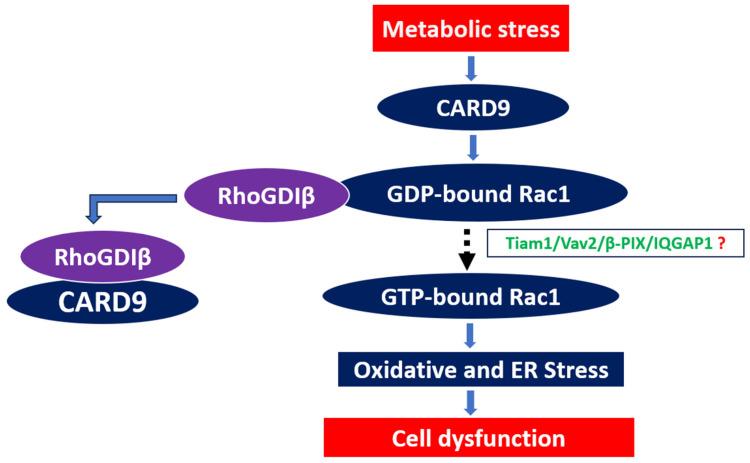
Small (monomeric) GTP-binding proteins (smgs; Cdc42 and Rac1) play requisite roles in islet beta cell function, including glucose-stimulated insulin secretion. In addition, emerging evidence suggests that sustained (constitutive) activation of smgs (e.g., Rac1) culminates in the genesis of islet beta cell dysfunction under the duress of chronic hyperglycemia. It is noteworthy that functions (i.e., activation-deactivation) of smgs in many cells, including the islet beta cell, have been shown to be under the regulatory control of at least three factors, namely the guanine nucleotide exchange factors (GEFs), the GTPase-activating proteins (GAPs), and the GDP-dissociation inhibitors (GDIs). The overall objective of this review is to highlight our current understanding of the regulatory roles of the RhoGDIβ-Rac1-CARD9 signalome in the pathology of beta cell dysfunction under chronic hyperglycemic stress. For brevity, this review is structured by an overview of smgs and their regulatory proteins/factors in the beta cell, followed by a discussion of potential roles of the RhoGDIβ-Rac1-CARD9 axis in the onset of cellular dysfunction under the duress of metabolic stress. Overall conclusions, potential knowledge gaps, and opportunities for future research in this field of islet biology are highlighted in the last section.
小(单体)GTP结合蛋白(smgs;Cdc42和Rac1)在胰岛β细胞功能中发挥着必要作用,包括葡萄糖刺激的胰岛素分泌。此外,新出现的证据表明,在慢性高血糖的胁迫下,smgs(如Rac1)的持续(组成性)激活最终会导致胰岛β细胞功能障碍的发生。值得注意的是,包括胰岛β细胞在内的许多细胞中,smgs的功能(即激活-失活)已被证明受至少三种因子的调控,即鸟嘌呤核苷酸交换因子(GEFs)、GTP酶激活蛋白(GAPs)和GDP解离抑制剂(GDIs)。本综述的总体目标是强调我们目前对RhoGDIβ-Rac1-CARD9信号组在慢性高血糖应激下β细胞功能障碍病理学中的调控作用的理解。为简洁起见,本综述首先概述了β细胞中的smgs及其调控蛋白/因子,然后讨论了RhoGDIβ-Rac1-CARD9轴在代谢应激胁迫下细胞功能障碍发生中的潜在作用。最后一部分强调了胰岛生物学这一领域的总体结论、潜在的知识空白以及未来研究的机会。


 Zotero 插件