
利用多组学分析对嗅神经母细胞瘤分子病理生理学的最新见解
Updated Insights into the Molecular Pathophysiology of Olfactory Neuroblastoma Using Multi-Omics Analysis.
作者信息
Demir Enes, Montgomery Deondra, Naravetla Varun, Karsy Michael
机构信息
School of Medicine, Eskisehir Osmangazi University, Eskişehir 26040, Türkiye.
College of Human Medicine, Michigan State University, East Lansing, MI 48824, USA.
出版信息
J Pers Med. 2025 Jul 13;15(7):309. doi: 10.3390/jpm15070309.
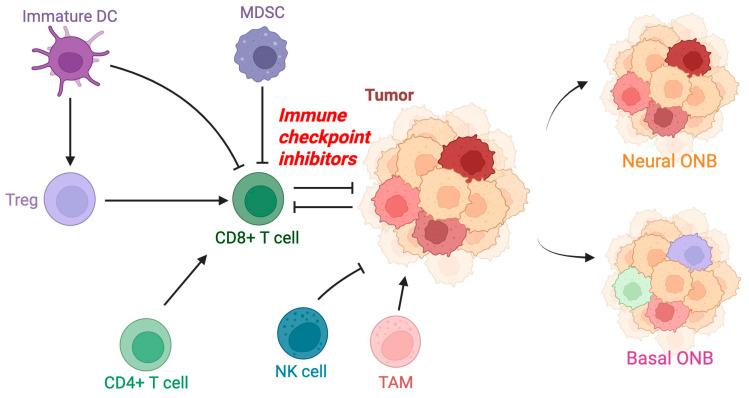
: Olfactory neuroblastoma (ONB), also known as esthesioneuroblastoma, is a rare neuroectodermal malignancy of the nasal cavity characterized by aggressive local invasion and variable metastatic potential, with diverse clinical behavior, often presenting at advanced stages. ONB poses challenges for targeted therapeutic strategies, despite advances in surgical and multimodal treatment strategies, because of the rarity of this disease and the limited understanding of its molecular pathophysiology. : A comprehensive review of genomic, multi-omic, and molecular studies was performed to integrate known targeted sites in ONB with the current understanding of its pathophysiology. : Recent genetic and molecular studies have identified significant epigenetic and signaling pathway alterations that are critical in pathogenesis and treatment resistance and may serve as potential therapeutic targets. Additionally, novel discovered immunohistochemical and transcriptomic markers, such as , , and , offer improved diagnostic specificity and prognostication. Multi-genomic platforms (i.e., multi-omics), involving the combined integration of transcriptomics, epigenetics, and proteomics findings, have led to several recent insights, including the subclassification of neural and basal genomic subtypes, the identification of key driver mutations, and new insights into disease development. This review synthesizes current knowledge on the molecular landscape of ONB, including its tumor origin, immune microenvironment, genetic alterations, and key molecular pathways involved in its pathogenesis. : Future research may benefit from integrating these findings into precision medicine approaches, enabling earlier diagnosis and more accurate prognosis.
嗅神经母细胞瘤(ONB),也称为感觉神经母细胞瘤,是一种罕见的鼻腔神经外胚层恶性肿瘤,其特征为局部侵袭性强且转移潜能各异,临床行为多样,常于晚期出现。尽管手术和多模式治疗策略有所进展,但由于该疾病罕见且对其分子病理生理学了解有限,ONB对靶向治疗策略构成挑战。
对基因组、多组学和分子研究进行了全面综述,以将ONB中已知的靶向位点与当前对其病理生理学的理解相结合。
最近的基因和分子研究已经确定了重要的表观遗传和信号通路改变,这些改变在发病机制和治疗耐药性中至关重要,可能作为潜在的治疗靶点。此外,新发现的免疫组化和转录组学标志物,如 、 和 ,提高了诊断特异性和预后判断能力。多基因组平台(即多组学),涉及转录组学、表观遗传学和蛋白质组学研究结果的综合整合,带来了一些最新见解,包括神经和基底基因组亚型的分类、关键驱动突变的识别以及对疾病发展的新认识。本综述综合了关于ONB分子格局的当前知识,包括其肿瘤起源、免疫微环境、基因改变以及发病机制中涉及的关键分子途径。
未来的研究可能受益于将这些发现整合到精准医学方法中,从而实现更早的诊断和更准确的预后。

 Zotero 插件