
胰岛素样生长因子结合蛋白1对周围动脉疾病心血管并发症的预后评估价值
The Prognostic Potential of Insulin-like Growth Factor-Binding Protein 1 for Cardiovascular Complications in Peripheral Artery Disease.
作者信息
Li Ben, Shaikh Farah, Younes Houssam, Abuhalimeh Batool, Zamzam Abdelrahman, Abdin Rawand, Qadura Mohammad
机构信息
Department of Surgery, University of Toronto, Toronto, ON M5S 1A1, Canada.
Division of Vascular Surgery, St. Michael's Hospital, Unity Health Toronto, University of Toronto, Toronto, ON M5B 1W8, Canada.
出版信息
J Cardiovasc Dev Dis. 2025 Jul 1;12(7):253. doi: 10.3390/jcdd12070253.
BACKGROUND/OBJECTIVES: Patients with peripheral artery disease (PAD) have a heightened risk of major adverse cardiovascular events (MACE), including myocardial infarction, stroke, and death. Despite this, limited progress has been made in identifying reliable biomarkers to prognosticate such outcomes. Circulating growth factors, known to influence endothelial function and the progression of atherosclerosis, may hold prognostic value in this context. The objective of this research was to evaluate a broad range of blood-based growth factors to investigate their potential as predictors of MACE in patients diagnosed with PAD.
METHODS
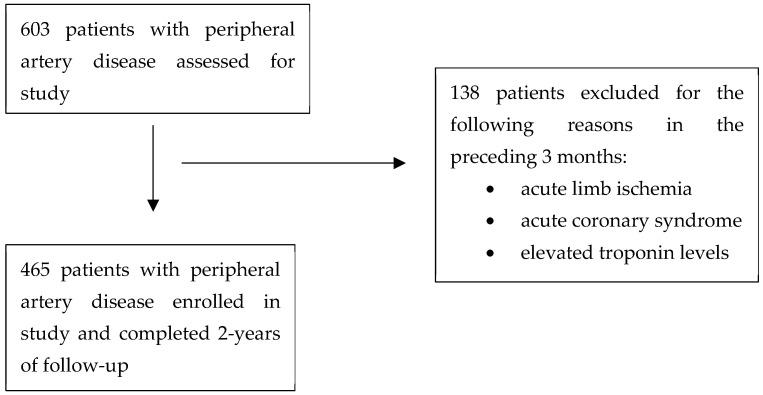
A total of 465 patients with PAD were enrolled in a prospective cohort study. Baseline plasma levels of five different growth factors were measured, and participants were monitored over a two-year period. The primary outcome was the occurrence of MACE within those two years. Comparative analysis of protein levels between patients who did and did not experience MACE was performed using the Mann-Whitney U test. To assess the individual prognostic significance of each protein for predicting MACE within two years, Cox proportional hazards regression was performed, adjusting for clinical and demographic factors including a history of coronary and cerebrovascular disease. Subgroup analysis was performed to assess the prognostic value of these proteins in females, who may be at higher risk of PAD-related adverse events. Net reclassification improvement (NRI), integrated discrimination improvement (IDI), and area under the receiver operating characteristic curve (AUROC) were calculated to assess the added value of significant biomarkers to model performance for predicting 2-year MACE when compared to using demographic/clinical features alone. Kaplan-Meier curves stratified by IGFBP-1 tertiles compared using log-rank tests and Cox proportional hazards analysis were used to assess 2-year MACE risk trajectory based on plasma protein levels.
RESULTS
The average participant age was 71 years (SD 10); 31.1% were female and 47.2% had diabetes. By the end of the two-year follow-up, 18.1% ( = 84) had experienced MACE. Of all proteins studied, only insulin-like growth factor-binding protein 1 (IGFBP-1) showed a significant elevation among patients who suffered MACE versus those who remained event-free (20.66 [SD 3.91] vs. 13.94 [SD 3.80] pg/mL; = 0.012). IGFBP-1 remained a significant independent predictor of 2-year MACE occurrence in the multivariable Cox analysis (adjusted hazard ratio [HR] 1.57, 95% CI 1.21-1.97; = 0.012). Subgroup analyses revealed that IGFBP-1 was significantly associated with 2-year MACE occurrence in both females (adjusted HR 1.52, 95% CI 1.16-1.97; = 0.015) and males (adjusted HR 1.04, 95% CI 1.02-1.22; = 0.045). Incorporating IGFBP-1 into the clinical risk prediction model significantly enhanced its predictive performance, with an increase in the AUROC from 0.73 (95% CI 0.71-0.75) to 0.79 (95% CI 0.77-0.81; = 0.01), an NRI of 0.21 (95% CI 0.07-0.36; = 0.014), and an IDI of 0.041 (95% CI 0.015-0.066; = 0.008), highlighting the prognostic value of IGFBP-1. Kaplan-Meier analysis showed an increase in the cumulative incidence of 2-year MACE across IGFBP-1 tertiles. Patients in the highest IGFBP-1 tertile experienced a significantly higher event rate compared to those in the lowest tertile (log-rank = 0.008). In the Cox proportional hazards analysis, the highest tertile of IGFBP-1 was associated with increased 2-year MACE risk compared to the lowest tertile (adjusted HR 1.81; 95% CI: 1.31-2.65; = 0.001).
CONCLUSIONS
Among the growth factors analyzed, IGFBP-1 emerged as the sole biomarker independently linked to the development of MACE over a two-year span in both female and male PAD patients. The addition of IGFBP-1 to clinical features significantly improved model predictive performance for 2-year MACE. Measuring IGFBP-1 levels may enhance risk stratification and guide the intensity of therapeutic interventions and referrals to cardiovascular specialists, ultimately supporting more personalized and effective management strategies for patients with PAD to reduce systemic vascular risk.
背景/目的:外周动脉疾病(PAD)患者发生主要不良心血管事件(MACE)的风险增加,包括心肌梗死、中风和死亡。尽管如此,在确定可靠的生物标志物以预测此类结局方面进展有限。已知循环生长因子会影响内皮功能和动脉粥样硬化的进展,在此背景下可能具有预后价值。本研究的目的是评估多种基于血液的生长因子,以研究它们作为PAD诊断患者MACE预测指标的潜力。
方法
共有465例PAD患者纳入一项前瞻性队列研究。测量了五种不同生长因子的基线血浆水平,并对参与者进行了为期两年的监测。主要结局是这两年内发生的MACE。使用Mann-Whitney U检验对发生和未发生MACE的患者之间的蛋白质水平进行比较分析。为评估每种蛋白质在预测两年内MACE的个体预后意义,进行了Cox比例风险回归分析,并对包括冠心病和脑血管疾病史在内的临床和人口统计学因素进行了调整。进行亚组分析以评估这些蛋白质在女性中的预后价值,女性可能发生PAD相关不良事件的风险更高。计算净重新分类改善(NRI)、综合判别改善(IDI)和受试者操作特征曲线下面积(AUROC),以评估与仅使用人口统计学/临床特征相比,显著生物标志物对预测2年MACE模型性能的增加值。使用对数秩检验和Cox比例风险分析比较按胰岛素样生长因子结合蛋白-1(IGFBP-1)三分位数分层的Kaplan-Meier曲线,以根据血浆蛋白水平评估2年MACE风险轨迹。
结果
参与者的平均年龄为71岁(标准差10);31.1%为女性,47.2%患有糖尿病。到两年随访结束时,18.1%(n = 84)发生了MACE。在所有研究的蛋白质中,只有胰岛素样生长因子结合蛋白-1(IGFBP-1)在发生MACE的患者中显著高于未发生事件的患者(20.66 [标准差3.91] vs. 13.94 [标准差3.80] pg/mL;P = 0.012)。在多变量Cox分析中,IGFBP-1仍然是2年MACE发生的显著独立预测因子(调整后风险比[HR] 1.57,95%置信区间1.21 - 1.97;P = 0.012)。亚组分析显示,IGFBP-1在女性(调整后HR 1.52,95%置信区间1.16 - 1.97;P = 0.015)和男性(调整后HR 1.04,95%置信区间1.02 - 1.22;P = 0.045)中均与2年MACE发生显著相关。将IGFBP-1纳入临床风险预测模型显著提高了其预测性能,AUROC从0.73(95%置信区间0.71 - 0.75)增加到0.79(95%置信区间0.77 - 0.81;P = 0.01),NRI为0.21(95%置信区间0.07 - 0.36;P = 0.014),IDI为0.(此处原文有误,推测可能是0.041)(95%置信区间0.015 - 0.066;P = 0.008),突出了IGFBP-1的预后价值。Kaplan-Meier分析显示,2年MACE的累积发生率在IGFBP-1三分位数中呈上升趋势。IGFBP-1最高三分位数的患者与最低三分位数的患者相比,事件发生率显著更高(对数秩P = 0.008)。在Cox比例风险分析中,与最低三分位数相比,IGFBP-1最高三分位数与2年MACE风险增加相关(调整后HR 1.81;95%置信区间:1.31 - 2.65;P = 0.001)。
结论
在分析的生长因子中,IGFBP-1是唯一与女性和男性PAD患者两年内MACE发生独立相关的生物标志物。将IGFBP-1添加到临床特征中显著改善了2年MACE的模型预测性能。测量IGFBP-1水平可能会加强风险分层,并指导治疗干预的强度以及转介至心血管专科医生,最终支持针对PAD患者更个性化和有效的管理策略,以降低全身血管风险。

 Zotero 插件