
中国新装修房屋所用地板材料中邻苯二甲酸酯的存在情况、迁移行为及环境负担
Occurrence, Migration Behavior, and Environmental Burden of Phthalate Esters in Flooring Materials Used in Newly Renovated Chinese Homes.
作者信息
Zhang Ying, Chen Li-Bo, Shen Hao-Yang, Wu Zi-Chao, Zhu Ning-Zheng, Gao Chong-Jing, Guo Ying
机构信息
Zhejiang Provincial Top Discipline of Biological Engineering (Level A), Zhejiang Wanli University, Ningbo 315100, China.
State Key Laboratory of Pollution Control and Resources Reuse, College of Environmental Science and Engineering, Tongji University, Shanghai 200092, China.
出版信息
Toxics. 2025 Jun 20;13(7):517. doi: 10.3390/toxics13070517.
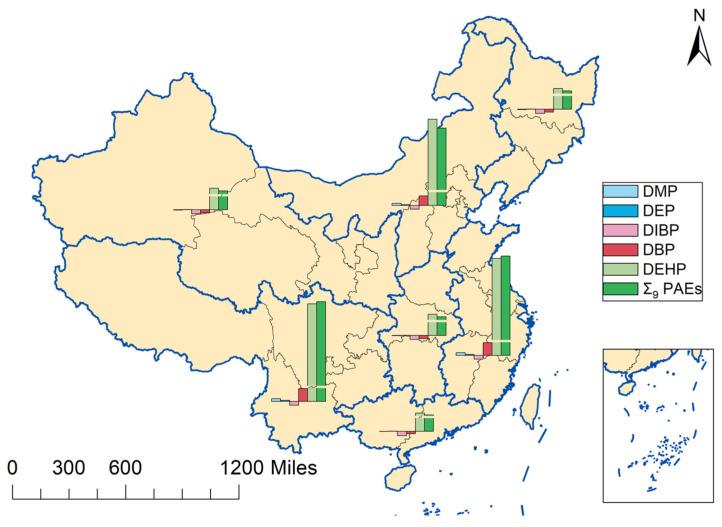
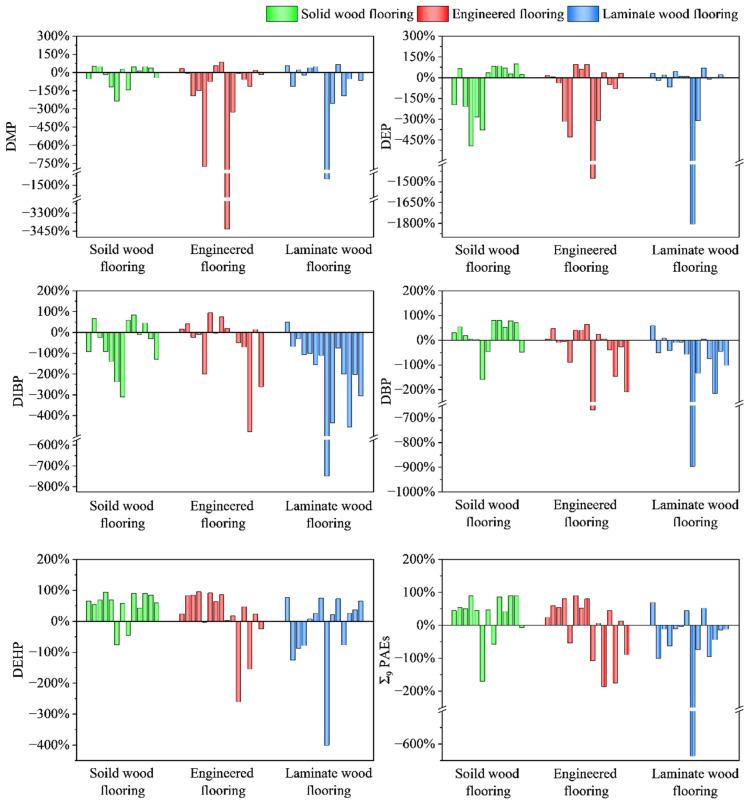
Phthalic acid esters (PAEs), a class of synthetic semi-volatile organic compounds, are extensively incorporated into decorative materials. However, their specific occurrence, migration behaviors, and environmental impact on these materials-which comprise the largest surface areas in residential settings-remain insufficiently understood. This study investigated the distribution, emission dynamics, and environmental burdens of PAEs in flooring commonly used in Chinese households. The results showed that PAEs are widespread in flooring, with total concentrations ranging from 1220 to 166,000 ng/g (14,100 ng/g, median value). Solid wood flooring (55,900 ng/g) exhibited significantly higher PAE levels compared to engineered flooring (22,600 ng/g) and laminate flooring (4000 ng/g) ( < 0.05). Migration experiments revealed that solid wood flooring tended to continuously release PAEs, laminate flooring showed a pronounced capacity for PAE absorption, and engineered flooring exhibited both release and absorption behaviors. The initial PAE concentration is the dominant factor influencing migration rates, while the flooring type and substrate density also contribute to varying degrees. The estimated environmental burdens of PAEs resulting from flooring in newly renovated Chinese households ranged from 3.63 × 10 ng to 3.45 × 10 ng, with a median value of 1.23 × 10 ng. Households in the eastern and southwestern regions exhibited the highest PAE burdens, while the southern region showed the lowest. Socioeconomic factors such as residential floor area, number of rooms, household income, and renovation budget significantly influenced the environmental burden of PAEs derived from flooring.
邻苯二甲酸酯(PAEs)是一类合成半挥发性有机化合物,被广泛应用于装饰材料中。然而,它们在这些构成住宅环境中最大表面积的材料中的具体存在情况、迁移行为以及对环境的影响仍未得到充分了解。本研究调查了中国家庭常用地板中PAEs的分布、排放动态和环境负担。结果表明,PAEs在地板中广泛存在,总浓度范围为1220至166,000纳克/克(中位数为14,100纳克/克)。实木地板(55,900纳克/克)的PAE含量明显高于强化地板(22,600纳克/克)和复合地板(4000纳克/克)(<0.05)。迁移实验表明,实木地板倾向于持续释放PAEs,复合地板表现出显著的PAE吸收能力,而强化地板则兼具释放和吸收行为。初始PAE浓度是影响迁移速率的主要因素,而地板类型和基材密度也有不同程度的影响。新装修的中国家庭中,地板产生的PAEs估计环境负担范围为3.63×10纳克至3.45×10纳克,中位数为1.23×10纳克。东部和西南部地区的家庭PAE负担最高,而南部地区最低。住宅面积、房间数量、家庭收入和装修预算等社会经济因素显著影响了地板产生的PAEs的环境负担。
 Zotero 插件