
奥密克戎对仓鼠嗅觉的影响。
Omicron Impacts Olfaction in Hamsters.
作者信息
Guérin Virginie, Khan Mantasha, Bourgon Clara, Boujedli Younes, Jacquelin Juliette, von Bartheld Christopher S, Martin-Latil Sandra, Klonjkowski Bernard, Le Poder Sophie, Meunier Nicolas
机构信息
UMR 1161 Virologie, INRAE-ENVA-ANSES, École Nationale Vétérinaire d'Alfort, Paris, France.
Unité de Virologie et Immunologie Moléculaires (UR892), INRAE, Université Paris-Saclay, Jouy-en-Josas, France.
出版信息
FASEB J. 2025 Jul 31;39(14):e70879. doi: 10.1096/fj.202501431RR.
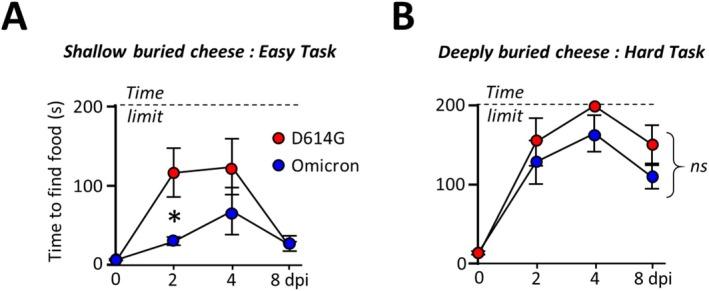
Olfactory disorders have been a hallmark of COVID-19. Since the emergence of Omicron, the prevalence of anosmia has dropped, reducing interest for Omicron pathophysiology in the nasal cavity. Using the hamster model, we show that despite a lower impact than early variants of SARS-CoV-2 (D614G), Omicron BA.1 infection leads to hyposmia as early as 2 days postinfection (dpi). While the olfactory epithelium was mostly spared from Omicron infection at 2 dpi, the respiratory epithelium was strongly infected with increased presence of inflammation markers, epithelial damage, and cellular debris in the lumen of the nasal cavity. The hyposmia caused by the early SARS-CoV-2 variant and Omicron BA.1 infection was similar at 4 and 8 dpi. At 4 dpi, Omicron successfully infected the olfactory epithelium although to a lesser extent than D614G. The BA.1 infection led to innate immune cell invasion and desquamation of the olfactory epithelium similarly as the D614G variant, with persistent inflammatory markers in the olfactory turbinates at 8 dpi despite clearance of the virus. Overall, our results indicate that Omicron successfully infects the nasal epithelium including the olfactory epithelium, but with a delay and to a lesser extent than previous SARS-CoV-2 variants. These results are consistent with Omicron pathophysiology in humans showing a decreased olfactory threshold sensitivity that may be caused, as at the early stage in hamsters, by cellular debris filling the lumen of the olfactory cleft following epithelial damage.
嗅觉障碍一直是新冠病毒病的一个特征。自奥密克戎毒株出现以来,嗅觉丧失的患病率有所下降,这降低了人们对奥密克戎毒株在鼻腔病理生理学方面的研究兴趣。我们使用仓鼠模型表明,尽管奥密克戎BA.1毒株的影响比新冠病毒早期变体(D614G)小,但感染后2天(dpi)就会导致嗅觉减退。在感染后2天,嗅觉上皮大多未受奥密克戎毒株感染,而呼吸道上皮受到严重感染,鼻腔腔内炎症标志物增加、上皮损伤和细胞碎片增多。早期新冠病毒变体和奥密克戎BA.1毒株感染在4天和8天时导致的嗅觉减退情况相似。在4天时,奥密克戎毒株成功感染了嗅觉上皮,尽管程度低于D614G变体。与D614G变体类似,BA.1毒株感染导致先天免疫细胞侵入和嗅觉上皮脱屑,尽管病毒已清除,但在感染后8天,鼻甲中仍有持续的炎症标志物。总体而言,我们的结果表明,奥密克戎毒株成功感染了包括嗅觉上皮在内的鼻上皮,但比之前的新冠病毒变体延迟且程度较轻。这些结果与人类奥密克戎毒株病理生理学一致,表明嗅觉阈值敏感性降低,这可能如在仓鼠早期阶段一样,是由上皮损伤后充满嗅裂腔的细胞碎片所致。



 Zotero 插件