
在新冠疫情期间,巴基斯坦新生儿队列中A组呼吸道合胞病毒的进化轨迹与传播情况。
Evolutionary trajectory and spread of respiratory syncytial virus group A in neonatal cohorts in Pakistan amidst the COVID-19 pandemic.
作者信息
Tamim Sana, Trovao Nidia S, Paoli Julia, Ahad Abdul, Badar Nazish, Aamir Uzma Bashir, Salman Muhammad, Ikram Aamer
机构信息
National Institute of Health, Chak Shahzad, Islamabad, Pakistan.
Division of International Epidemiology and Population Studies, Fogarty International Centre, National Institutes of Health, Bethesda, MD, 20892, USA.
出版信息
Sci Rep. 2025 Jul 27;15(1):27329. doi: 10.1038/s41598-025-87332-w.
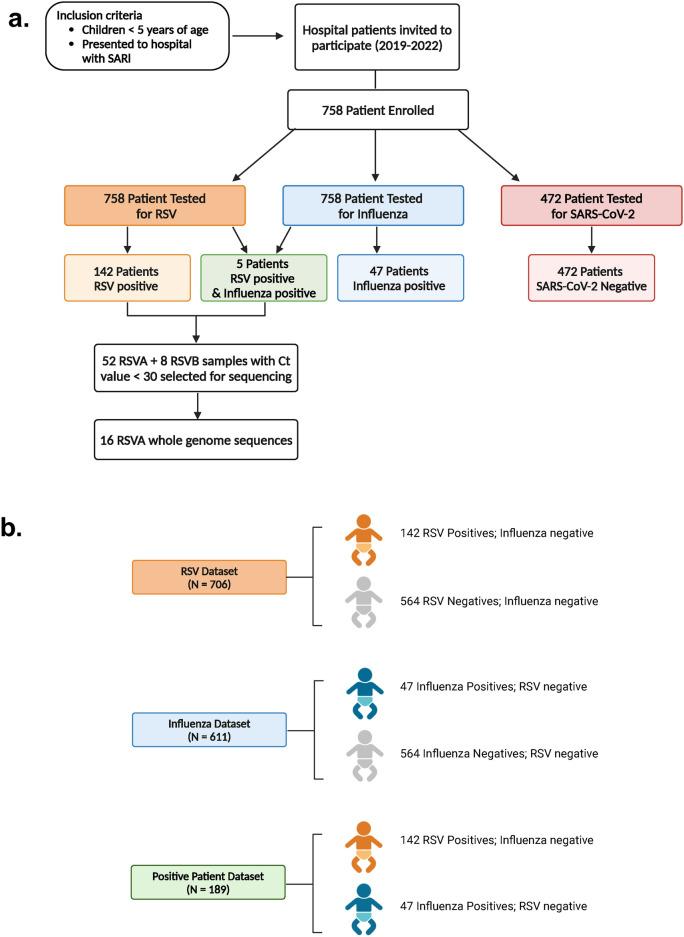
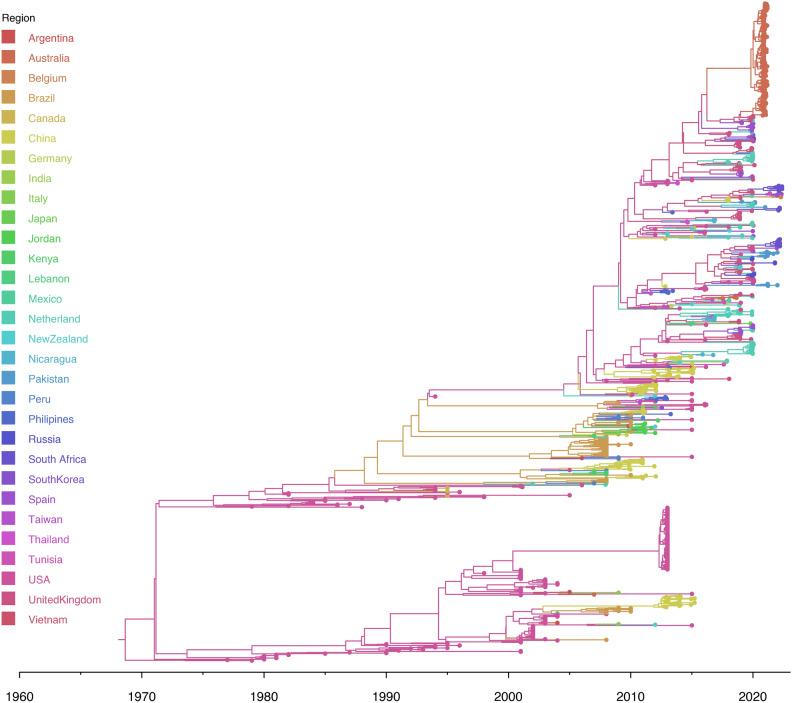
A collaborative effort by the National Institute of Health, Pakistan and the World Health Organization initiated RSV surveillance in children under 2 years old in 2019 in Pakistan. This study aimed to characterise RSV disease, assess genetic diversity of circulating subtypes, and reconstruct the evolutionary history and transmission dynamics during the COVID-19 pandemic. Nasal swabs were collected weekly from five sites across three seasons (2019-2022). A subset of samples was sequenced and studied using the BEAST phylodynamic framework. Multivariate logistic regression was performed to explore associations between patient characteristics and infection odds. Out of 758 samples collected, 18.7% tested positive for RSV, mostly RSV-A (93.6%). Influenza A and B positivity rates were 4.2% and 6.3%, respectively. RSV positivity increased from 13% in 2019-2020 to 32.1% in 2020-2021, likely due to the wide spread of respiratory infection and limited implementation of preventive measures. These rates later dropped to 10.0% (2021-22), suggesting a possible re-implementation of such measures. Mutational analysis revealed a unique P376S mutation within the F-4-2 epitopic region of the F gene of one Pakistani virus, which contributes to viral protein oligomerization. The phylodynamic inference revealed predominant circulation of RSV-A over a wider geographical region, reflecting a combination of continual viral entry, with three introductions in 2020, and one each in 2017 and 2018, and one event of persistence across seasons. The observed introductions likely stemmed from Pakistani nationals returning from Europe to their home country. Combined RSV surveillance and phylodynamic modeling effectively uncovers RSV transmission patterns and provides valuable insights for the development and deployment of RSV vaccination and treatment strategies.
巴基斯坦国立卫生研究院和世界卫生组织共同努力,于2019年在巴基斯坦启动了对2岁以下儿童的呼吸道合胞病毒(RSV)监测。本研究旨在描述RSV疾病特征,评估流行亚型的遗传多样性,并重建新冠疫情期间的进化史和传播动态。在三个季节(2019 - 2022年)中,每周从五个地点采集鼻拭子。使用贝叶斯进化分析采样树(BEAST)系统发育动力学框架对一部分样本进行测序和研究。进行多变量逻辑回归以探索患者特征与感染几率之间的关联。在收集的758个样本中,18.7%的样本RSV检测呈阳性,大部分为RSV - A(93.6%)。甲型和乙型流感的阳性率分别为4.2%和6.3%。RSV阳性率从2019 - 2020年的13%增至2020 - 2021年的32.1%,这可能是由于呼吸道感染广泛传播以及预防措施实施有限。这些比率随后降至10.0%(2021 - 2022年),表明可能重新实施了此类措施。突变分析揭示,一株巴基斯坦病毒的F基因F - 4 - 2表位区域内存在一个独特的P376S突变,该突变有助于病毒蛋白寡聚化。系统发育动力学推断显示,RSV - A在更广泛的地理区域占主导地位,这反映了持续的病毒输入(2020年有三次输入,2017年和2018年各有一次输入)与一次跨季节持续传播事件的结合。观察到的输入可能源于从欧洲回国的巴基斯坦公民。RSV监测与系统发育动力学建模相结合,有效地揭示了RSV传播模式,并为RSV疫苗接种和治疗策略的制定与部署提供了有价值的见解。


 Zotero 插件