
直接从阳性血培养物中对革兰氏阴性菌进行欧盟CAST快速药敏试验的评估。
Evaluation of EUCAST Rapid Antimicrobial Susceptibility Testing for Gram-Negative Bacteria Directly from Positive Blood Cultures.
作者信息
Tian Peng-Peng, Yang Hui, Wang Tian, Wang Li, Du Meng-Yao, Su Shan-Shan, Zhu Li-Sha, Wang Xian-Mo, Xie Liang-Cai, Fan Wen, Tian Tian, Yi Hua-Wei
机构信息
Laboratory Department, The First Affiliated Hospital of Yangtze University, Jingzhou, Hubei, People's Republic of China.
Ophthalmology Department, The First Affiliated Hospital of Yangtze University, Jingzhou, Hubei, People's Republic of China.
出版信息
Infect Drug Resist. 2025 Jul 23;18:3579-3590. doi: 10.2147/IDR.S514981. eCollection 2025.
PURPOSE
This study aims to evaluate the accuracy of EUCAST rapid antimicrobial susceptibility testing (RAST) for Gram-negative bacteria directly from positive blood cultures, comparing it with short-term incubation (5-7 hours) and conventional broth microdilution methods.
METHODS
A total of 139 Gram-negative isolates were tested. RAST results were assessed at 4 h, 6 h against minimal inhibitory concentration results using the short-term incubation (5-7 h) method, while at 16-20 h, the RAST results were compared to conventional method. For those with interpretable results, CLSI M52 was used to define cutoffs for equivalence in antimicrobial susceptibility testing.
RESULTS
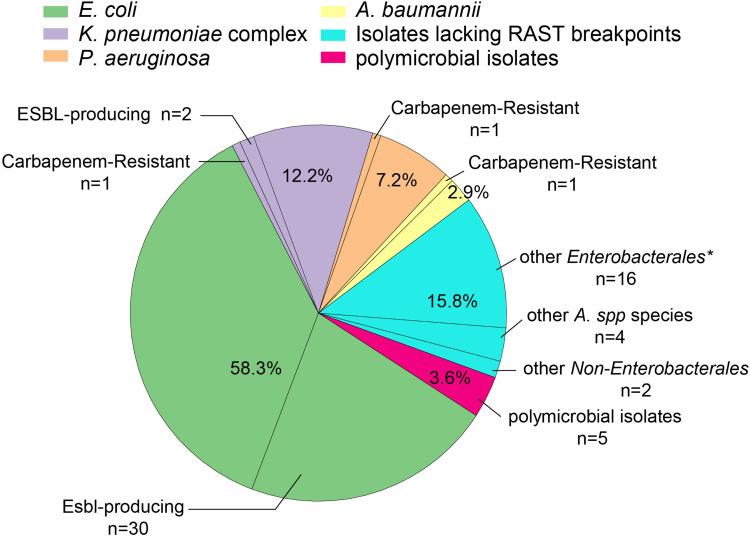
Among all isolates, 80.6% (112/139) were successfully interpreted based on EUCAST RAST breakpoints, including (81), complex (17), (10) and (4). The overall category agreements for all tested antibiotics were 98.9%, 99.5%, and 99.7% at 4, 6, and 16-20 hours, respectively, for , and 100% for , and . The area of technical uncertainty rate significantly decreased over time, from 9.1% at 4 hours to 3.1% at 16-20 hours ( < 0.05). The method effectively identified extended-spectrum beta-lactamase (ESBL)-producing and carbapenem-resistant bacteria, demonstrating performance comparable to the BD system. Additionally, results for other could be interpreted using the RAST breakpoints for . The integration of RAST into routine workflows provides rapid and accurate results without incurring additional costs or labor.
CONCLUSION
RAST is a reliable and cost-effective method for testing Gram-negative bacteria directly from blood cultures, significantly reducing turnaround time. Utilizing RAST at various reading times (6 hours and 16-20 hours) optimizes clinical workflows, enhances antimicrobial stewardship, and improves patient outcomes.
目的
本研究旨在评估欧盟CAST快速抗菌药物敏感性试验(RAST)直接对革兰氏阴性菌阳性血培养物进行检测的准确性,并将其与短期培养(5 - 7小时)和传统肉汤微量稀释法进行比较。
方法
共检测了139株革兰氏阴性菌分离株。使用短期培养(5 - 7小时)方法,在4小时、6小时时将RAST结果与最低抑菌浓度结果进行评估比较,而在16 - 20小时时,将RAST结果与传统方法进行比较。对于结果可解释的菌株,采用CLSI M52来定义抗菌药物敏感性试验中的等效性临界值。
结果
在所有分离株中,80.6%(112/139)基于欧盟CAST RAST断点成功得到解释,包括(81株)、复合菌(17株)、(10株)和(4株)。对于所有测试抗生素,在4小时、6小时和16 - 20小时时,总体类别一致性分别为98.9%、99.5%和99.7%,对于和分别为100%。技术不确定率区域随时间显著降低,从4小时时的9.1%降至16 - 20小时时的3.1%(<0.05)。该方法有效鉴定了产超广谱β-内酰胺酶(ESBL)和耐碳青霉烯类细菌,其性能与BD系统相当。此外,其他的结果可使用的RAST断点进行解释。将RAST整合到常规工作流程中可提供快速准确的结果,且不会产生额外成本或劳动力。
结论
RAST是一种可靠且具有成本效益的方法,可直接从血培养物中检测革兰氏阴性菌,显著缩短周转时间。在不同读取时间(6小时和16 - 20小时)使用RAST可优化临床工作流程,加强抗菌药物管理,并改善患者预后。


 Zotero 插件