
肯尼亚农村地区的孕产妇心理健康与儿童饮食多样性:两项基线研究的汇总分析结果
Maternal Mental Health and Child Dietary Diversity in Rural Kenya: Findings From a Pooled Analysis of 2 Baseline Studies.
作者信息
Kalam Md Abul, McCann Juliet K, Shakil Zarmeen, Gambari Aishat, Ochieng Michael, Jeong Joshua
机构信息
Global Health and Development Program, Laney Graduate School, Emory University, Atlanta, GA, United States.
Hubert Department of Global Health, Rollins School of Public Health, Emory University, Atlanta, GA, United States.
出版信息
Curr Dev Nutr. 2025 Jun 24;9(7):107497. doi: 10.1016/j.cdnut.2025.107497. eCollection 2025 Jul.
BACKGROUND
Most studies linking maternal mental health and child outcomes are from high-income countries and relatively few studies have explored how maternal mental health influences child nutrition in impoverished and rural settings across low-income countries.
OBJECTIVES
This study aimed to assess the association between maternal mental health and child dietary diversity (CDD) in rural western Kenya.
METHODS
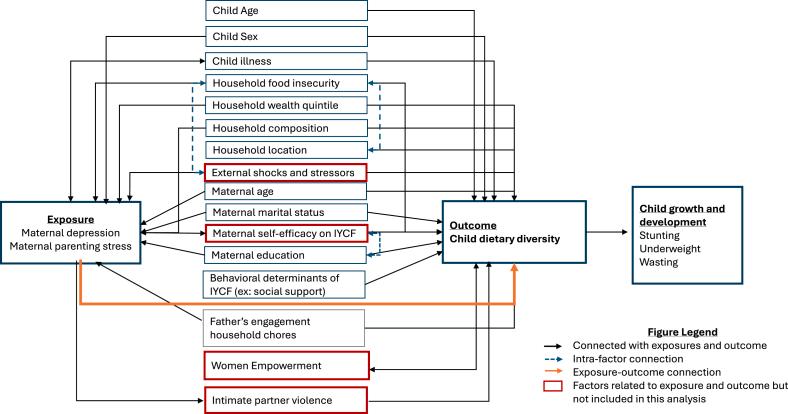
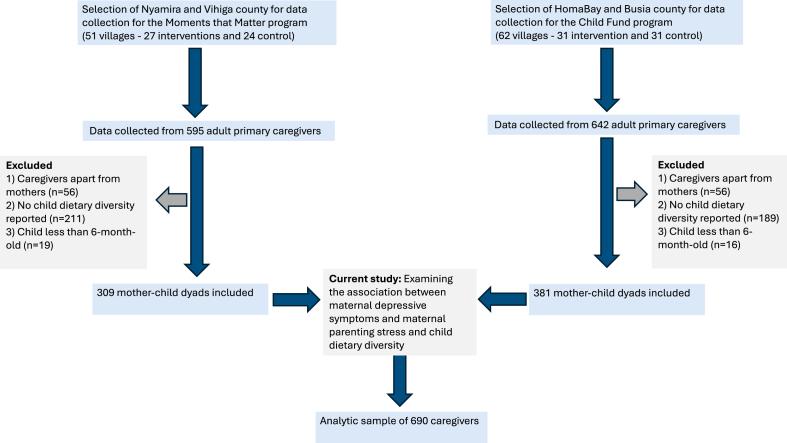
The analysis pooled baseline data from 2 RCTs of nurturing care interventions in rural western Kenya (clinical trial registrations are clinicaltrials.gov: NCT05796934 and clinicaltrials.gov NCT06165315, respectively). The 2 primary exposure variables were binary indicators for elevated maternal parenting stress and risk of maternal depression, which were self-reported using Parenting Stress Index-Short Form and Center of Epidemiologic Studies Depression Scale, respectively. The outcome was CDD, assessed using the World Health Organization measure for dietary diversity, which was based on maternal reports of the number of food groups consumed by the child in the past 24 h. Multivariable linear regression analyses were used to examine the association between maternal parenting stress, maternal depression and CDD.
RESULTS
The analytic sample was 690 mother-child dyads. The mean maternal age was ∼28 y (range: 17-49 y), whereas the mean child age was ∼14 mo (range: 6-25 mo). The mean dietary diversity score was 4.40 of 8 food groups. Approximately 20.14% of mothers had elevated parenting stress, whereas 41% were at risk of depression. The adjusted models showed that elevated maternal parenting stress was associated with lower CDD (β: -0.39, 95% CI: -0.80, 0.02; = 0.059), whereas the association was not statistically significant between risk of maternal depression and CDD (β: 0.14, 95% CI: -0.14, 0.43; = 0.323). Multiple sociodemographic factors were significantly associated with CDD. Children of mothers with higher social support, older children (range: 6-25 mo), and female children had higher dietary diversity. Meanwhile children from high food-insecure households had lower dietary diversity.
CONCLUSIONS
These findings underscore the importance of integrating psychosocial components within child nutrition programs to address not only maternal mental health but also support the broader caregiving environment for families in low-and-middle-income settings like Kenya. Strengthening caregivers' social support networks as part of these interventions may also have potential for promoting maternal mental health and children's nutritional well-being.
背景
大多数将母亲心理健康与儿童结局联系起来的研究来自高收入国家,相对较少的研究探讨了在低收入国家的贫困农村地区,母亲心理健康如何影响儿童营养。
目的
本研究旨在评估肯尼亚西部农村地区母亲心理健康与儿童饮食多样性(CDD)之间的关联。
方法
该分析汇总了肯尼亚西部农村地区两项养育照护干预随机对照试验的基线数据(临床试验注册号分别为clinicaltrials.gov:NCT05796934和clinicaltrials.gov NCT06165315)。两个主要暴露变量分别是母亲养育压力升高和母亲抑郁风险的二元指标,分别使用《养育压力指数简表》和《流行病学研究中心抑郁量表》进行自我报告。结局指标是CDD,采用世界卫生组织的饮食多样性衡量标准进行评估,该标准基于母亲报告的孩子在过去24小时内食用的食物种类数量。采用多变量线性回归分析来检验母亲养育压力、母亲抑郁与CDD之间的关联。
结果
分析样本为690对母婴。母亲的平均年龄约为28岁(范围:17 - 49岁),而孩子的平均年龄约为14个月(范围:6 - 25个月)。在8种食物种类中,饮食多样性得分的平均值为4.40。约20.14%的母亲养育压力升高,而41%有抑郁风险。调整后的模型显示,母亲养育压力升高与较低的CDD相关(β:-0.39,95%CI:-0.80,0.02;P = 0.059),而母亲抑郁风险与CDD之间的关联无统计学意义(β:0.14,95%CI:-0.14,0.43;P = 0.323)。多个社会人口学因素与CDD显著相关。社会支持较高的母亲的孩子、年龄较大的孩子(范围:6 - 25个月)以及女童的饮食多样性较高。同时,来自粮食安全状况差的家庭的孩子饮食多样性较低。
结论
这些发现强调了在儿童营养项目中纳入心理社会成分的重要性,这不仅能解决母亲的心理健康问题,还能为肯尼亚等中低收入环境中的家庭提供更广泛的照护环境支持。作为这些干预措施的一部分,加强照顾者的社会支持网络也可能有助于促进母亲的心理健康和儿童的营养状况。
 Zotero 插件