
三方基序蛋白在泌尿系统癌症中的作用:一项系统综述
The Roles of Tripartite Motif Proteins in Urological Cancers: A Systematic Review.
作者信息
Yamada Yuta, Kimura Naoki, Maki Kazuki, Hakozaki Yuji, Urabe Fumihiko, Kimura Shoji, Fujimura Tetsuya, Inoue Satoshi, Kume Haruki
机构信息
Department of Urology, Graduate School of Medicine, The University of Tokyo, Bunkyo-Ku, Tokyo 113-8655, Japan.
Department of Urology, The Jikei University Daisan Hospital, Komae-Shi 201-8601, Tokyo, Japan.
出版信息
Cancers (Basel). 2025 Jul 16;17(14):2367. doi: 10.3390/cancers17142367.
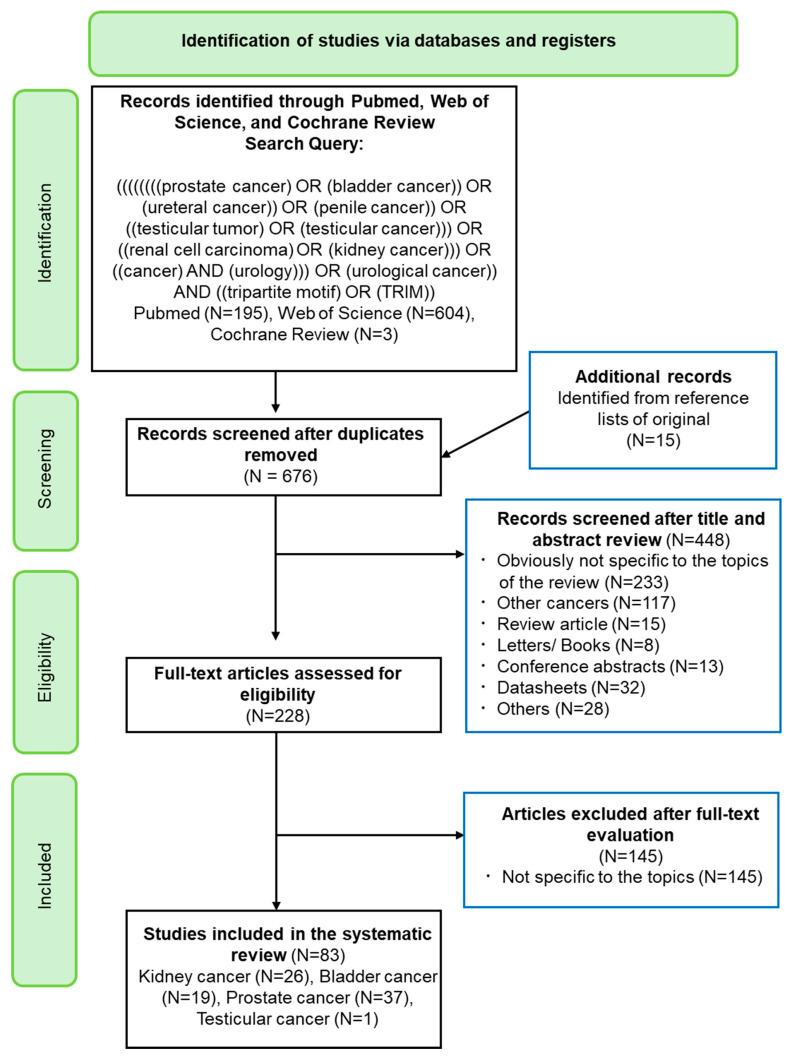
We aimed to investigate the roles of tripartite motif (TRIM) proteins in urological cancers. : A systematic review was conducted to investigate the oncological role of tripartite motif proteins in urological cancers. : A total of 84 articles were identified for the final analysis (26 articles on kidney cancers, 19 on bladder cancers, 37 on prostate cancers, and 1 on testicular cancers). In total, 27 TRIM family proteins were involved in kidney cancer, of which 9 were associated with tumor-promoting findings (TRIM24, TRIM27, TRIM37, TRIM44, TRIM46, TRIM47, TRIM59, TRIM63, and TRIM65) and of which 9 TRIM proteins were tumor-suppressive (TRIM2, TRIM7, TRIM8, TRIM13, TRIM21, TRIM26, TRIM28, TRIM33, and TRIM58). Fourteen TRIM family proteins were associated with bladder cancer (tumor-promoting: TRIM9, TRIM25, TRIM26, TRIM28, TRIM29, TRIM59, TRIM65, and TRIM66; tumor-suppressive: TRIM19 and TRIM38). Ten TRIM family proteins were associated with prostate cancer (tumor-promoting: TRIM11, TRIM24, TRIM28, TRIM33, TRIM44, TRIM59, TRIM63, TRIM66, and TRIM68; tumor-suppressive: TRIM32 and TRIM36). Twenty-eight TRIM family proteins were identified to be associated with prostate cancer (tumor-promoting: TRIM11, TRIM24, TRIM28, TRIM33, TRIM44, TRIM59, TRIM63, TRIM66, and TRIM68; tumor-suppressive: TRIM32 and TRIM36). TRIM proteins regulate urological cancers by ubiquitination or modulation of oncologic pathways. : This review identifies TRIM proteins that are involved in urological cancers. Some of these proteins have the potential to be the therapeutic target.
我们旨在研究三联基序(TRIM)蛋白在泌尿系统癌症中的作用。:进行了一项系统综述,以研究三联基序蛋白在泌尿系统癌症中的肿瘤学作用。:共确定84篇文章用于最终分析(26篇关于肾癌,19篇关于膀胱癌,37篇关于前列腺癌,1篇关于睾丸癌)。总共有27种TRIM家族蛋白参与肾癌,其中9种与促进肿瘤的结果相关(TRIM24、TRIM27、TRIM37、TRIM44、TRIM46、TRIM47、TRIM59、TRIM63和TRIM65),9种TRIM蛋白具有肿瘤抑制作用(TRIM2、TRIM7、TRIM8、TRIM13、TRIM21、TRIM26、TRIM28、TRIM33和TRIM58)。14种TRIM家族蛋白与膀胱癌相关(促进肿瘤:TRIM9、TRIM25、TRIM26、TRIM28、TRIM29、TRIM59、TRIM65和TRIM66;肿瘤抑制:TRIM19和TRIM38)。10种TRIM家族蛋白与前列腺癌相关(促进肿瘤:TRIM11、TRIM24、TRIM28、TRIM33、TRIM44、TRIM59、TRIM63、TRIM66和TRIM68;肿瘤抑制:TRIM32和TRIM36)。28种TRIM家族蛋白被确定与前列腺癌相关(促进肿瘤:TRIM11、TRIM24、TRIM28、TRIM33、TRIM44、TRIM59、TRIM63、TRIM66和TRIM68;肿瘤抑制:TRIM32和TRIM36)。TRIM蛋白通过泛素化或调节肿瘤途径来调控泌尿系统癌症。:本综述确定了参与泌尿系统癌症的TRIM蛋白。其中一些蛋白有可能成为治疗靶点。

 Zotero 插件