
非小细胞肺癌中同时发生的基因组改变:梳理纷繁复杂的情况
Co-Occurring Genomic Alterations in NSCLC: Making Order into a Crowded List.
作者信息
Attili Ilaria, Fabrizio Federico Pio, Marinis Filippo de
机构信息
Division of Thoracic Oncology, European Institute of Oncology, IEO, IRCCS, 20141 Milan, Italy.
Department of Medicine and Surgery, University of Enna "Kore", 94100 Enna, Italy.
出版信息
Cancers (Basel). 2025 Jul 18;17(14):2388. doi: 10.3390/cancers17142388.
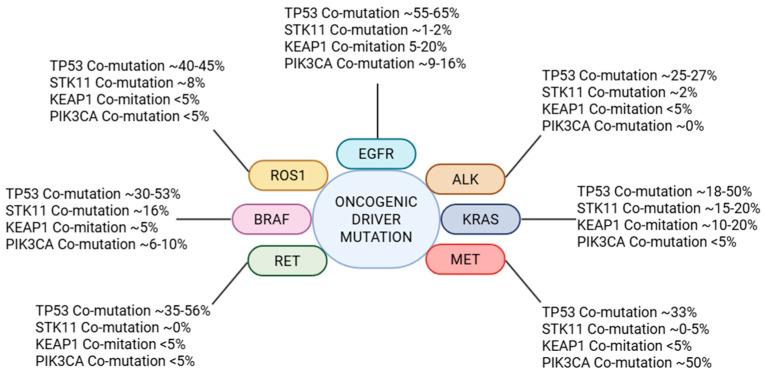
Worldwide, lung cancer is one of the most common cancers, with non-small cell lung cancer (NSCLC) including up to 80-85% of all lung cancer diagnoses. The landscape of NSCLC is characterized by a heterogeneous spectrum of gene alterations, with tyrosine kinase inhibitors (TKIs) and targeted treatments that significantly improve survival outcomes for patients with oncogene-addicted NSCLC, offering superior efficacy, and often favorable safety and tolerability profiles compared to chemotherapy-based treatments. However, the complexity of NSCLC extends to co-occurring genomic alterations or amplifications in tumor suppressors and other oncogenes, such as , , , , , and others, that significantly influence disease progression, therapeutic resistance, and clinical outcomes. These co-mutations often contribute to the development of primary and acquired resistance to targeted therapies, complicating decision-making strategies. This review provides a timely and comprehensive synthesis of current insights into co-mutations in NSCLC, with a particular focus on their clinical implications, and offers a novel perspective by integrating recent molecular insights with therapeutic challenges, addressing existing knowledge gaps through a more integrative and clinically oriented analysis of co-mutations. Advances in next-generation sequencing (NGS) and molecular profiling have enabled the identification of these co-alterations, paving the way for more personalized therapeutic approaches. However, challenges remain in interpreting the functional interplay of co-mutations and translating these insights into effective clinical interventions. This review also highlights the significance of co-mutations in shaping NSCLC biology, and discusses their impact on current therapeutic paradigms, emphasizing the need for integrative biomarker-driven approaches to improve outcomes in NSCLC.
在全球范围内,肺癌是最常见的癌症之一,其中非小细胞肺癌(NSCLC)占所有肺癌诊断病例的80%-85%。NSCLC的特征是基因改变谱具有异质性,酪氨酸激酶抑制剂(TKIs)和靶向治疗可显著改善对致癌基因成瘾的NSCLC患者的生存结果,与基于化疗的治疗相比,具有更高的疗效,且通常具有良好的安全性和耐受性。然而,NSCLC的复杂性还体现在肿瘤抑制因子和其他致癌基因中同时发生的基因组改变或扩增,如 、 、 、 、 等,这些改变会显著影响疾病进展、治疗耐药性和临床结果。这些共突变往往导致对靶向治疗产生原发性和获得性耐药,使决策策略变得复杂。本综述及时全面地综合了当前对NSCLC中共突变的见解,特别关注其临床意义,并通过将最新的分子见解与治疗挑战相结合,以更综合和临床导向的共突变分析来填补现有知识空白,提供了一个新的视角。下一代测序(NGS)和分子谱分析的进展使这些共改变得以识别,为更个性化的治疗方法铺平了道路。然而,在解释共突变的功能相互作用并将这些见解转化为有效的临床干预措施方面仍存在挑战。本综述还强调了共突变在塑造NSCLC生物学方面的重要性,并讨论了它们对当前治疗模式的影响,强调需要采用综合的生物标志物驱动方法来改善NSCLC的治疗结果。
 Zotero 插件