
用于体外将星形胶质细胞重编程为神经前体细胞的慢病毒报告系统的开发
Development of a Lentiviral Reporter System for In Vitro Reprogramming of Astrocytes to Neuronal Precursors.
作者信息
Schnaubelt Anna, Zheng Guoli, Hatami Maryam, Tödt Johannes, Wang Hao, Skutella Thomas, Unterberg Andreas, Zweckberger Klaus, Younsi Alexander
机构信息
Department of Neurosurgery, Heidelberg University Hospital, 69120 Heidelberg, Germany.
Medical Faculty, University of Heidelberg, 69120 Heidelberg, Germany.
出版信息
Biology (Basel). 2025 Jul 5;14(7):817. doi: 10.3390/biology14070817.
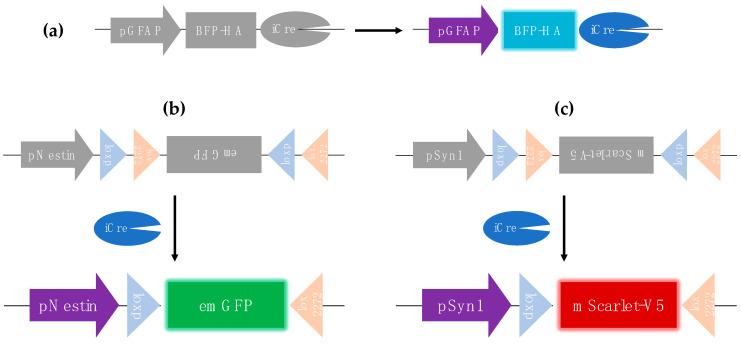
Astrocytes, which proliferate after brain injury, represent a promising target for cellular reprogramming due to their abundance and ability to support brain repair. In this study, we investigated the in vitro reprogramming of primary cortical astrocytes from neonatal rats into neuronal precursor cells (NPCs) using the transcription factors Oct4, Sox2, and Klf4 (OSK), delivered via lentiviral vectors. We designed a reporter system to trace the conversion of astrocytes to NPCs and neurons by using GFAP-driven iCre and Nestin- or Synapsin1-driven fluorescent reporters. After transduction, we observed morphological changes and the expression of neuronal markers in some cells, while many cells remained in a transitional state, expressing both astrocytic and neuronal features. Importantly, the study was not designed to quantify reprogramming efficiency or demonstrate full astrocyte-to-neuron conversion but rather to establish and evaluate a traceable reporter system. Our data suggest that OSK-mediated reprogramming in this in vitro model can initiate conversion of astrocytes to neuronal precursor-like cells, although the process is complex and incomplete within the one-week timeframe. We also highlight limitations in co-transduction efficiency and potential silencing of the reporter system during reprogramming. These findings provide an initial technical platform to explore astrocyte reprogramming in vitro and inform future studies aiming to refine these methods and apply them in vivo.
星形胶质细胞在脑损伤后会增殖,由于其数量丰富且具有支持脑修复的能力,因此成为细胞重编程的一个有前景的靶点。在本研究中,我们使用慢病毒载体递送转录因子Oct4、Sox2和Klf4(OSK),研究了新生大鼠原代皮质星形胶质细胞在体外重编程为神经前体细胞(NPCs)的情况。我们设计了一个报告系统,通过使用GFAP驱动的iCre以及Nestin或Synapsin1驱动的荧光报告基因来追踪星形胶质细胞向NPCs和神经元的转化。转导后,我们在一些细胞中观察到了形态变化和神经元标志物的表达,而许多细胞仍处于过渡状态,同时表达星形胶质细胞和神经元的特征。重要的是,该研究并非旨在量化重编程效率或证明星形胶质细胞向神经元的完全转化,而是建立和评估一个可追踪的报告系统。我们的数据表明,在这个体外模型中,OSK介导的重编程可以启动星形胶质细胞向神经前体样细胞的转化,尽管在一周的时间范围内这个过程是复杂且不完全的。我们还强调了共转导效率的局限性以及重编程过程中报告系统可能出现的沉默。这些发现提供了一个初步的技术平台,用于在体外探索星形胶质细胞重编程,并为未来旨在改进这些方法并将其应用于体内的研究提供参考。




 Zotero 插件