
黑色素瘤中的肿瘤微环境——特征与临床意义
Tumor Microenvironment in Melanoma-Characteristic and Clinical Implications.
作者信息
Sikorski Hubert, Żmijewski Michał Aleksander, Piotrowska Anna
机构信息
Department of Histology, Faculty of Medicine, Medical University of Gdańsk, Dębinki 1 Str., 80-211 Gdańsk, Poland.
出版信息
Int J Mol Sci. 2025 Jul 15;26(14):6778. doi: 10.3390/ijms26146778.
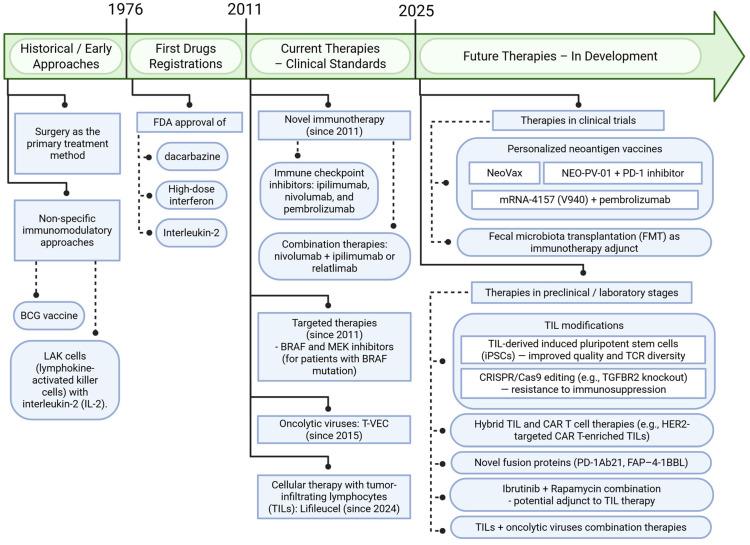
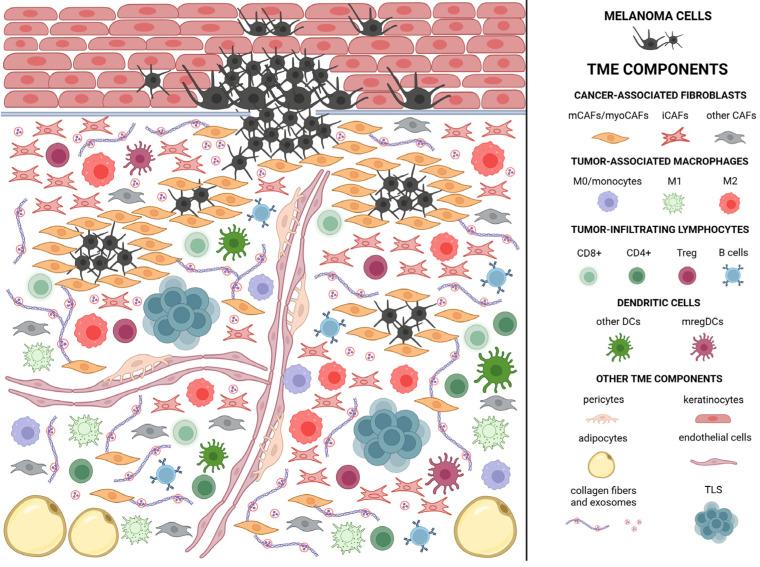
Cutaneous melanoma is an aggressive cancer with an increasing incidence worldwide, highlighting the need for research into its pathogenesis. The tumor microenvironment (TME) plays a critical role in melanoma progression and consists of cellular components and an extracellular matrix (ECM) rich in cytokines and signaling molecules. The most abundant stromal cells within the TME are cancer-associated fibroblasts (CAFs), which remodel the ECM and modulate immune responses. Among immune cells, tumor-associated macrophages (TAMs) predominate, and their polarization toward the M2 phenotype supports tumor progression. Tumor-infiltrating lymphocytes (TILs) have diverse functions, including cytotoxic T-cells, helper T-cells that modulate immune response, B-cells forming tertiary lymphoid structures (TLS), and regulatory T-cells with immunosuppressive properties. Dendritic cells (DCs) also play a complex role in the TME. A notable subpopulation are mature regulatory dendritic cells (mregDCs), which contribute to immune evasion. All of these TME components may drive tumorigenesis. Advancements in melanoma treatment-including immunotherapy and targeted therapies-have significantly improved outcomes in advanced-stage disease. In parallel, emerging approaches targeting the tumor microenvironment and gut microbiome, as well as personalized strategies such as neoantigen vaccines and cell-based therapies, are under active investigation and may further enhance therapeutic efficacy in the near future.
皮肤黑色素瘤是一种侵袭性癌症,在全球范围内发病率不断上升,这凸显了对其发病机制进行研究的必要性。肿瘤微环境(TME)在黑色素瘤进展中起关键作用,由细胞成分和富含细胞因子及信号分子的细胞外基质(ECM)组成。TME中最丰富的基质细胞是癌症相关成纤维细胞(CAFs),它们重塑ECM并调节免疫反应。在免疫细胞中,肿瘤相关巨噬细胞(TAMs)占主导地位,它们向M2表型的极化支持肿瘤进展。肿瘤浸润淋巴细胞(TILs)具有多种功能,包括细胞毒性T细胞、调节免疫反应的辅助性T细胞、形成三级淋巴结构(TLS)的B细胞以及具有免疫抑制特性的调节性T细胞。树突状细胞(DCs)在TME中也发挥着复杂的作用。一个值得注意的亚群是成熟的调节性树突状细胞(mregDCs),它们有助于免疫逃逸。所有这些TME成分都可能驱动肿瘤发生。黑色素瘤治疗的进展——包括免疫疗法和靶向疗法——显著改善了晚期疾病的治疗效果。与此同时,针对肿瘤微环境和肠道微生物群的新兴方法,以及新抗原疫苗和基于细胞的疗法等个性化策略正在积极研究中,可能在不久的将来进一步提高治疗效果。


 Zotero 插件