
双调蛋白在纤维化疾病和癌症中的作用
Amphiregulin in Fibrotic Diseases and Cancer.
作者信息
Kim Tae Rim, Son Beomseok, Lee Chun Geun, Park Han-Oh
机构信息
siRNAgen Therapeutics, Daejeon 34302, Republic of Korea.
Department of Molecular Microbiology and Immunology, Brown University, Providence, RI 02912, USA.
出版信息
Int J Mol Sci. 2025 Jul 19;26(14):6945. doi: 10.3390/ijms26146945.
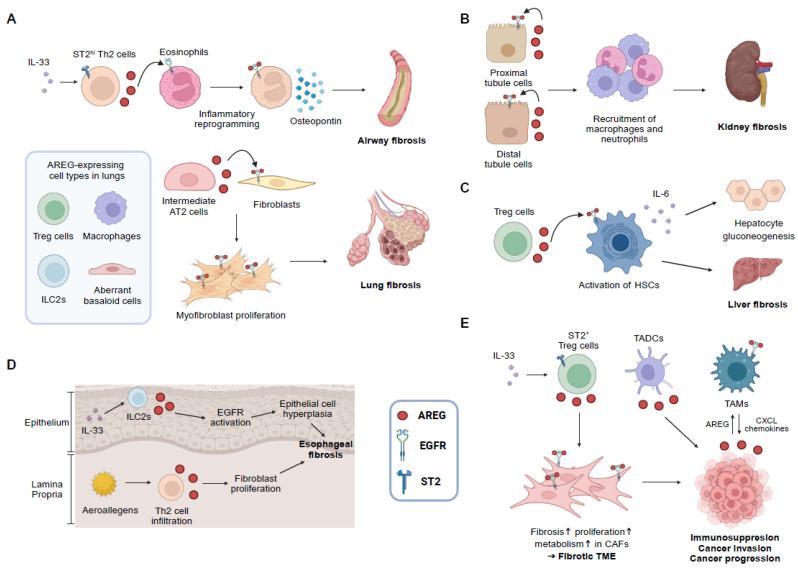
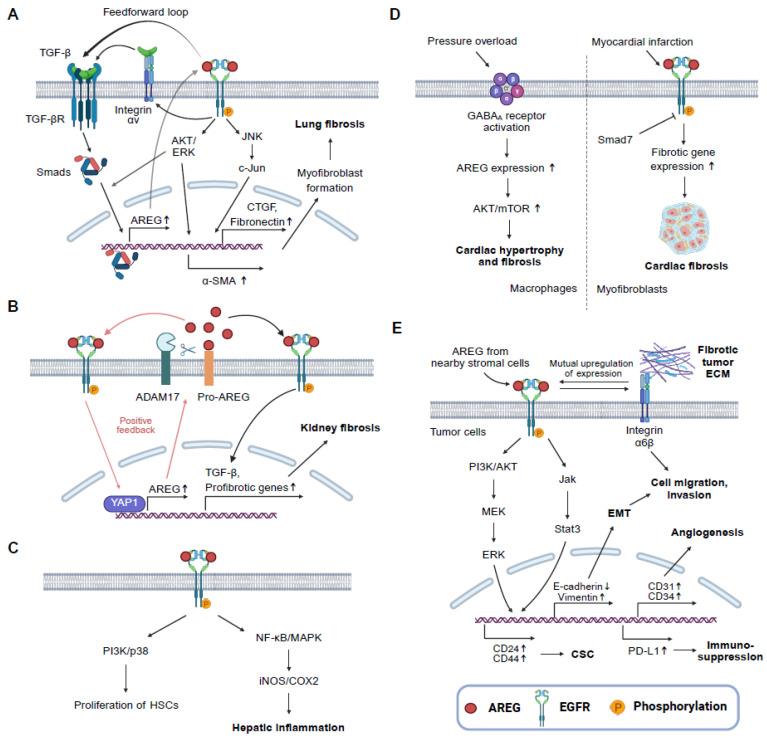
Fibrotic disorders pose a significant global health burden due to limited treatment options, creating an urgent need for novel therapeutic strategies. Amphiregulin (AREG), a low-affinity ligand for the epidermal growth factor receptor (EGFR), has emerged as a key mediator of fibrogenesis through dual signaling pathways. Unlike high-affinity EGFR ligands, AREG induces sustained signaling that activates downstream effectors and promotes the integrin-mediated activation of transforming growth factor (TGF)-β. This enables both canonical and non-canonical EGFR signaling pathways that contribute to fibrosis. Elevated AREG expression correlates with disease severity across multiple organs, including the lungs, kidneys, liver, and heart. The therapeutic targeting of AREG has shown promising antifibrotic and anticancer effects, suggesting a dual-benefit strategy. The increasing recognition of the shared mechanisms between fibrosis and cancer further supports the development of unified treatment approaches. The inhibition of AREG has been shown to sensitize fibrotic tumor microenvironments to chemotherapy, enhancing combination therapy efficacy. Targeted therapies, such as Self-Assembled-Micelle inhibitory RNA (SAMiRNA)-AREG, have demonstrated enhanced specificity and favorable safety profiles in preclinical studies and early clinical trials. Personalized treatment based on AREG expression may improve clinical outcomes, establishing AREG as a promising precision medicine target for both fibrotic and malignant diseases. This review aims to provide a comprehensive understanding of AREG biology and evaluate its therapeutic potential in fibrosis and cancer.
由于治疗选择有限,纤维化疾病给全球健康带来了重大负担,因此迫切需要新的治疗策略。双调蛋白(AREG)是表皮生长因子受体(EGFR)的低亲和力配体,已成为通过双信号通路介导纤维化形成的关键介质。与高亲和力EGFR配体不同,AREG诱导持续信号传导,激活下游效应器并促进整合素介导的转化生长因子(TGF)-β激活。这使得经典和非经典EGFR信号通路都参与纤维化过程。AREG表达升高与包括肺、肾、肝和心脏在内的多个器官的疾病严重程度相关。针对AREG的治疗已显示出有前景的抗纤维化和抗癌作用,提示了一种双重获益策略。对纤维化和癌症之间共同机制的认识不断增加,进一步支持了统一治疗方法的开发。已证明抑制AREG可使纤维化肿瘤微环境对化疗敏感,提高联合治疗疗效。靶向治疗,如自组装胶束抑制性RNA(SAMiRNA)-AREG,在临床前研究和早期临床试验中已显示出增强的特异性和良好的安全性。基于AREG表达的个性化治疗可能改善临床结果,使AREG成为纤维化和恶性疾病有前景的精准医学靶点。本综述旨在全面了解AREG生物学,并评估其在纤维化和癌症中的治疗潜力。
 Zotero 插件