
泰国各地兽医诊所中人和动物的抗菌药物耐药模式及基因的比较分析
A Comparative Analysis of Antimicrobial Resistance Patterns and Genes in From Humans and Animals in Veterinary Clinics Across Thailand.
作者信息
Buranasinsup Shutipen, Wiratsudakul Anuwat, Suwanpakdee Sarin, Jiemtaweeboon Sineenard, Maklon Khuanwalai, Sakcamduang Walasinee, Chantong Boonrat
机构信息
Department of Pre-Clinic and Applied Animal Science, Faculty of Veterinary Science, Mahidol University, Nakhon Pathom 73170, Thailand.
Department of Clinical Sciences and Public Health, Faculty of Veterinary Science, Mahidol University, Nakhon Pathom 73170, Thailand.
出版信息
Transbound Emerg Dis. 2025 Jul 21;2025:5541655. doi: 10.1155/tbed/5541655. eCollection 2025.
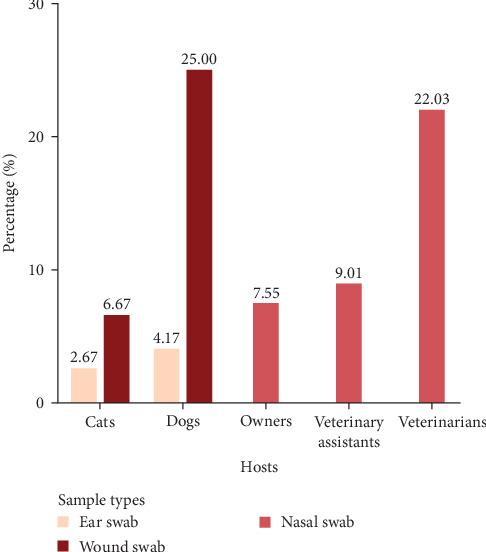
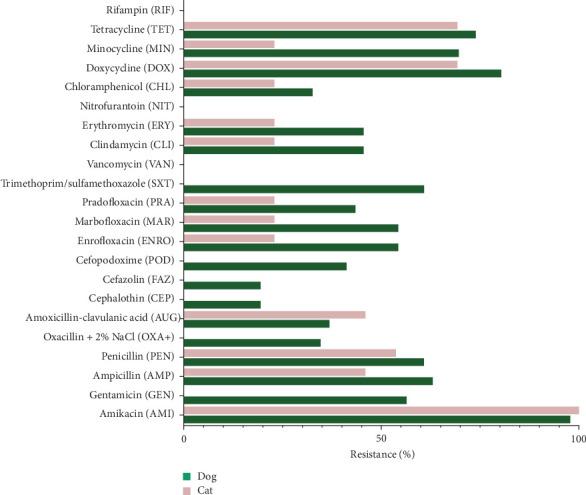
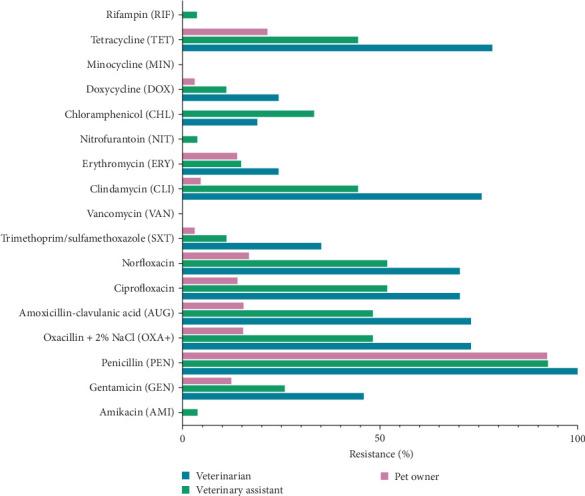
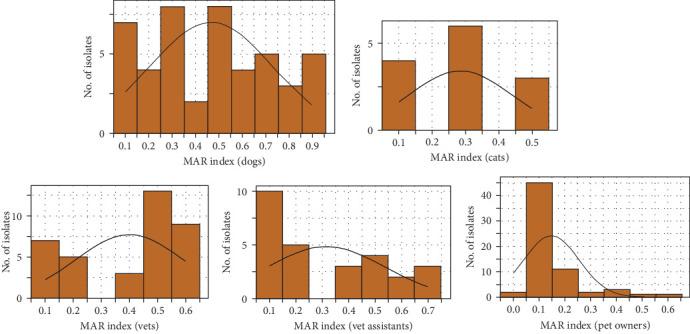
Antimicrobial resistance (AMR) in () poses critical public health challenges by limiting treatment efficacy and elevating morbidity, mortality, and healthcare costs. This study examined the prevalence and characteristics of AMR in isolated from humans (veterinarians, veterinary assistants, and pet owners) and animals (dogs and cats) in veterinary clinics across five provinces in Thailand. A total of 882 samples were collected from which 188 isolates were recovered and subjected to antimicrobial susceptibility testing and resistance gene detection. Substantial variations in AMR profiles were observed across host categories, with veterinarians and veterinary assistants exhibiting higher resistance rates than pet owners. The β-lactam resistance gene Z was prevalent in all groups, whereas A was predominantly detected in veterinarians and dogs, emphasizing the occupational risk and zoonotic transmission potential. The aminoglycoside resistance gene AD was common in cats, and quinolone resistance genes A and A were identified in veterinarians and dogs. Macrolide resistance genes A and A, lincosamide resistance gene A, and tetracycline resistance gene K were widely distributed across the groups. typing of isolates revealed diverse group distributions, with group I was predominant in human samples and associated with the highest AMR gene expression, while group III was most prevalent in animal samples and also exhibited elevated AMR gene expression within that group. This study underscored the diverse distribution of AMR genes, with veterinarians and veterinary assistants facing higher occupational risks. The findings highlighted the importance of integrated antimicrobial stewardship and surveillance within a One Health framework to mitigate the spread of AMR in veterinary and community settings.
(此处括号内容缺失)中的抗菌药物耐药性(AMR)通过限制治疗效果、提高发病率、死亡率和医疗成本,对公共卫生构成了严峻挑战。本研究调查了泰国五个省份兽医诊所中从人类(兽医、兽医助理和宠物主人)和动物(狗和猫)分离出的(此处括号内容缺失)的AMR流行情况和特征。共收集了882份样本,从中分离出188株(此处括号内容缺失)菌株,并进行了抗菌药物敏感性测试和耐药基因检测。不同宿主类别之间的AMR谱存在显著差异,兽医和兽医助理的耐药率高于宠物主人。β-内酰胺耐药基因Z在所有组中都很普遍,而A主要在兽医和狗中检测到,这突出了职业风险和人畜共患病传播的可能性。氨基糖苷类耐药基因AD在猫中很常见,喹诺酮类耐药基因A和A在兽医和狗中被鉴定出来。大环内酯类耐药基因A和A、林可酰胺类耐药基因A和四环素类耐药基因K在各组中广泛分布。(此处括号内容缺失)菌株的分型显示出不同的组分布,其中I组在人类样本中占主导地位,且与最高的AMR基因表达相关,而III组在动物样本中最普遍,并且在该组中也表现出较高的AMR基因表达。本研究强调了AMR基因的多样分布,兽医和兽医助理面临更高的职业风险。研究结果突出了在“同一健康”框架内进行综合抗菌药物管理和监测以减轻AMR在兽医和社区环境中传播的重要性。


 Zotero 插件