
糖尿病患者坐骨神经神经内血流、周围神经病变与足部溃疡之间的关联。
Association between intraneural blood flow of the sciatic nerve, peripheral neuropathies, and foot ulcers in patients with diabetes.
作者信息
Chen Shun-Ping, Li Ruo-Yu, Hong Jing, Ye Ting-Ting, Zhu Hong
机构信息
Department of Ultrasonography, The First Affiliated Hospital of Wenzhou Medical University, Wenzhou, China.
National Key Clinical Specialty (Wound Healing), The First Affiliated Hospital of Wenzhou Medical University, Wenzhou, China.
出版信息
Quant Imaging Med Surg. 2025 Jul 1;15(7):6234-6251. doi: 10.21037/qims-2024-2773. Epub 2025 Jun 30.
BACKGROUND
Intraneural blood flow (INBF) serves as a useful marker for diagnosing peripheral neuropathies. However, the specific relationship between sciatic nerve INBF (SN) and the occurrence of diabetic peripheral neuropathies (DPNs) and diabetic foot ulcers (DFUs) remains ambiguous. Thus, the purpose of this study was to investigate the association between SN, as detected by power Doppler ultrasound, and the presence of DPNs and DFUs in patients with diabetes.
METHODS
A retrospective cross-sectional study was performed on patients with diabetes between June 2018 and July 2024. The study population was categorized into two groups based on electroneurophysiological findings: a DPN and a non-DPN group. Within the DPN group, the patients were subdivided as DFU and non-DFU subgroups. Clinical characteristics and ultrasound parameters, including SN, were compared between those groups and subgroups. Logistic regression analysis was employed to investigate the relationships between SN and the presence of DPN and DFU. Additionally, the diagnostic performance of SN was assessed through the areas under the receiver operating characteristic curves (AUROCs) for identifying DPN and DFU. Meanwhile, sciatic nerves (SNs) of healthy controls (HCs) were taken as normal controls to determine whether SN can be detected in HC by power Doppler ultrasound.
RESULTS
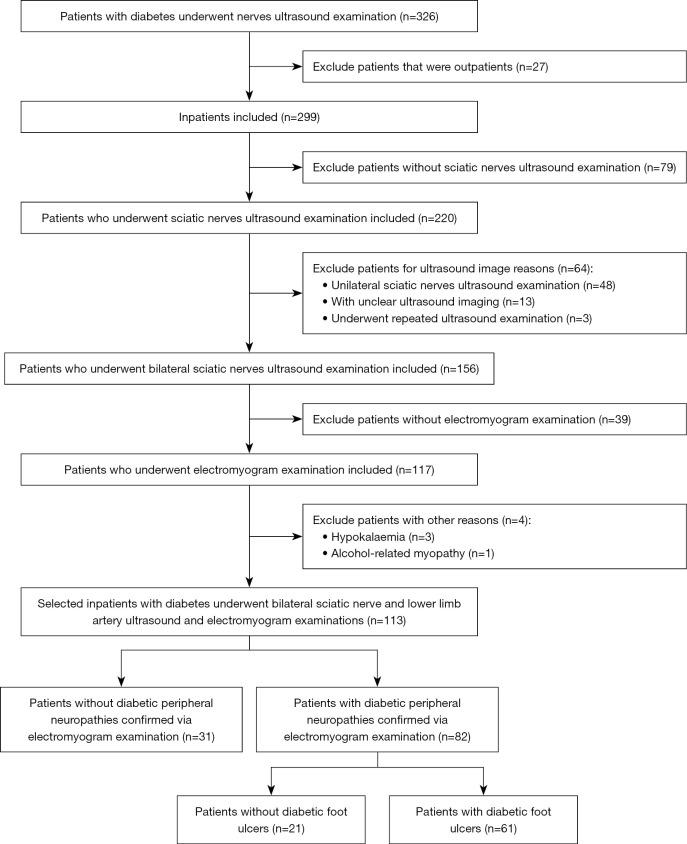
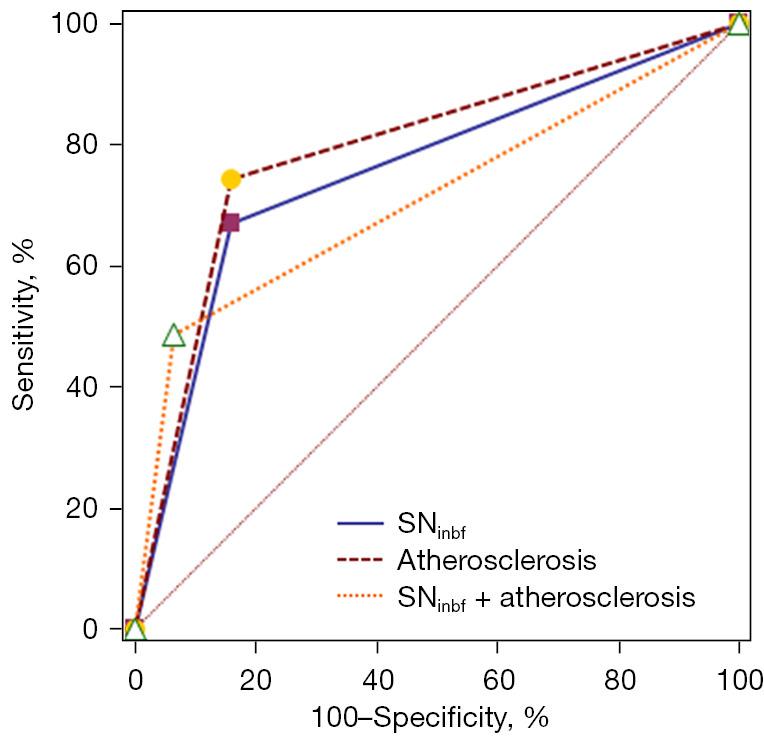
The study included 113 patients with diabetes [mean age ± standard deviation (SD), 63.81±12.31 years; 71 males] (82 had DPN and 31 did not). The subgroup analysis of DPN patients included 61 individuals with DFU and 21 without. Adjusted logistic regression analysis revealed a significant independent association between SN and the presence of DPN in patients with diabetes [odds ratio (OR): 7.399; 95% confidence interval (CI): 1.959-27.944; P=0.004]. Further analysis within the DPN subgroup confirmed a significant association between SN and the presence of DFUs (OR: 12.255; 95% CI: 2.881-52.135; P=0.001). The AUROC for SN in diagnosing DPN and DFU was 0.755 and 0.727, respectively (all P<0.05), with corresponding sensitivities and specificities of 67.1% and 83.9% for DPN and 78.7% and 66.7% for DFU, respectively. Additionally, there were 19 HCs (38 SNs, matched gender and age with patients with diabetes). Among those HC, no SN was detected by power Doppler ultrasound.
CONCLUSIONS
SN is positively correlated with DPN in patients with diabetes and with DFU in those with DPN, suggesting that SN is a valuable indicator for diagnosing both DPN and DFU.
背景
神经内血流(INBF)是诊断周围神经病变的有用标志物。然而,坐骨神经内血流(SN)与糖尿病周围神经病变(DPN)及糖尿病足溃疡(DFU)发生之间的具体关系仍不明确。因此,本研究旨在探讨经能量多普勒超声检测的SN与糖尿病患者DPN及DFU存在情况之间的关联。
方法
对2018年6月至2024年7月期间的糖尿病患者进行一项回顾性横断面研究。根据神经电生理检查结果将研究人群分为两组:DPN组和非DPN组。在DPN组内,患者又细分为DFU亚组和非DFU亚组。比较这些组和亚组之间的临床特征及超声参数,包括SN。采用逻辑回归分析来研究SN与DPN及DFU存在情况之间的关系。此外,通过用于识别DPN和DFU的受试者操作特征曲线下面积(AUROCs)评估SN的诊断性能。同时,将健康对照(HC)的坐骨神经作为正常对照,以确定能否通过能量多普勒超声在HC中检测到SN。
结果
本研究纳入了113例糖尿病患者[平均年龄±标准差(SD),63.81±12.31岁;男性71例](82例有DPN,31例无DPN)。DPN患者的亚组分析包括61例有DFU的个体和21例无DFU的个体。校正后的逻辑回归分析显示,SN与糖尿病患者DPN的存在之间存在显著的独立关联[比值比(OR):7.399;95%置信区间(CI):1.959 - 27.944;P = 0.004]。在DPN亚组内的进一步分析证实,SN与DFU的存在之间存在显著关联(OR:12.255;95% CI:2.881 - 52.135;P = 0.001)。SN诊断DPN和DFU的AUROC分别为0.755和0.727(均P < 0.05),DPN对应的敏感性和特异性分别为67.1%和83.



 Zotero 插件