
推进野火烟雾暴露的新指标:阿拉斯加的案例研究,以衔接公共卫生、气候适应和火灾管理。
Advancing new metrics for wildfire smoke exposure: case study in Alaska to bridge public health, climate adaptation, and fire management.
作者信息
Hahn Micah B, Athauda Nelsha R, Dong Zhiwei, Bradley Melissa, Mao Jingqiu, Mickley Loretta J
机构信息
Institute for Circumpolar Health Studies, University of Alaska Anchorage, Anchorage, AK, United States of America.
Geophysical Institute and Department of Chemistry and Biochemistry, University of Alaska Fairbanks, Fairbanks, AK, United States of America.
出版信息
Environ Res Lett. 2025 Aug 1;20(8):084073. doi: 10.1088/1748-9326/adeff6. Epub 2025 Jul 25.
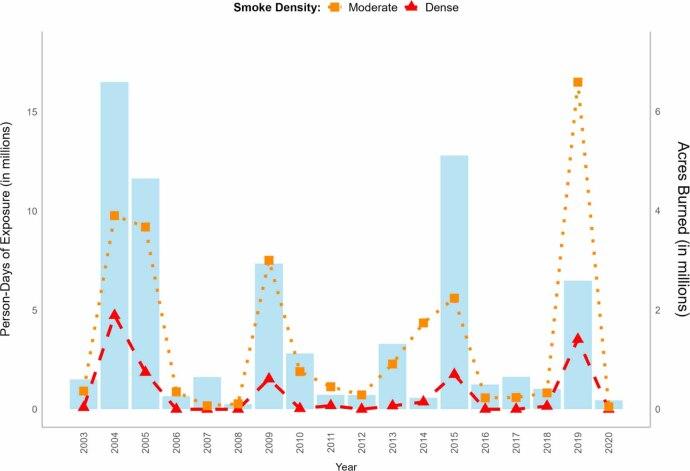
Wildfire activity is increasing globally due to climate change, with implications for air quality and public health. Fine particulate matter (PM) from wildfire smoke contributes to cardiorespiratory morbidity and mortality, adverse birth outcomes, mental health stressors, and disruptions to food security and traditional livelihoods. However, quantifying health risks remains difficult due to sparse monitoring, challenges in isolating wildfire-specific pollution, and limited long-term exposure assessments. We developed a historical air quality dataset for Alaska using a hybrid approach that integrates GEOS-Chem atmospheric modeling with ground-based data to estimate daily wildfire-attributable PM at a 0.625° × 0.5° resolution from 2003 to 2020. We aggregated these estimates by census tract and derived metrics to quantify long-term wildfire smoke exposure, then combined these estimates with social vulnerability data to identify populations disproportionately affected. Alaskans experienced an average of 3.5 million person-days of moderate and >800 000 person-days of dense smoke exposure annually. In years when over 2 million acres burned, 86%-98% of census tracts recorded at least 1 d of moderate smoke, and up to 73% experienced dense smoke. Northern Interior Alaska had over 300 cumulative days of poor air quality (∼10% of summer days) over the 18 year period, with smoke waves lasting as long as 43 d. Tracts identified as having high smoke exposure and high smoke vulnerability were generally in rural Interior Alaska; however, urban tracts in Interior and Southcentral were also identified. High-exposure census tracts had statistically greater proportions of housing cost-burdened residents and women of childbearing age. This study highlights the need to move beyond traditional fire metrics and adopt measures that better capture the full scope of human exposure. Our approach provides a framework for assessing health risks and integrating public health into climate adaptation and fire management especially in wildfire-prone regions where observations are sparse.
由于气候变化,全球野火活动日益增加,这对空气质量和公众健康产生了影响。野火烟雾中的细颗粒物(PM)会导致心肺疾病的发病率和死亡率上升、不良出生结局、心理健康压力源以及对粮食安全和传统生计的破坏。然而,由于监测数据稀少、区分野火特定污染存在挑战以及长期暴露评估有限,量化健康风险仍然困难。我们采用一种混合方法为阿拉斯加开发了一个历史空气质量数据集,该方法将GEOS-Chem大气模型与地面数据相结合,以估算2003年至2020年期间分辨率为0.625°×0.5°的每日野火源PM。我们按普查区汇总这些估算值,并得出量化长期野火烟雾暴露的指标,然后将这些估算值与社会脆弱性数据相结合,以确定受影响尤为严重的人群。阿拉斯加人每年平均有350万人日暴露于中度烟雾中,超过80万人日暴露于浓烟中。在超过200万英亩土地被烧毁的年份,86% - 98%的普查区记录到至少1天的中度烟雾,高达73%的普查区经历了浓烟。在18年期间,阿拉斯加内陆北部累计有超过300天空气质量较差(约占夏季天数的10%),烟雾波持续长达43天。被确定为高烟雾暴露和高烟雾脆弱性的区域通常位于阿拉斯加内陆农村地区;不过,内陆和中南部的城市区域也被确定为高风险区域。高暴露普查区中住房成本负担较重的居民和育龄妇女的比例在统计学上更高。这项研究强调需要超越传统的火灾指标,采取能更好地全面衡量人类暴露情况的措施。我们的方法提供了一个评估健康风险以及将公共卫生纳入气候适应和火灾管理的框架,特别是在观测数据稀少的野火多发地区。



 Zotero 插件