
尼日利亚哈科特港大都市临床和非临床来源分离菌的多重抗生素耐药性指数测定及分子鉴定
Multiple antibiotic resistance indexing and molecular identification of isolated from clinical and nonclinical sources in Port Harcourt Metropolis, Nigeria.
作者信息
Isaiah Doubra Otis, Otokunefor Kome, Agbagwa Obakpororo Ejiro
机构信息
Department of Microbiology, Faculty of Science, Niger Delta University, Bayelsa State, Nigeria.
Department of Microbiology, Faculty of Science, University of Port Harcourt, Rivers State, Nigeria.
出版信息
Pan Afr Med J. 2025 May 13;51:11. doi: 10.11604/pamj.2025.51.11.38524. eCollection 2025.
INTRODUCTION
the emergence of antibiotic resistance in E. coli strains has led to a variety of clinical illnesses in both humans and animals, with consequences for human health and the environment.
METHODS
this cross-sectional study was conducted to determine the risk of increased antibiotic resistance by calculating the multiple antibiotic resistance (MAR) index of E. coli in Port Harcourt, Rivers State, Nigeria. A higher MAR index close to 1 was interpreted as having a higher level of antibiotic resistance, while a lower MAR index close to 0 is an indicative of little to no resistance. In this study, a total of 200 samples from clinical (urine and stool) and non-clinical sources (soil and poultry) were randomly collected following ethical approval. Escherichia coli was isolated on Eosin Methylene Blue agar and identified using standard biochemical tests. The antimicrobial susceptibility profile was determined using the disk diffusion methodology with Mueller-Hinton agar according to the instructions of the Clinical and Laboratory Standards Institute (CLSI). Escherichia coli isolates were amplified in this investigation using a 16s rRNA gene-based polymerase chain reaction (PCR) technique.
RESULTS
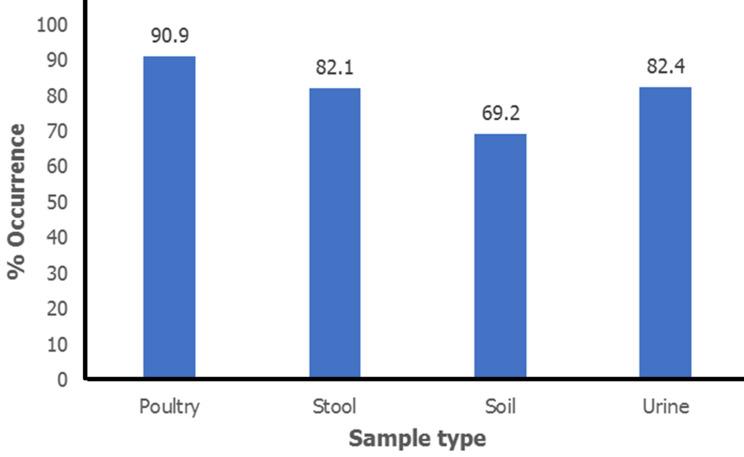
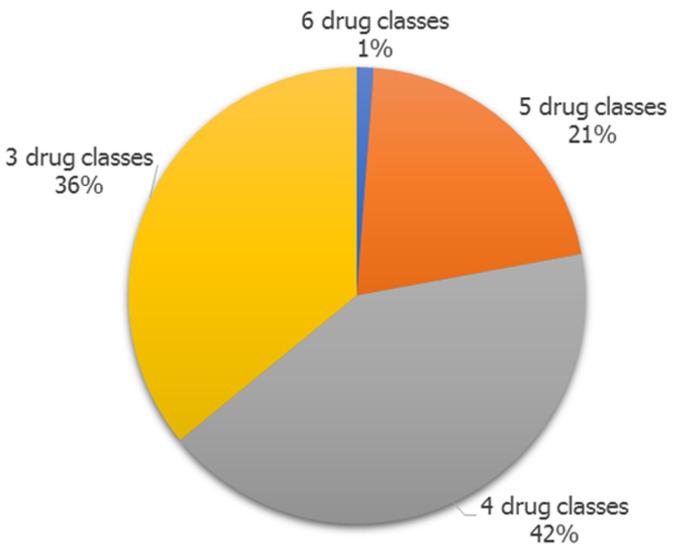
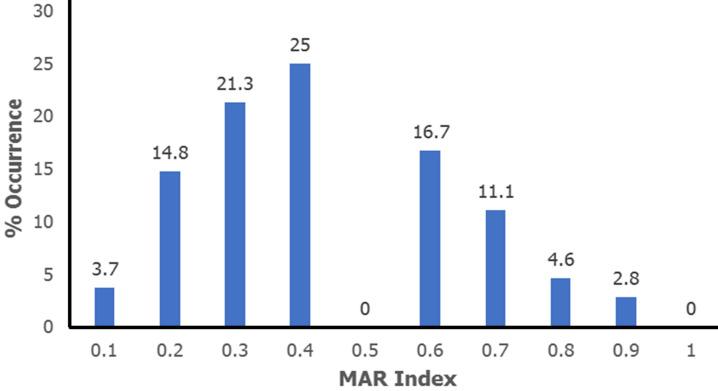
for both 73% clinical (n=100) and 35% non-clinical (n=100) isolates, amoxicillin/clavulanic acid showed the highest rate of resistance with 82.2% (60 of 73) and 100% (35 of 35) respectively, whereas nitrofurantoin showed the lowest rate of resistance at 1.4% (1 of 73) clinical and no resistance was found for the nonclinical E. coli isolates. The study presumptively finds a higher resistance to 4 drug classes, with 42%, and the lowest of 1% to 6 drug classes of antibiotics. Additionally, MAR indices > 0.2 were observed in this study, which indicates excessive use of antibiotics. MAR index of 0.4 was the most frequent, with a 25% prevalence. The results of this investigation show that a MAR index of 0.4 suggests widespread antibiotic resistance, with 25% of the bacterial isolates from both sources exhibiting resistance to the tested antibiotics. A MAR index > 0.2 in this study indicates that 14.8% of the E. coli isolates were ineffective against the tested antibiotics. The bacteria isolates in this study have developed resistance to multiple antibiotics if the MAR index is greater than 0.2, which is an indication of overuse or inappropriate antibiotic use. The genotypic test verified 82.9% non-clinical E. coli (found in environmental soil and poultry samples) and 82.2% clinical E. coli (found in patient urine and stool samples). In this study, E. coli isolates were genotypically identified using the 16s rRNA gene.
CONCLUSION
the high levels of MAR indices in E. coli as presented in this study could be indicative of antibiotic treatment failures in both clinical and nonclinical settings, which can serve as a potential reservoir of drug-resistant E. coli that are harmful and therefore require continuous monitoring.
引言
大肠杆菌菌株中抗生素耐药性的出现导致了人类和动物的多种临床疾病,对人类健康和环境都产生了影响。
方法
本横断面研究旨在通过计算尼日利亚河流州哈科特港大肠杆菌的多重耐药(MAR)指数,来确定抗生素耐药性增加的风险。接近1的较高MAR指数被解释为具有较高水平的抗生素耐药性,而接近0的较低MAR指数则表明几乎没有或没有耐药性。在本研究中,经伦理批准后,从临床(尿液和粪便)和非临床来源(土壤和家禽)随机收集了总共200个样本。在伊红美蓝琼脂上分离出大肠杆菌,并使用标准生化试验进行鉴定。根据临床和实验室标准协会(CLSI)的说明,采用纸片扩散法在 Mueller-Hinton 琼脂上测定抗菌药物敏感性谱。在本研究中,使用基于16s rRNA基因的聚合酶链反应(PCR)技术扩增大肠杆菌分离株。
结果
对于73%的临床分离株(n = 100)和35%的非临床分离株(n = 100),阿莫西林/克拉维酸的耐药率最高,分别为82.2%(73株中的60株)和100%(35株中的35株),而呋喃妥因的耐药率最低,临床分离株为1.4%(73株中的1株),非临床大肠杆菌分离株未发现耐药情况。该研究推测发现对4类药物的耐药性较高,为42%,对1%至6类抗生素的耐药性最低。此外,本研究中观察到MAR指数>0.2,这表明抗生素使用过度。MAR指数为0.4最为常见,患病率为25%。本研究结果表明,MAR指数为0.4表明存在广泛的抗生素耐药性,来自两种来源的细菌分离株中有25%对测试抗生素表现出耐药性。本研究中MAR指数>0.2表明14.8%的大肠杆菌分离株对测试抗生素无效。如果MAR指数大于0.2,本研究中的细菌分离株已对多种抗生素产生耐药性,这表明存在抗生素过度使用或使用不当的情况。基因分型测试验证了82.9%的非临床大肠杆菌(存在于环境土壤和家禽样本中)和82.2%的临床大肠杆菌(存在于患者尿液和粪便样本中)。在本研究中,使用16s rRNA基因对大肠杆菌分离株进行基因分型鉴定。
结论
本研究中大肠杆菌的高MAR指数可能表明临床和非临床环境中抗生素治疗失败,这可能成为有害耐药大肠杆菌的潜在储存库,因此需要持续监测。

 Zotero 插件