
植物源天然产物作为酪氨酸激酶途径调节剂在肺癌治疗中的作用
The Role of Plant-Derived Natural Products as a Regulator of the Tyrosine Kinase Pathway in the Management of Lung Cancer.
作者信息
Alrumaihi Faris, Rahmani Arshad Husain, Prabhu Sitrarasu Vijaya, Kumar Vikalp, Anwar Shehwaz
机构信息
Department of Medical Laboratories, College of Applied Medical Sciences, Qassim University, Buraydah 51452, Saudi Arabia.
Department of Biotechnology, Microbiology and Bioinformatics, National College (Autonomous), Tiruchirapalli 620001, India.
出版信息
Curr Issues Mol Biol. 2025 Jun 30;47(7):498. doi: 10.3390/cimb47070498.
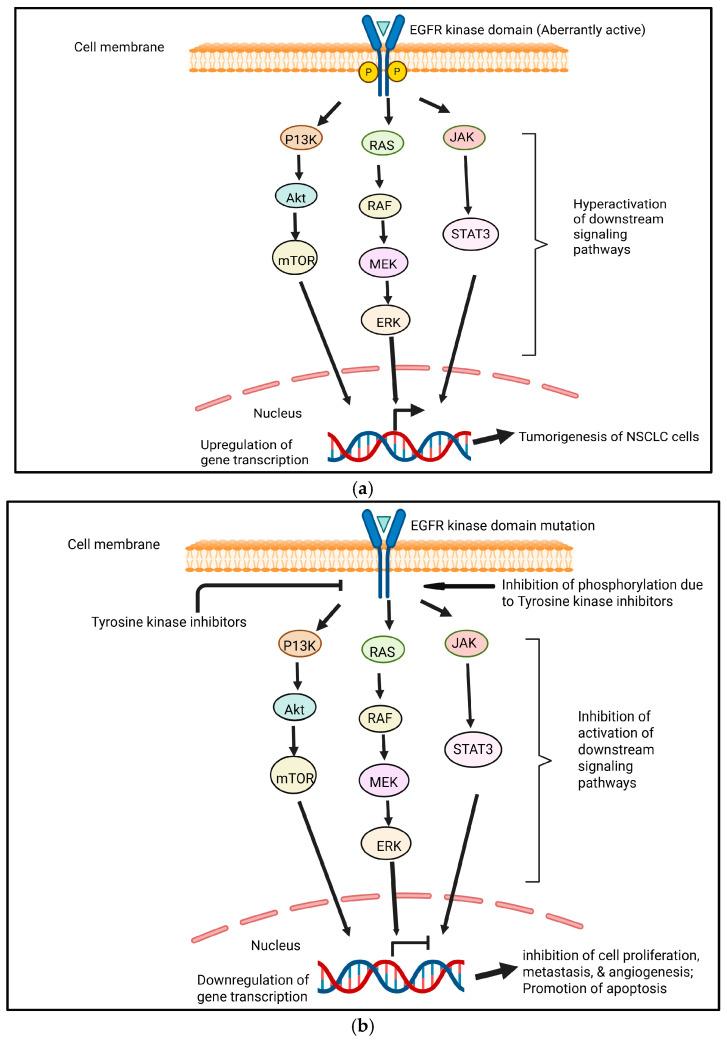
One of the most common malignant tumors worldwide is lung cancer, and it is associated with the highest death rate among all cancers. Traditional treatment options for lung cancer include radiation, chemotherapy, targeted therapy, and surgical resection. However, the survival rate is low, and the outlook is still dreadfully dire. The pursuit of a paradigm change in treatment approaches is, therefore, imperative. Tyrosine kinases (TKs), a subclass of protein kinases, regulate vital cellular function by phosphorylating tyrosine residues in proteins. Mutations, overexpression, and autocrine paracrine stimulation can transform TKs into oncogenic drivers, causing cancer pathogenesis. Tyrosine kinase inhibitors (TKIs) have emerged as an attractive targeted therapy option, especially for non-small cell lung cancer (NSCLC). However, resistance to TKIs, and adverse cardiovascular effects such as heart failure, atrial fibrillation, hypertension, and sudden death, are among the most common adverse effects of TKIs. There is increasing interest in plant-derived natural products in the hunt for powerful chemosensitizer and pathway modulators for enhancing TKI activity and/or overcoming resistance mechanisms. This highlights the mechanism of TKs' activation in cancer, the role of TKIs in NSCLC mechanisms, and the challenges posed by TKI-acquired resistance. Additionally, we explored various plant-derived natural products' bioactive compounds with the chemosensitizer and pathway-modulating potential with TKs' inhibitory and anticancer effects. Our review suggests that a combination of natural products with TKIs may provide a novel and promising strategy for overcoming resistance in lung cancer. In future, further preclinical and clinical studies are advised.
肺癌是全球最常见的恶性肿瘤之一,并且在所有癌症中其死亡率最高。肺癌的传统治疗选择包括放疗、化疗、靶向治疗和手术切除。然而,生存率较低,前景仍然极其严峻。因此,迫切需要在治疗方法上寻求范式转变。酪氨酸激酶(TKs)是蛋白激酶的一个亚类,通过使蛋白质中的酪氨酸残基磷酸化来调节重要的细胞功能。突变、过表达和自分泌旁分泌刺激可将酪氨酸激酶转变为致癌驱动因子,导致癌症发病机制。酪氨酸激酶抑制剂(TKIs)已成为一种有吸引力的靶向治疗选择,尤其是对于非小细胞肺癌(NSCLC)。然而,对TKIs的耐药性以及诸如心力衰竭、心房颤动、高血压和猝死等不良心血管效应是TKIs最常见的不良反应。在寻找强大的化学增敏剂和途径调节剂以增强TKI活性和/或克服耐药机制方面,人们对植物来源的天然产物的兴趣与日俱增。这突出了酪氨酸激酶在癌症中的激活机制、TKIs在NSCLC机制中的作用以及TKI获得性耐药带来的挑战。此外,我们探索了各种植物来源的天然产物的生物活性化合物,它们具有化学增敏剂和途径调节潜力以及酪氨酸激酶抑制和抗癌作用。我们的综述表明,天然产物与TKIs联合使用可能为克服肺癌耐药性提供一种新颖且有前景的策略。未来,建议进行进一步的临床前和临床研究。

 Zotero 插件