
影响一项新型多地点社区衰弱项目实施的促进因素和制约因素:领导者和实施者的观点
Enablers and constraints influencing implementation of a novel, multi-site community-based frailty programme: perspectives of leaders and implementers.
作者信息
Teng Poh Hoon June, Tan Hwee Teng Robyn, Ha Ngoc Huong Lien, Lim Wee Shiong, Ding Yew Yoong, Tan Woan Shin
机构信息
Geriatric Education and Research Institute, Singapore, Singapore.
Institute of Policy Studies, National University of Singapore, Singapore, Singapore.
出版信息
BMC Geriatr. 2025 Jul 29;25(1):557. doi: 10.1186/s12877-025-06164-5.
BACKGROUND
Evaluations of integrated care models for frailty anchored by comprehensive geriatric assessment have reported mixed effects on patient outcomes. Various reasons have been proposed, including how implementation varies widely across different contexts. This paper aims to identify the key enablers and constraints that influenced the implementation of a novel community-based frailty programme- the Geriatric Services Hub- in the rapidly ageing nation-state of Singapore through the perspectives of programme leaders and implementers from five sites.
METHODS
Seventy-four programme leaders and implementers were recruited for in-depth interviews and focus group discussions. The Framework Method was used to summarise and compare data across different sites and perspectives.
RESULTS
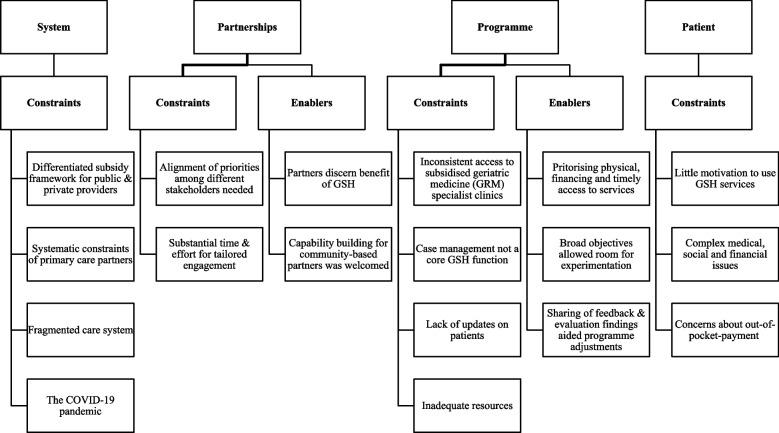
The findings on enablers and constraints were organised into four domains: System, partnership, programme and patient factors. Systemic factors include differing subsidies across public and private healthcare providers, systemic constraints of primary-care partners, a fragmented system of care, and the COVID-19 pandemic. Partnership factors include how capability-building for primary-care and community partners was welcomed by stakeholders. At the programme level, ensuring physical, financing, and timely access to services by frail older adults was prioritised. However, as noted under patient factors, some GSH patients faced complex medical, social, and financial issues that may affect service utilisation.
CONCLUSIONS
Systemic factors had a major influence on the implementation of GSH and we posit that they hold particular relevance for integrated care models in complex healthcare systems. Whole-system changes above and beyond implementation efforts of individual programmes may be needed for successful and sustainable implementation of integrated care.
背景
以综合老年评估为依托的衰弱综合照护模式评估报告显示,对患者结局的影响不一。人们提出了各种原因,包括实施方式在不同背景下差异很大。本文旨在通过来自五个地点的项目负责人和实施者的视角,确定影响在迅速老龄化的新加坡实施一项新型社区衰弱项目——老年服务中心——的关键推动因素和制约因素。
方法
招募了74名项目负责人和实施者进行深入访谈和焦点小组讨论。采用框架法对不同地点和视角的数据进行总结和比较。
结果
关于推动因素和制约因素的调查结果分为四个领域:系统、伙伴关系、项目和患者因素。系统因素包括公立和私立医疗服务提供者的补贴差异、初级保健伙伴的系统制约、碎片化的照护体系以及新冠疫情。伙伴关系因素包括利益相关者对初级保健和社区伙伴能力建设的欢迎程度。在项目层面,优先确保体弱老年人能够实际获得、有资金支持且及时获得服务。然而,如患者因素所述,一些老年服务中心的患者面临复杂的医疗、社会和财务问题,可能会影响服务利用。
结论
系统因素对老年服务中心的实施有重大影响,我们认为它们与复杂医疗系统中的综合照护模式特别相关。为了成功且可持续地实施综合照护,可能需要在个别项目实施努力之外进行全系统变革。

 Zotero 插件