
转录组学和代谢组学联合分析揭示不同代谢途径和基因对苦瓜果实不同发育阶段生长发育的动态调控
Transcriptomic and Metabolomic Joint Analysis Revealing Different Metabolic Pathways and Genes Dynamically Regulating Bitter Gourd ( L.) Fruit Growth and Development in Different Stages.
作者信息
Qiu Boyin, Li Dazhong, Zhang Qianrong, Lin Hui, Li Yongping, Wen Qingfang, Zhu Haisheng
机构信息
Crops Research Institute, Fujian Academy of Agricultural Sciences, Fuzhou 350002, China.
出版信息
Plants (Basel). 2025 Jul 21;14(14):2248. doi: 10.3390/plants14142248.
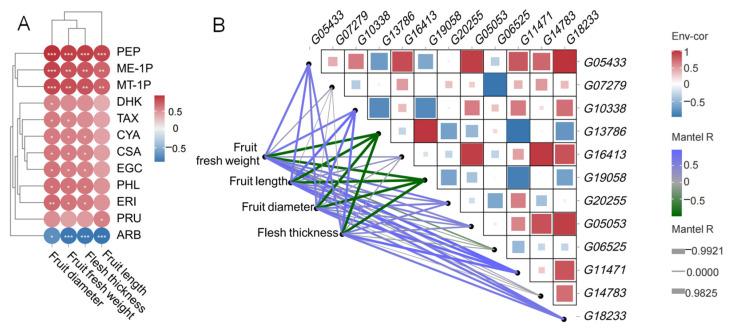
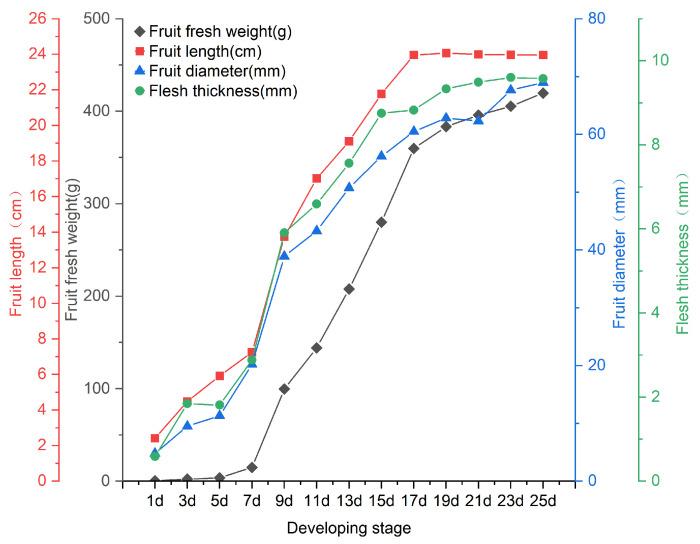
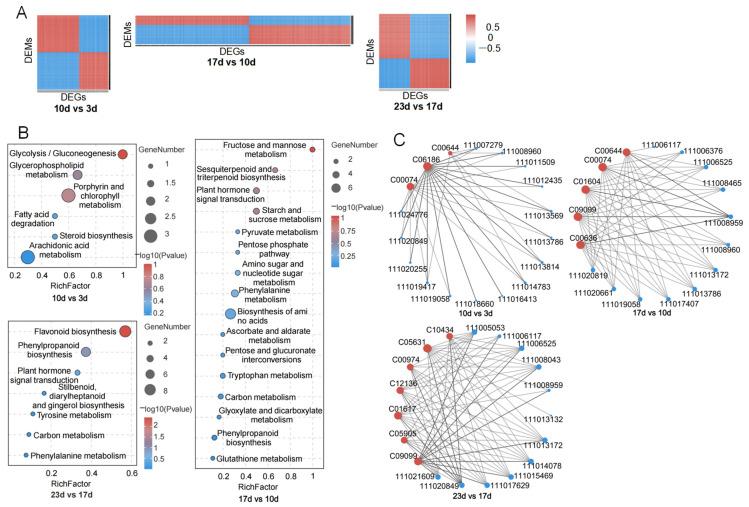
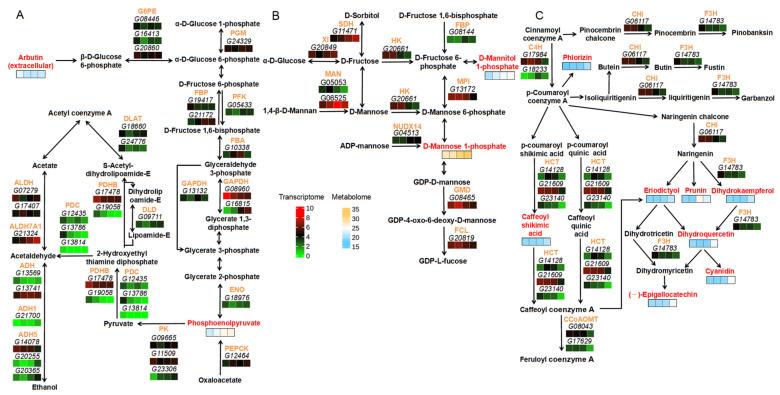
Insights into dynamic regulatory factors in various stages of growth and development can guide strategies for precision and targeted breeding. Bitter gourd, as a vegetable product with medicinal value, plays a role in both agricultural and medical fields. In this study, phenotypic observations, metabolomic and transcriptomic analyses, and differential gene expression patterns, along with a correlation analysis, were conducted in different stages of fruit growth and development. The results revealed that the growth rate of fruit's fresh weight, length, diameter, and flesh thickness during the first seven days was slow, and that it then rapidly increased after the seventh day, and finally slowed once more after 17 days, indicating that the overall process followed a "slow-fast-slow" pattern. Transcriptomic and metabolomic analyses identified several differentially expressed genes and metabolites, and joint analyses revealed that each of the glycolysis/gluconeogenesis, fructose and mannose metabolism and flavonoid biosynthesis pathways individually play significant roles in the dynamic regulation of fruit growth and development during the early, middle, and late stages. Among these, 53 differentially expressed genes (DEGs) and 12 differentially expressed metabolites (DEMs) were found in these pathways. A total of 12 randomly selected DEGs were analyzed using quantitative PCR, and the results showed that gene expression levels were generally consistent with transcriptomic sequencing results, exhibiting dynamic changes with varying expression levels. Correlation analysis revealed that 11 DEMs were positively correlated with four traits except for arbutin, while eight DEGs were related to all traits, including six significantly positive and two significantly negative correlations. These findings enhance our understanding of the regulatory network governing yield and quality and provide substantial evidence to support improvements in breeding programs.
深入了解生长发育各阶段的动态调控因子可为精准育种和定向育种策略提供指导。苦瓜作为一种具有药用价值的蔬菜产品,在农业和医学领域均发挥着作用。在本研究中,对果实生长发育的不同阶段进行了表型观察、代谢组学和转录组学分析、差异基因表达模式以及相关性分析。结果表明,果实鲜重、长度、直径和果肉厚度在前七天的生长速度较慢,在第七天后迅速增加,而在17天后再次放缓,表明整个过程遵循“慢-快-慢”模式。转录组学和代谢组学分析鉴定出了几个差异表达基因和代谢物,联合分析表明,糖酵解/糖异生、果糖和甘露糖代谢以及类黄酮生物合成途径在果实生长发育的早期、中期和后期的动态调控中均各自发挥着重要作用。其中,在这些途径中发现了53个差异表达基因(DEG)和12个差异表达代谢物(DEM)。使用定量PCR对总共12个随机选择的DEG进行了分析,结果表明基因表达水平总体上与转录组测序结果一致,呈现出表达水平的动态变化。相关性分析表明,除熊果苷外,11个DEM与四个性状呈正相关,而8个DEG与所有性状相关,包括6个显著正相关和2个显著负相关。这些发现加深了我们对产量和品质调控网络的理解,并为支持育种计划的改进提供了大量证据。


 Zotero 插件