
隐孢子虫钙依赖性蛋白激酶1抑制剂BKI-1708的抗隐孢子虫功效
Anti-Cryptosporidium efficacy of BKI-1708, an inhibitor of Cryptosporidium calcium-dependent protein kinase 1.
作者信息
Choi Ryan, Hulverson Matthew A, Schaefer Deborah A, Betzer Dana P, Riggs Michael W, Huang Wenlin, Sun Vicky, Whitman Grant R, McCloskey Molly C, Marsh Kennan, Buck Wayne R, Wagner David S, Yang Junhai, Bowman Andrew P, Ciurlionis Rita, Ajiboye Jubilee, Hemphill Andrew, Sigalapalli Dilep K, Arnold Samuel L M, Barrett Lynn K, Ojo Kayode K, Fan Erkang, Van Voorhis Wesley C
机构信息
Department of Medicine, Division of Allergy and Infectious Diseases, Center for Emerging and Re-emerging Infectious Disease (CERID), University of Washington, Seattle, Washington, United States of America.
School of Animal and Comparative Biomedical Sciences, College of Agriculture and Life Sciences, University of Arizona, Tucson, Arizona, United States of America.
出版信息
PLoS Negl Trop Dis. 2025 Jul 30;19(7):e0013263. doi: 10.1371/journal.pntd.0013263. eCollection 2025 Jul.
BACKGROUND
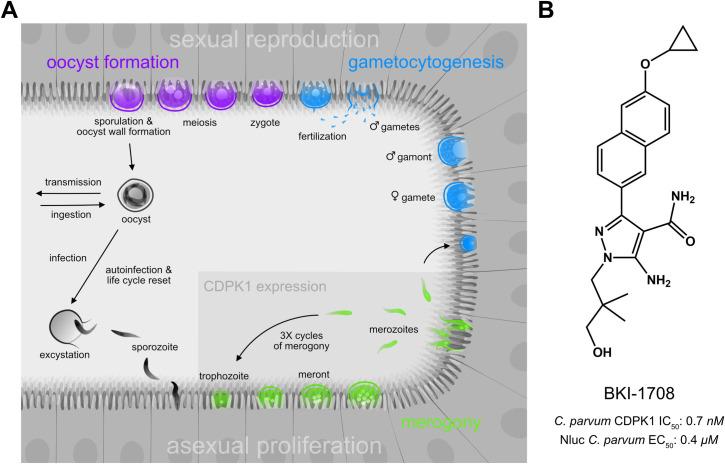
Diarrheal pathogens, such as Cryptosporidium, impose a heavy burden of disease in resource-limited regions. Cryptosporidiosis often causes chronic infection in immunocompromised people and gastrointestinal injury in malnourished children, leading to wasting, stunting, and cognitive impairment. Current treatment for cryptosporidiosis fails in these vulnerable populations, highlighting the need for new medicines. Here we describe the anti-Cryptosporidium efficacy, pharmacokinetics, and safety of a bumped kinase inhibitor BKI-1708. BKI-1708 inhibits the essential molecular target, calcium-dependent protein kinase 1 (CDPK1), which is highly expressed in the major proliferative stages of the parasite life cycle.
METHODS AND FINDINGS
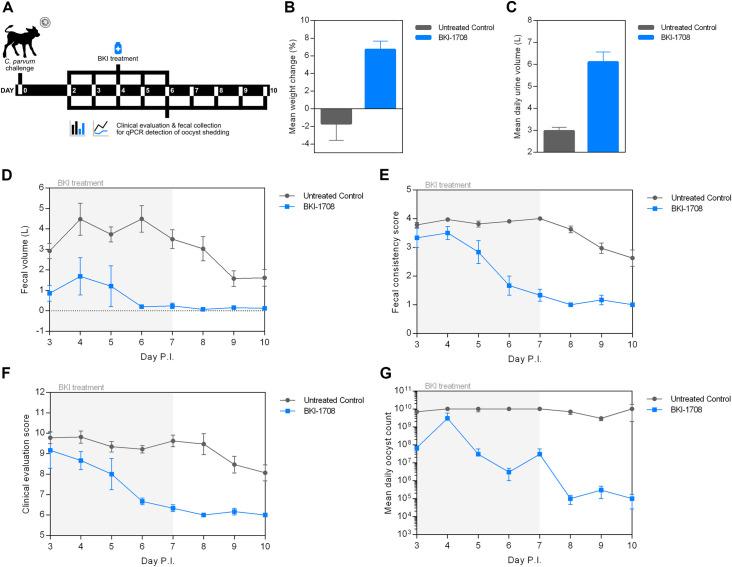
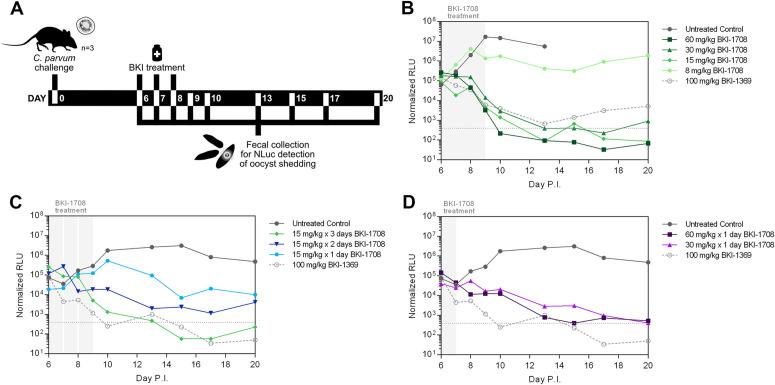
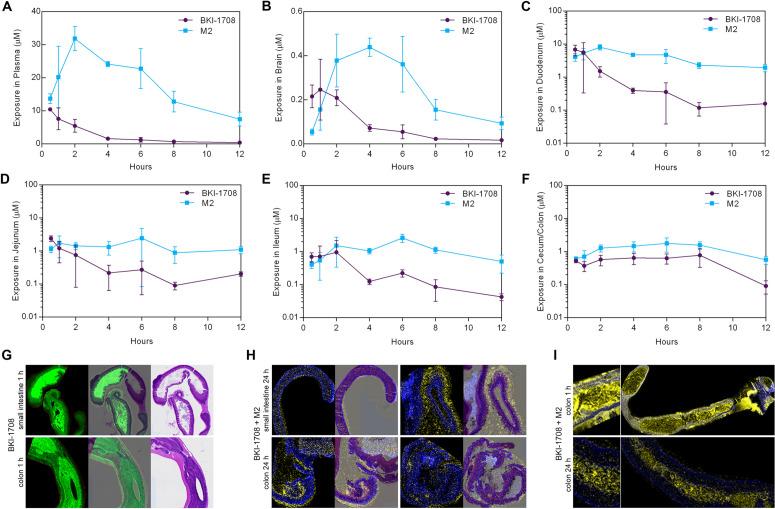
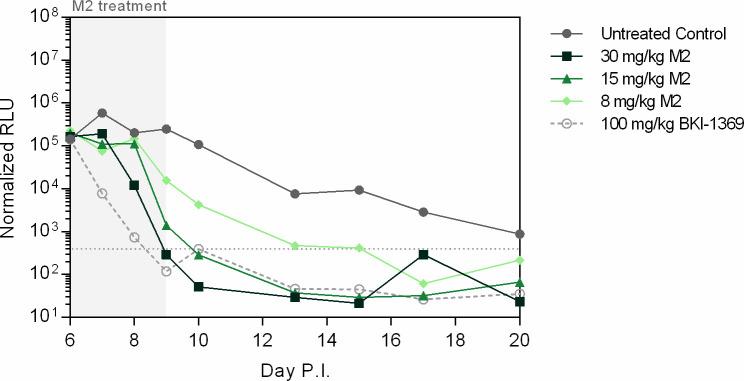
Efficacy was demonstrated in the Cryptosporidium parvum IFNγ-KO mouse infection and calf diarrhea models. Dose response in the mouse model demonstrated oral doses as low as 15 mg/kg administered daily for 3 days completely suppressed oocyst shedding. Metabolite profiling in pre-clinical species and human hepatocytes identified an active metabolite, M2, which retains sub-micromolar activity against C. parvum. Pharmacokinetic analysis of BKI-1708 and M2 in mice demonstrates good systemic exposure, important for treating biliary and upper respiratory infections in some cases of cryptosporidiosis. In mice, M2 reaches 7-fold and >3-fold higher levels over BKI-1708 in plasma and the gastrointestinal tract, respectively. Oral administration of M2 completely suppressed oocyst shedding in the mouse model at doses as low as 8 mg/kg for 3 days. Wide safety margins are demonstrated in mice, rats, and dogs.
CONCLUSIONS
BKI-1708 has characteristics of a safe and effective drug for treating Cryptosporidium infections in animal models and shows promise for use in humans. Moreover, BKI-1708 and M2 formed in vivo, offer an attractive prospect of a dually active preclinical candidate for the treatment of cryptosporidiosis.
背景
腹泻病原体,如隐孢子虫,在资源有限地区造成沉重的疾病负担。隐孢子虫病常导致免疫功能低下者慢性感染,以及营养不良儿童胃肠道损伤,进而导致消瘦、发育迟缓及认知障碍。目前针对隐孢子虫病的治疗方法在这些弱势群体中效果不佳,凸显了对新药的需求。在此,我们描述了一种碰撞激酶抑制剂BKI - 1708对隐孢子虫的疗效、药代动力学及安全性。BKI - 1708抑制关键分子靶点钙依赖性蛋白激酶1(CDPK1),该靶点在寄生虫生命周期的主要增殖阶段高度表达。
方法与结果
在微小隐孢子虫IFNγ基因敲除小鼠感染模型和小牛腹泻模型中证实了疗效。小鼠模型中的剂量反应表明,每日口服低至15mg/kg,连续给药3天可完全抑制卵囊排出。临床前物种和人肝细胞中的代谢物谱分析确定了一种活性代谢物M2,其对微小隐孢子虫仍具有亚微摩尔活性。对BKI - 1708和M2在小鼠体内的药代动力学分析表明,其具有良好的全身暴露,这在某些隐孢子虫病病例中对治疗胆道和上呼吸道感染很重要。在小鼠体内,M2在血浆和胃肠道中的水平分别比BKI - 1708高7倍和3倍以上。口服M2低至8mg/kg,连续3天可完全抑制小鼠模型中的卵囊排出。在小鼠、大鼠和狗身上均显示出较宽的安全范围。
结论
BKI - 1708在动物模型中具有治疗隐孢子虫感染的安全有效药物特性,有望用于人类。此外,BKI - 1708及其体内形成的M2为治疗隐孢子虫病提供了一种具有双重活性的临床前候选药物的诱人前景。


 Zotero 插件