
细胞因子相关基因与炎症谱作为重度抑郁症潜在生物标志物的研究
Cytokine-Related Genes and Inflammatory Profiles as Potential Biomarkers in Major Depressive Disorder.
作者信息
Oh Haein, Kong Na Yeong, Jung Sung-Won, Kim Hee-Cheol, Kim Shin, Kang Junho, Lee Hojun
机构信息
Department of Psychiatry, School of Medicine, Keimyung University, Daegu, Republic of Korea.
Department of Immunology, School of Medicine, Keimyung University, Daegu, Republic of Korea.
出版信息
Psychiatry Investig. 2025 Aug;22(8):858-869. doi: 10.30773/pi.2025.0013. Epub 2025 Jul 31.
OBJECTIVE
Based on the neuroimmunological hypothesis of major depressive disorder (MDD), we analyzed the existing research to identify cytokine-related genes associated with MDD. Furthermore, we examined the cytokine alterations in patients with MDD as potential biomarkers for diagnosis and monitoring.
METHODS
Differentially expressed genes (DEGs) related to MDD were identified using the GEO2R tool on public datasets, followed by functional enrichment analyses with Gene Ontology and Kyoto Encyclopedia of Genes and Genomes pathways. Protein-protein interaction (PPI) networks were constructed using Cytoscape to identify hub genes. Finally, blood samples from 20 patients with MDD and 10 healthy controls were analyzed using the Olink® Target 96 Inflammation panel with proximity extension assay (PEA) technology to identify potential protein biomarkers.
RESULTS
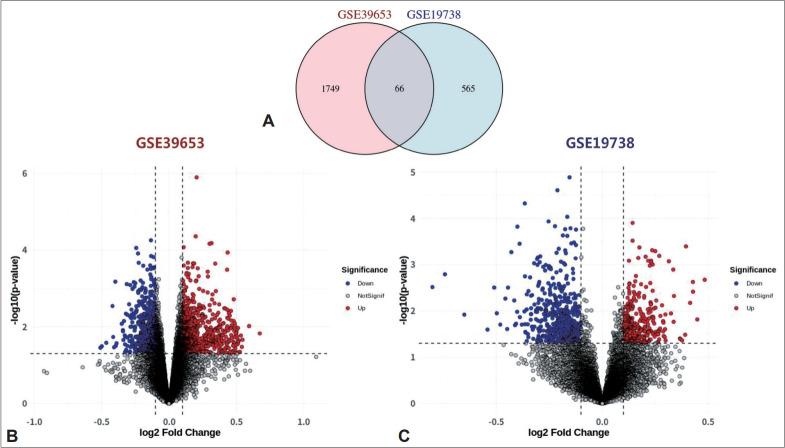
Two GEO datasets related to MDD were analyzed to identify 66 common DEGs. Following the PPI analysis, 46 genes were identified. Functional enrichment analysis revealed that these genes were closely related to immune-related pathways. Subsequent blood sample analysis of patients with MDD and healthy controls confirmed that 18 cytokines related to 46 DEGs were significantly upregulated. Among the identified cytokines, oncostatin M (OSM) showed the highest receiver operating characteristic (ROC) performance (area under the curve [AUC]=0.96), followed by hepatocyte growth factor (HGF) (AUC=0.95), cluster of differentiation 6 (CD6) (AUC=0.90), and tumor necrosis factor superfamily 14 (TNFSF14) (AUC=0.90).
CONCLUSION
Our study confirms that neuroinflammation is an important pathophysiological aspect of MDD and that several related cytokines, such as OSM, HGF, CD6, and TNFSF14, may be potential biomarkers of MDD.
目的
基于重度抑郁症(MDD)的神经免疫学假说,我们分析了现有研究以确定与MDD相关的细胞因子相关基因。此外,我们研究了MDD患者的细胞因子变化,将其作为诊断和监测的潜在生物标志物。
方法
使用公共数据集上的GEO2R工具识别与MDD相关的差异表达基因(DEG),随后通过基因本体论和京都基因与基因组百科全书通路进行功能富集分析。使用Cytoscape构建蛋白质-蛋白质相互作用(PPI)网络以识别枢纽基因。最后,使用Olink® Target 96炎症检测板和邻近延伸分析(PEA)技术分析20例MDD患者和10例健康对照的血样,以识别潜在的蛋白质生物标志物。
结果
分析了两个与MDD相关的GEO数据集,以识别66个常见的DEG。经过PPI分析,确定了其中46个基因。功能富集分析表明,这些基因与免疫相关通路密切相关。随后对MDD患者和健康对照的血样分析证实,与46个DEG相关的18种细胞因子显著上调。在鉴定出的细胞因子中,抑瘤素M(OSM)显示出最高的受试者工作特征(ROC)性能(曲线下面积[AUC]=0.96),其次是肝细胞生长因子(HGF)(AUC=0.95)、分化簇6(CD6)(AUC=0.90)和肿瘤坏死因子超家族14(TNFSF14)(AUC=0.90)。
结论
我们的研究证实神经炎症是MDD的一个重要病理生理学方面,并且几种相关的细胞因子,如OSM、HGF、CD6和TNFSF14,可能是MDD的潜在生物标志物。



 Zotero 插件