
在英国生物银行中评估表型年龄相较于实际年龄增强心血管疾病风险预测的潜力。
Evaluating the potential of phenotypic age to enhance cardiovascular risk prediction over chronological age in the UK Biobank.
作者信息
Kwan Kristine J S, Xie Shi-Shuai, Li Hai-Lei, Lin Xue-Guang, Lu Yi-Jie, Chen Bo, Ge Kai-Xin, Tang Shu-Ya, Zhang Hui, Jiang Shuai, Tang Jing-Dong
机构信息
Department of Vascular Surgery, Shanghai Key Laboratory of Vascular Lesions Regulation and Remodeling, Fudan University Pudong Medical Center, Shanghai, 201399, China.
Division of Vascular Surgery, Department of Surgery, The University of Hong Kong, Hong Kong SAR, China.
出版信息
Sci Rep. 2025 Jul 30;15(1):27858. doi: 10.1038/s41598-025-12495-5.
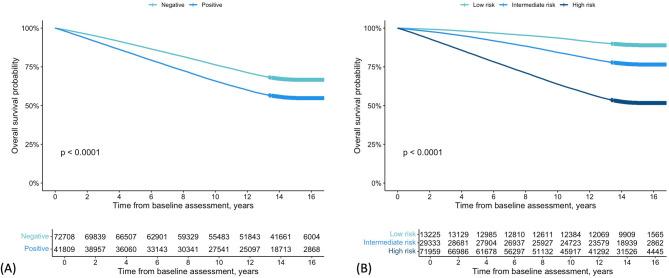
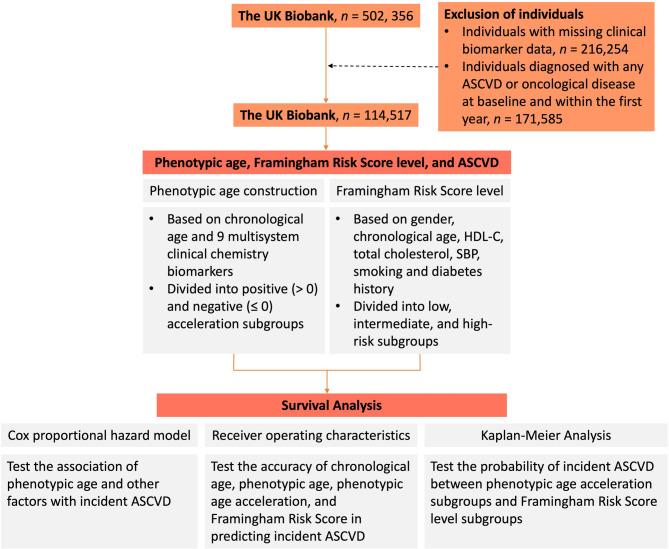
Phenotypic age acceleration (PhenoAgeAccel) is a novel biological indicator estimates an individual's mortality risk. The primary aim of this study was to evaluate the association between PhenoAge and PhenoAgeAccel with incident cardiovascular diseases (CVD) in the UK Biobank cohort. We analyzed data from 114,517 UK Biobank participants free of CVD history at baseline. PhenoAgeAccel of was obtained by regressing PhenoAge on chronological age (ChronoAge). We applied a Cox regression model with time-dependent variables to assess the association between PhenoAgeAccel and incident CVD. The predictive value of PhenoAge and PhenoAgeAccel was evaluated with reference to the Framingham Risk Score (FRS) model using Kaplan-Meier curves, receiver operating characteristic curves (AUC), and Harrel's C-index. The positive PhenoAgeAccel comprised of 36.5% of the cohort. The mean ChronoAge and PhenoAge of participants in the positive PhenoAgeAccel group was 57.5 years and 61.7 years, respectively. The mean ChronoAge and PhenoAge of participants in the negative PhenoAgeAccel group was 56.1 years and 52.5 years, respectively. Incident CVD occurred at a higher rate in the positive PhenoAgeAccel group (44.8% vs. 33.1%) at a comparatively shorter period (11.2 years vs. 12.4 years). The AUC of PhenoAge in predicting incident CVD was lower than the FRS but higher than ChronoAge (69.3% vs. 70.9% vs. 68.1%, respectively). Discriminative performance was assessed using Harrell's C-index. The model including established cardiovascular risk factors yielded a C-index of 0.670, compared to 0.674 for the model incorporating PhenoAgeAccel (difference = 0.0049, p < 0.001). Separately, the Framingham Risk Score (FRS) model achieved a higher C-index of 0.697 versus 0.674 for the PhenoAgeAccel model (difference = 0.022, p < 0.001). Kaplein-Meier survival patterns of the positive PhenoAgeAccel group was similar to the high-risk group of FRS level. At time points year 4, 8, 12, and 16, the freedom-from-CVD probability for positive PhenoAgeAccel groups versus FRS high risk groups were 86.2% vs. 85.7%, 72.6% vs. 71.1%, 60.0% vs. 57.4%, and 54.8% vs. 51.7% respectively. Positive PhenoAgeAccel was associated with higher 10-year CVD risk, suggesting its potential as an adjunct in CVD risk assessment. PhenoAge, by incorporating biological aging markers, may offer more nuanced risk insights compared to ChronoAge. These findings are primarily applicable to men, given the male predominance in the cohort, and should be interpreted with caution for women.
表型年龄加速(PhenoAgeAccel)是一种估计个体死亡风险的新型生物学指标。本研究的主要目的是评估英国生物银行队列中PhenoAge和PhenoAgeAccel与心血管疾病(CVD)发病之间的关联。我们分析了来自114517名基线时无CVD病史的英国生物银行参与者的数据。通过将PhenoAge对实足年龄(ChronoAge)进行回归分析获得PhenoAgeAccel。我们应用了一个带有时间依存变量的Cox回归模型来评估PhenoAgeAccel与CVD发病之间的关联。使用Kaplan-Meier曲线、受试者工作特征曲线(AUC)和Harrell氏C指数,参照弗雷明汉风险评分(FRS)模型评估PhenoAge和PhenoAgeAccel的预测价值。阳性PhenoAgeAccel占队列的36.5%。阳性PhenoAgeAccel组参与者的平均实足年龄和PhenoAge分别为57.5岁和61.7岁。阴性PhenoAgeAccel组参与者的平均实足年龄和PhenoAge分别为56.1岁和52.5岁。阳性PhenoAgeAccel组CVD发病率较高(44.8%对33.1%),且发病时间相对较短(11.2年对12.4年)。PhenoAge预测CVD发病的AUC低于FRS但高于ChronoAge(分别为69.3%对70.9%对68.1%)。使用Harrell氏C指数评估判别性能。包含已确定心血管危险因素的模型C指数为0.670,而纳入PhenoAgeAccel的模型C指数为0.674(差异=0.0049,p<0.001)。单独来看,弗雷明汉风险评分(FRS)模型的C指数为0.697,高于PhenoAgeAccel模型的0.674(差异=0.022,p<0.001)。阳性PhenoAgeAccel组的Kaplein-Meier生存模式与FRS水平的高危组相似。在第4、8、12和16年的时间点,阳性PhenoAgeAccel组与FRS高危组的无CVD概率分别为86.2%对85.7%、72.6%对71.1%、60.0%对57.4%和54.8%对51.7%。阳性PhenoAgeAccel与较高的10年CVD风险相关,表明其在CVD风险评估中作为辅助指标的潜力。PhenoAge通过纳入生物衰老标志物,与ChronoAge相比可能提供更细致入微的风险见解。鉴于队列中男性占主导,这些发现主要适用于男性,但对女性的解释应谨慎。

 Zotero 插件