
肯尼亚、印度尼西亚和越南青少年中的欺凌受害与欺凌行为及其与精神障碍的关联:全国青少年心理健康调查结果
Bullying victimisation and perpetration and the association with mental disorders among adolescents in Kenya, Indonesia, and Vietnam: Findings from the National Adolescent Mental Health Surveys.
作者信息
Erskine Holly E, Maravilla Joemer C, Fine Shoshanna L, Ramaiya Astha, Li Mengmeng, Wahdi Amirah Ellyza, Wado Yohannes Dibaba, Loi Vu Manh, Whiteford Harvey A, Lawrence David, Thomas Hannah J, Scott James G
机构信息
School of Public Health, The University of Queensland, Herston, QLD, Australia.
Queensland Centre for Mental Health Research, Wacol, QLD, Australia.
出版信息
Child Adolesc Psychiatry Ment Health. 2025 Jul 31;19(Suppl 1):87. doi: 10.1186/s13034-025-00922-4.
BACKGROUND
Few studies report the prevalence of both bullying victimisation and perpetration at the national level in low- and middle-income countries, with fewer still reporting the association with mental disorders assessed diagnostically.
METHODS
Nationally representative household surveys of adolescents aged 10-17 years and their primary caregiver were conducted in Kenya, Indonesia, and Vietnam as part of the National Adolescent Mental Health Surveys (NAMHS). Adolescents were asked about bullying victimisation and perpetration in the past three months. The prevalence of mental disorders in the past 12 months was assessed using a diagnostic instrument. The prevalence of bullying involvement was calculated, along with bullying victimisation and perpetration which were further disaggregated by sex and age. Types of victimisation and perpetration were assessed among those who endorsed bullying involvement. Adjusted odds ratios quantified the association between any mental disorder and bullying victimisation and perpetration. All findings were weighted to the respective country's population and presented with 95% confidence intervals (CIs).
RESULTS
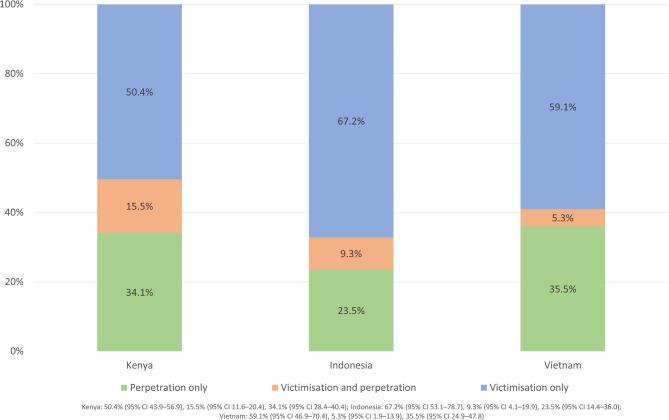
The prevalence of any bullying involvement was highest in Kenya (6.3%, CI 5.3-7.4), followed by Indonesia (3.4%, 95% CI 2.4-4.8), then Vietnam (1.9%, 95% CI 1.3-2.7). For bullying victimisation, both Kenya (4.1%, 95% CI 3.4-5.0) and Indonesia (2.6%, 95% CI 1.9-3.6) had significantly higher prevalence than Vietnam (1.2%, 95% CI 0.9-1.67). Kenya had significantly higher prevalence of bullying perpetration (3.1%, 95% CI 2.5-3.8) compared to Indonesia (1.1%, 95% CI 0.6-2.1) and Vietnam (0.8%, 95% CI 0.5-1.2). Adolescents experiencing bullying victimisation were significantly more likely to have a mental disorder than those who had not been bullied in all three countries (Kenya: aOR 2.17, 95% CI 1.50-3.15; Indonesia: aOR 3.55, 95% CI 1.47-8.59; Vietnam: aOR 4.71, 95% CI 1.82-12.21). The same was seen for bullying perpetration although only in Kenya (aOR 4.38, 95% CI 2.77-6.93) and Indonesia (aOR 4.32, 95% CI 1.62-11.51).
CONCLUSIONS
NAMHS is the first study to report national prevalence estimates of bullying victimisation and perpetration among adolescents in Kenya, Indonesia, and Vietnam. Bullying was strongly associated with adolescent mental disorders and is consequently an important consideration for strategies aimed at improving adolescent mental health.
背景
在低收入和中等收入国家,很少有研究报告全国范围内欺凌受害和欺凌实施的发生率,更少有人报告其与经诊断评估的精神障碍之间的关联。
方法
作为国家青少年心理健康调查(NAMHS)的一部分,在肯尼亚、印度尼西亚和越南对10至17岁的青少年及其主要照顾者进行了具有全国代表性的家庭调查。询问青少年在过去三个月内的欺凌受害和欺凌实施情况。使用诊断工具评估过去12个月内精神障碍的发生率。计算欺凌参与率,以及按性别和年龄进一步细分的欺凌受害和欺凌实施情况。在认可参与欺凌的人群中评估受害和实施的类型。调整后的优势比量化了任何精神障碍与欺凌受害和欺凌实施之间的关联。所有结果均按各自国家的人口加权,并给出95%置信区间(CI)。
结果
任何形式的欺凌参与率在肯尼亚最高(6.3%,CI 5.3 - 7.4),其次是印度尼西亚(3.4%,95% CI 2.4 - 4.8),然后是越南(1.9%,95% CI 1.3 - 2.7)。对于欺凌受害情况,肯尼亚(4.1%,95% CI 3.4 - 5.0)和印度尼西亚(2.6%,95% CI 1.9 - 3.6)的发生率均显著高于越南(1.2%,95% CI 0.9 - 1.67)。与印度尼西亚(1.1%,95% CI 0.6 - 2.1)和越南(0.8%,95% CI 0.5 - 1.2)相比,肯尼亚的欺凌实施发生率显著更高(3.1%,95% CI 2.5 - 3.8)。在所有三个国家中,遭受欺凌受害的青少年比未遭受欺凌的青少年患精神障碍的可能性显著更高(肯尼亚:调整后的优势比2.17,95% CI 1.50 - 3.15;印度尼西亚:调整后的优势比3.55,95% CI 1.47 - 8.59;越南:调整后的优势比4.71,95% CI 1.82 - 12.21)。欺凌实施情况也是如此,不过仅在肯尼亚(调整后的优势比4.38,95% CI 2.77 - 6.93)和印度尼西亚(调整后的优势比4.32,95% CI 1.62 - 11.51)有此情况。
结论
国家青少年心理健康调查是第一项报告肯尼亚、印度尼西亚和越南青少年中欺凌受害和欺凌实施全国发生率估计值的研究。欺凌与青少年精神障碍密切相关,因此是旨在改善青少年心理健康的策略的重要考量因素。
 Zotero 插件