
通过光氧化还原与氮杂环卡宾协同催化实现丙二烯的自由基C─H芳基化反应
Radical C─H-Aroylation of Allenes via Cooperative Photoredox and N-Heterocyclic Carbene Catalysis.
作者信息
Banjare Shyam Kumar, Lezius Lena, Studer Armido
机构信息
Chemistry Department, Organisch-Chemisches Institut, Universität Münster, 48149, Münster, Germany.
出版信息
Angew Chem Int Ed Engl. 2025 Sep 8;64(37):e202511689. doi: 10.1002/anie.202511689. Epub 2025 Jul 30.
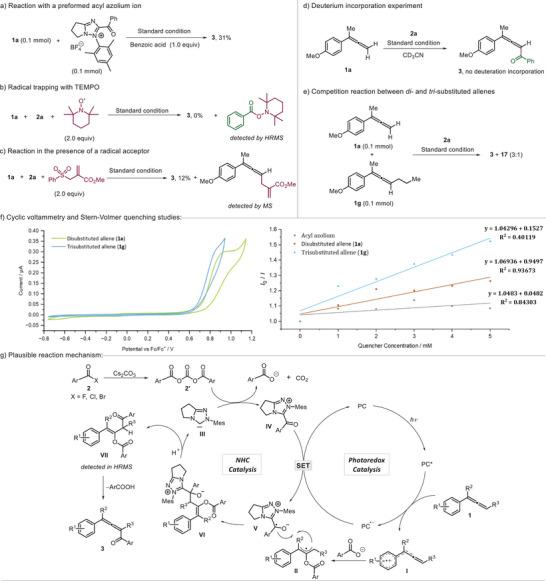
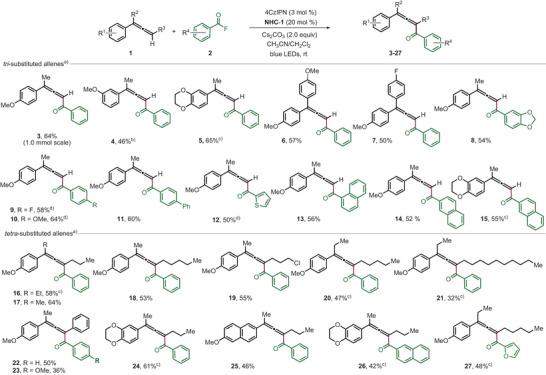
This study demonstrates the use of cooperative photoredox and N-heterocyclic carbene (NHC) catalysis for sp C─H acylation of allenes. The cascade comprises oxidative generation of an allene radical cation from an allene, its nucleophilic trapping to the corresponding allyl radical and highly regioselective cross coupling by a concomitantly reductively generated NHC-derived ketyl type radical. Ionic fragmentation of both the NHC and nucleophile ultimately yields the desired substituted allene. The organic photocatalyst, 4CzIPN, is highly effective in promoting both oxidative and reductive electron transfer steps. Tri- and tetra-substituted allenes can be obtained in good yields through such a cascade. Mechanistic studies-including radical trapping, acylazolium reactions, and Stern-Volmer quenching-support the proposed mechanism. Moreover, follow-up chemistry is conducted to demonstrate the synthetic value of the cascade products.
本研究展示了协同光氧化还原和N-杂环卡宾(NHC)催化用于丙二烯的sp C─H酰化反应。该串联反应包括从丙二烯氧化生成丙二烯自由基阳离子,其亲核捕获生成相应的烯丙基自由基,以及通过同时还原生成的NHC衍生的酮基型自由基进行高度区域选择性交叉偶联。NHC和亲核试剂的离子碎片化最终产生所需的取代丙二烯。有机光催化剂4CzIPN在促进氧化和还原电子转移步骤方面非常有效。通过这种串联反应可以以良好的产率获得三取代和四取代丙二烯。机理研究——包括自由基捕获、酰基唑鎓反应和斯特恩-沃尔默猝灭——支持所提出的机理。此外,还进行了后续化学实验以证明串联产物的合成价值。


 Zotero 插件