
前列腺特异抗原密度(PSA density)与肌层浸润率(MLR)相结合可提高前列腺癌的诊断准确性。
Combination of PSA density and MLR improves the diagnostic accuracy of prostate cancer.
作者信息
Guo Feng, Maolake Aerken, Ni Zecheng, Li Xun, Liu Bide, Tang Zetian, Shi Zhenfeng, Li Jiuzhi
机构信息
Department of Urology, People's Hospital of Xinjiang Uygur Autonomous Region, Xinjiang, China.
Departments of Cancer Genetics, Roswell Park Comprehensive Cancer Center, Buffalo, NY, United States.
出版信息
Front Oncol. 2025 Jul 16;15:1570584. doi: 10.3389/fonc.2025.1570584. eCollection 2025.
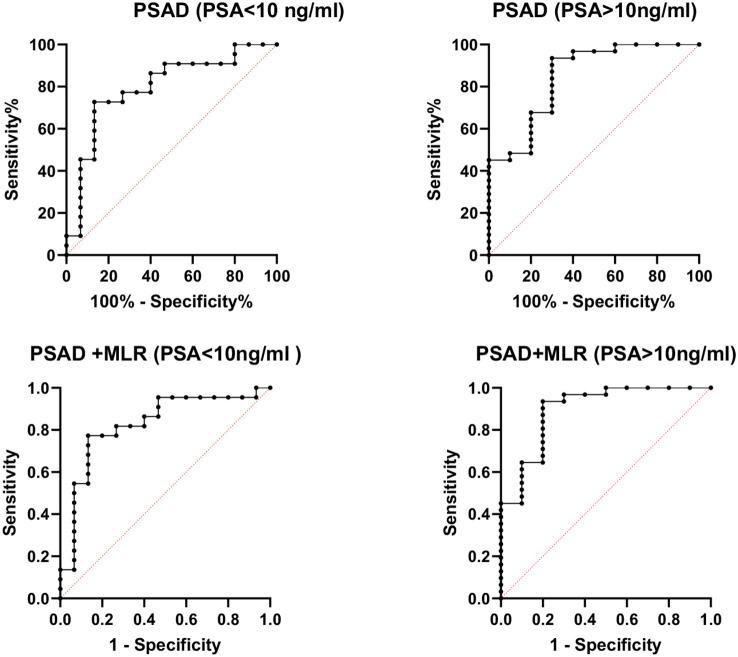
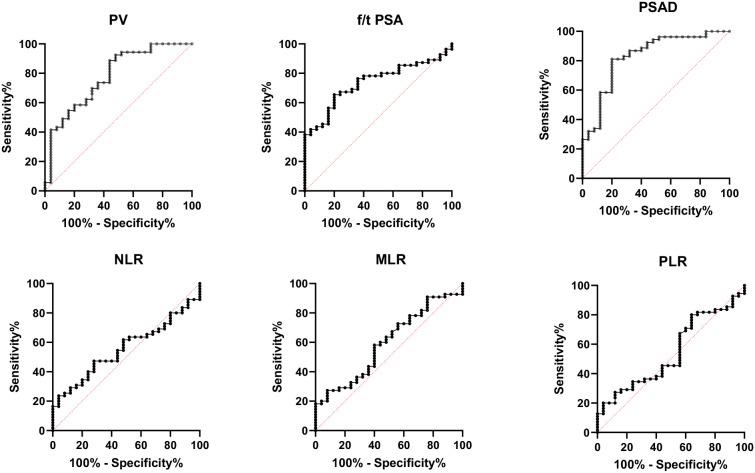
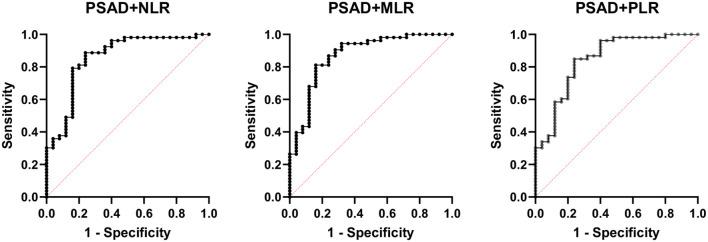
Prostate-specific antigen (PSA) is used to screen for prostate cancer for decades. However, PSA has poor specificity in prostate cancer screening within the 4.0- to 10.0-ng/mL range. This study aimed to develop a new prediction model for PCa in patients with a PSA level of 2.5-20 ng/mL. The clinical data of 80 patients with PSA 4-22 ng/mL from 2016 to 2022 were selected for retrospective analysis. Prostate volume was estimated by suprapubic ultrasonography. PSA and the inflammatory markers like neutrophil-to-lymphocyte ratio (NLR), platelet-to-lymphocyte ratio (PLR), and monocyte-to-lymphocyte ratio (MLR) in peripheral blood were analyyzed to assess their value in PCa. The diagnostic performance of PSA, PSA density (PSAD), and inflammatory markers, respectively, was estimated by ROC curve. The areas under the ROC curve for f/t PSA, PV, PSAD, MLR, NLR, and PLR for predicting PCa in patients with a PSA level of 4.0-22.0 ng/mL were 0.7375, 0.7774, 0.8294, 0.5945, 0.5571, and 0.5437, respectively. The PSAD performed better than f/t PSA and PV in the diagnosis of PCa. The specificity of PSAD was higher than that of f/tPSA when tPSA was in the gray zone (between 4 and 10 ng/mL). The area under the curve (AUC) increased when PSAD was combined with MLR in patients with PSA 4-10 ng/mL and patients with PSA 10-22 ng/mL, and the positive predictive values were 81.81% and 90.91%, respectively ( = 0.0008 and = 0.0002). PSAD has a moderate diagnostic value for PCa detection. The combination of PSAD and MLR could improve the diagnostic accuracy in PCa diagnosis.
几十年来,前列腺特异性抗原(PSA)一直用于前列腺癌的筛查。然而,在4.0至10.0 ng/mL范围内,PSA在前列腺癌筛查中的特异性较差。本研究旨在为PSA水平在2.5至20 ng/mL的患者开发一种新的前列腺癌预测模型。选取2016年至2022年期间80例PSA为4至22 ng/mL患者的临床资料进行回顾性分析。通过耻骨上超声估计前列腺体积。分析外周血中的PSA以及中性粒细胞与淋巴细胞比值(NLR)、血小板与淋巴细胞比值(PLR)和单核细胞与淋巴细胞比值(MLR)等炎症标志物,以评估它们在前列腺癌中的价值。分别通过ROC曲线估计PSA、PSA密度(PSAD)和炎症标志物的诊断性能。对于PSA水平在4.0至22.0 ng/mL的患者,游离/总PSA、前列腺体积(PV)、PSAD、MLR、NLR和PLR预测前列腺癌的ROC曲线下面积分别为0.7375、0.7774、0.8294、0.5945、0.5571和0.5437。在前列腺癌诊断中,PSAD的表现优于游离/总PSA和PV。当总PSA处于灰色区域(4至10 ng/mL之间)时,PSAD的特异性高于游离/总PSA。在PSA为4至10 ng/mL的患者和PSA为10至22 ng/mL的患者中,当PSAD与MLR联合使用时,曲线下面积(AUC)增加,阳性预测值分别为81.81%和90.91%(P = 0.0008和P = 0.0002)。PSAD对前列腺癌检测具有中等诊断价值。PSAD与MLR联合使用可提高前列腺癌诊断的准确性。

 Zotero 插件