
PROMIS-29量表v2.1在挪威康复背景下的测量属性
Measurement properties of the PROMIS-29 profile v2.1 in a Norwegian rehabilitation context.
作者信息
Rimehaug Stein Arne, Moe Rikke Helene, Dagfinrud Hanne, Fischer Felix, Johansen Thomas, Kjeken Ingvild, Klokkerud Mari, Fossmo Hanne Ludt, Lyken Anne Dorte, Kvalheim Tarja Rajalahti, Soldal Silje, Sand-Svartrud Anne-Lene
机构信息
Regional Rehabilitation Knowledge Center (RKR), Sunnaas Hospital, Oslo, Norway.
Health Services Research and Innovation Unit, Center for Treatment of Rheumatic and Musculoskeletal Diseases (REMEDY), Diakonhjemmet Hospital, Oslo, Norway.
出版信息
J Patient Rep Outcomes. 2025 Jul 31;9(1):98. doi: 10.1186/s41687-025-00929-7.
INTRODUCTION
Psychometric properties of the Patient-Reported Outcomes Measurement Information System Profile 29 (PROMIS-29) Norwegian version has previously been examined in a general population. This multicenter study aimed to examine the internal consistency, construct validity, responsiveness, score distribution and floor/ceiling effects of PROMIS-29 v2.1 in a Norwegian rehabilitation context.
METHODS
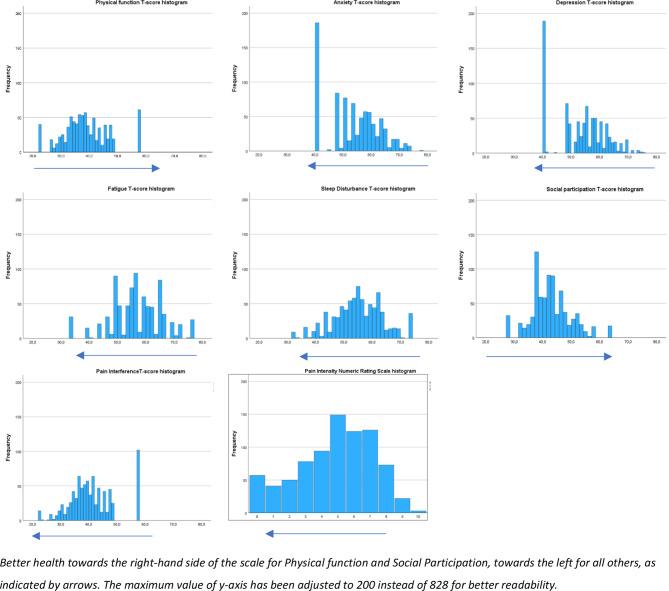
Patients receiving rehabilitation services participating in a longitudinal cohort study answered PROMIS-29 at baseline and at 3-month follow-up. Internal consistency was assessed by Cronbach's alpha and McDonald's omega. Construct validity was examined through hypothesis testing, using EQ-5D-5L as comparator measure. Hypotheses for correlations of change scores for both questionnaires were tested as an expression of responsiveness. Score distribution and floor/ceiling effects were examined with histograms and descriptive statistics.
RESULTS
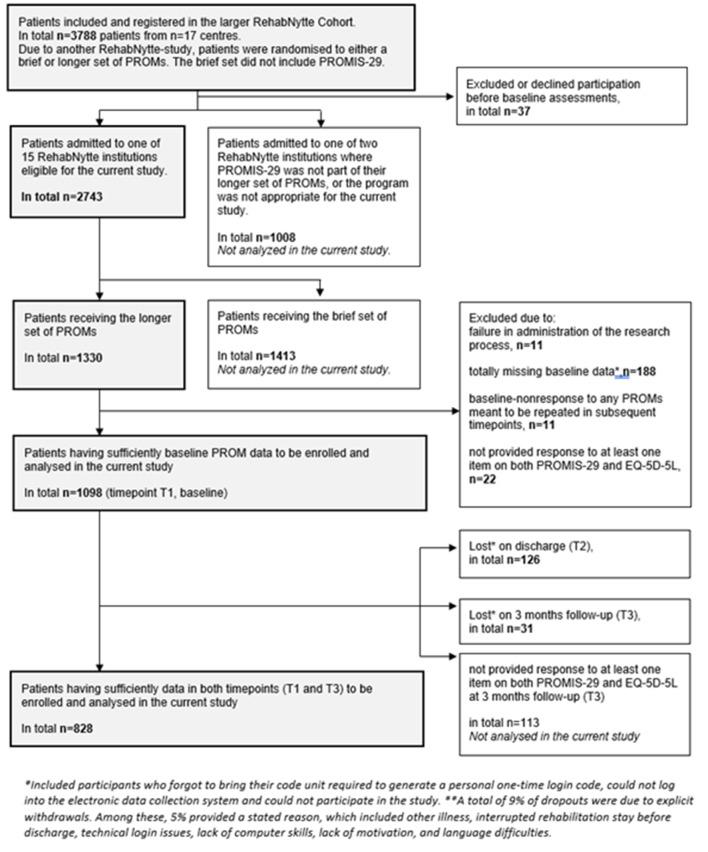
A total of 828 patients with a mean age of 54.3 years were included for analysis. The internal consistency for each PROMIS-29 domain was confirmed, with alpha and omega values exceeding the threshold of ≥ 0.70. Regarding correlations between PROMIS-29 and EQ-5D-5L, 34 out of 40 hypotheses were confirmed for construct validity and 19 out of 24 for responsiveness, both meeting our a priori criterion of ≥ 75% confirmed hypotheses. There was no floor effect of any PROMIS-29 domain in our sample, and ceiling effect only for anxiety and depression domain scores. Still, this confirmed the applicability of PROMIS-29 in a rehabilitation context.
CONCLUSION
The Norwegian PROMIS-29 has sufficient internal consistency, construct validity and responsiveness for use as an outcome measure for health status and health-related quality of life in rehabilitation.
TRIAL REGISTRATION NUMBER
ClinicalTrials.gov NCT03764982 RehabNytte study, registered 2018-12-04.
引言
患者报告结局测量信息系统简表29(PROMIS - 29)挪威语版本的心理测量特性此前已在普通人群中进行过检验。这项多中心研究旨在检验PROMIS - 29 v2.1在挪威康复背景下的内部一致性、结构效度、反应性、分数分布以及地板效应/天花板效应。
方法
参与纵向队列研究的接受康复服务的患者在基线和3个月随访时回答PROMIS - 29问卷。通过克朗巴哈α系数和麦克唐纳ω系数评估内部一致性。使用EQ - 5D - 5L作为对照测量,通过假设检验来检验结构效度。将两份问卷变化分数的相关性假设作为反应性的一种表达进行检验。通过直方图和描述性统计来检查分数分布以及地板效应/天花板效应。
结果
共纳入828名平均年龄为54.3岁的患者进行分析。每个PROMIS - 29领域的内部一致性得到确认,α系数和ω系数值超过≥0.70的阈值。关于PROMIS - 29与EQ - 5D - 5L之间的相关性,40个结构效度假设中有34个得到确认,24个反应性假设中有19个得到确认,两者均符合我们≥75%假设得到确认的先验标准。在我们的样本中,PROMIS - 29的任何领域均无地板效应,仅焦虑和抑郁领域分数有天花板效应。尽管如此,这证实了PROMIS - 29在康复背景下的适用性。
结论
挪威版PROMIS - 29具有足够的内部一致性、结构效度和反应性,可作为康复中健康状况和健康相关生活质量的结局测量指标。
试验注册号
ClinicalTrials.gov NCT03764982 RehabNytte研究,于2018年12月4日注册。
 Zotero 插件