
科学水牛养殖中的知识、态度和实践差距分析。
An analysis of knowledge, attitude and practice gaps in scientific buffalo husbandry.
作者信息
Makarabbi Gururaj, Sabu Aiswarya, Saxena Navneet, Sharma Madan Lal
机构信息
Indian Council of Agricultural Research-Central Institute for Research on Buffaloes (ICAR-CIRB), Hisar, Haryana, India.
出版信息
PLoS One. 2025 Jul 31;20(7):e0327208. doi: 10.1371/journal.pone.0327208. eCollection 2025.
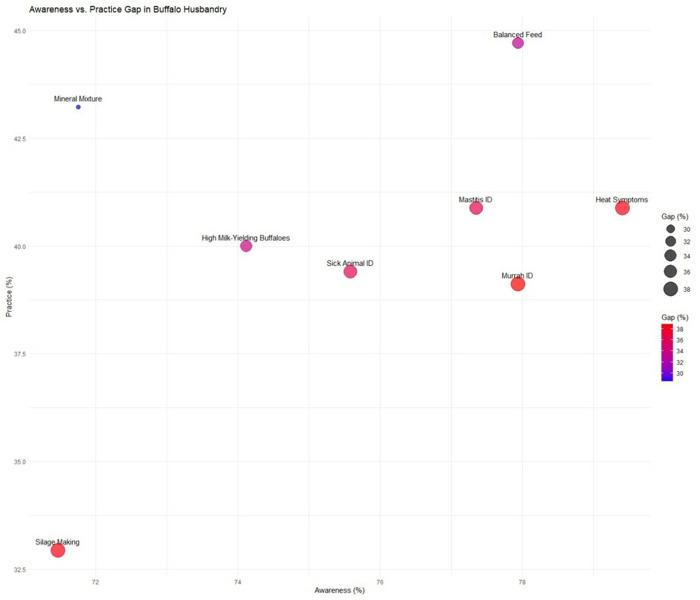
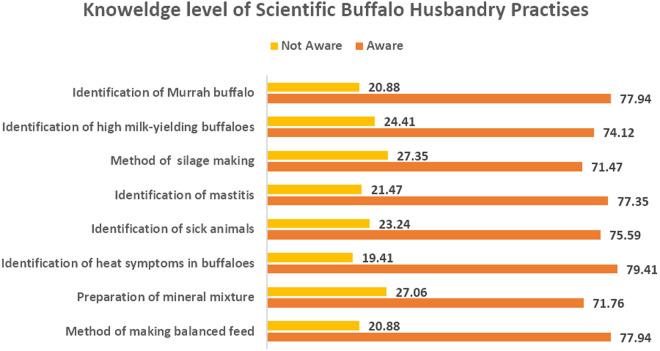
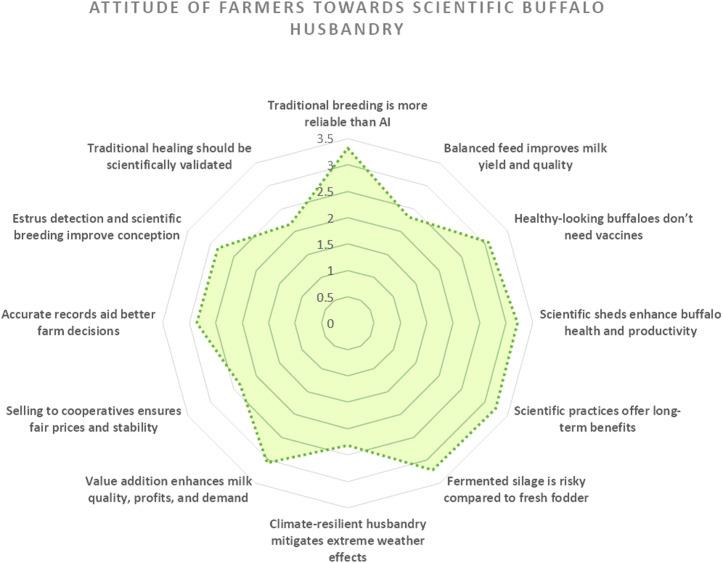
Buffalo husbandry remains vital to India's dairy sector, yet adoption gaps hinder productivity. This study assesses knowledge, attitudes, and practices (KAP) among 380 buffalo farmers in India, revealing critical disparities. While awareness was relatively high in key areas-heat detection (79.4%), mastitis identification (77.4%), and balanced feed (77.9%)-practice rates lagged severely (32.9-44.7%), with the widest gap in silage-making (71.5% awareness vs. 32.9% adoption, a 38.6-point deficit). Cluster analysis identified five farmer segments, highlighting adoption disparities: smallholders (36.8% of the sample) practised only 25% of techniques despite moderate knowledge, while commercial farmers (7.9%) achieved 90.5% adoption. Chi-square tests confirmed education (OR=3.4, p < 0.001) and herd size (OR=2.4, p < 0.01) as the strongest KAP predictors, with logistic regression underscoring income's pivotal role (OR=4.3 for practices). In order to bridge gaps, the study proposes three strategies: (1) targeted training for smallholders through farmer groups, (2) subsidized input bundles (feed, minerals) paired with mobile-based advisories, and (3) market incentives for quality milk to reward adoption. Findings stress the need to replace blanket extension approaches with segmented interventions addressing structural barriers (credit, vet access) and attitudinal resistance (silage scepticism, vaccine hesitancy). Policy action should prioritize doubling frontline extension staff and integrating cooperatives with digital tools to scale solutions.
水牛养殖对印度乳制品行业仍然至关重要,但采用差距阻碍了生产力。本研究评估了印度380名水牛养殖户的知识、态度和实践(KAP),揭示了关键差异。虽然在关键领域的认知度相对较高——发情检测(79.4%)、乳腺炎识别(77.4%)和平衡饲料(77.9%)——但实践率严重滞后(32.9%-44.7%),青贮制作方面的差距最大(认知度71.5%,采用率32.9%,相差38.6个百分点)。聚类分析确定了五个养殖户群体,突出了采用差距:小农户(占样本的36.8%)尽管有一定知识,但仅采用了25%的技术,而商业养殖户(7.9%)的采用率达到了90.5%。卡方检验证实教育程度(OR=3.4,p<0.001)和畜群规模(OR=2.4,p<0.01)是最强的KAP预测因素,逻辑回归强调收入的关键作用(实践方面的OR=4.3)。为了弥合差距,该研究提出了三项策略:(1)通过农户群体对小农户进行有针对性的培训;(2)补贴投入包(饲料、矿物质)并配以基于移动设备的咨询服务;(3)对优质牛奶给予市场激励以奖励采用行为。研究结果强调需要用针对结构性障碍(信贷、兽医服务获取)和态度阻力(对青贮的怀疑、对疫苗的犹豫)的分段干预措施取代一刀切的推广方法。政策行动应优先将一线推广人员增加一倍,并将合作社与数字工具整合以扩大解决方案的规模。
 Zotero 插件