
HLA-A2-WT1 CD3双特异性抗体RO7283420在复发/难治性急性髓系白血病中的剂量递增研究。
Dose escalation study of the HLA-A2-WT1 CD3 bispecific antibody RO7283420 in relapsed/refractory acute myeloid leukemia.
作者信息
Hutchings Martin, Korfi Koorosh, Montesinos Pau, Santoro Armando, Hou Hsin-An, Martinez-Sanchez Pilar, Vives Susana, Galimberti Sara, Chen Tsai-Yun, Frigeni Marco, Garciaz Sylvain, Salamero Garcia Olga, Yeh Su-Peng, Yee Karen, Esteve Jordi, Bajel Ashish, Fleming Shaun, Bretz Anne Catherine, Attig Jan, Sun Min, Nassiri Sina, Rutishauser Tobias, Klein Christian, Ma Y May, Schnetzler Gabriel, Vauleon Stephanie, Yu Huixin, Barata Teresa, Richard Muriel, Simon Silke, Hinton Heather, Keshelava Nino, Subklewe Marion
机构信息
Department of Hematology and Phase 1 Unit, Rigshospitalet, University of Copenhagen, Copenhagen, Denmark.
Department of Clinical Medicine, University of Copenhagen, Copenhagen, Denmark.
出版信息
Blood Neoplasia. 2025 May 11;2(3):100110. doi: 10.1016/j.bneo.2025.100110. eCollection 2025 Aug.
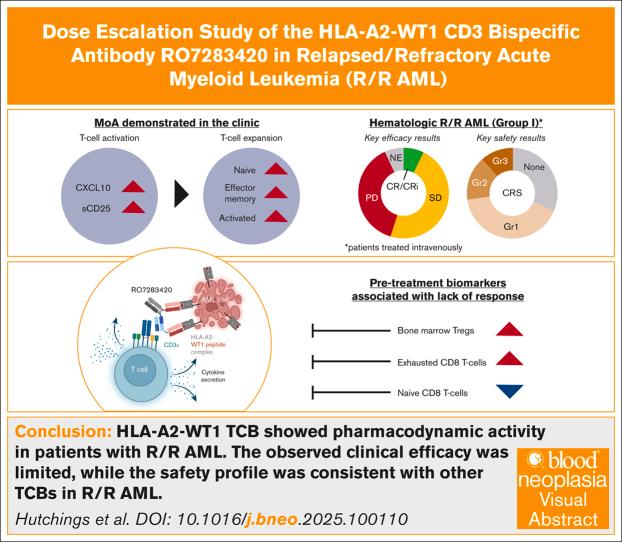
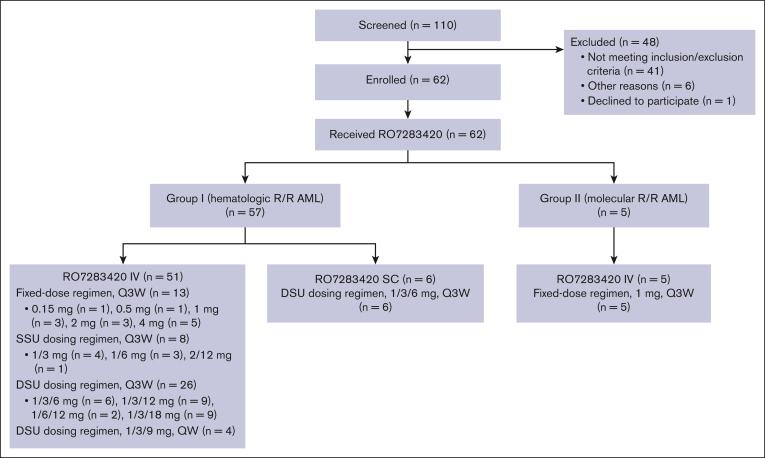
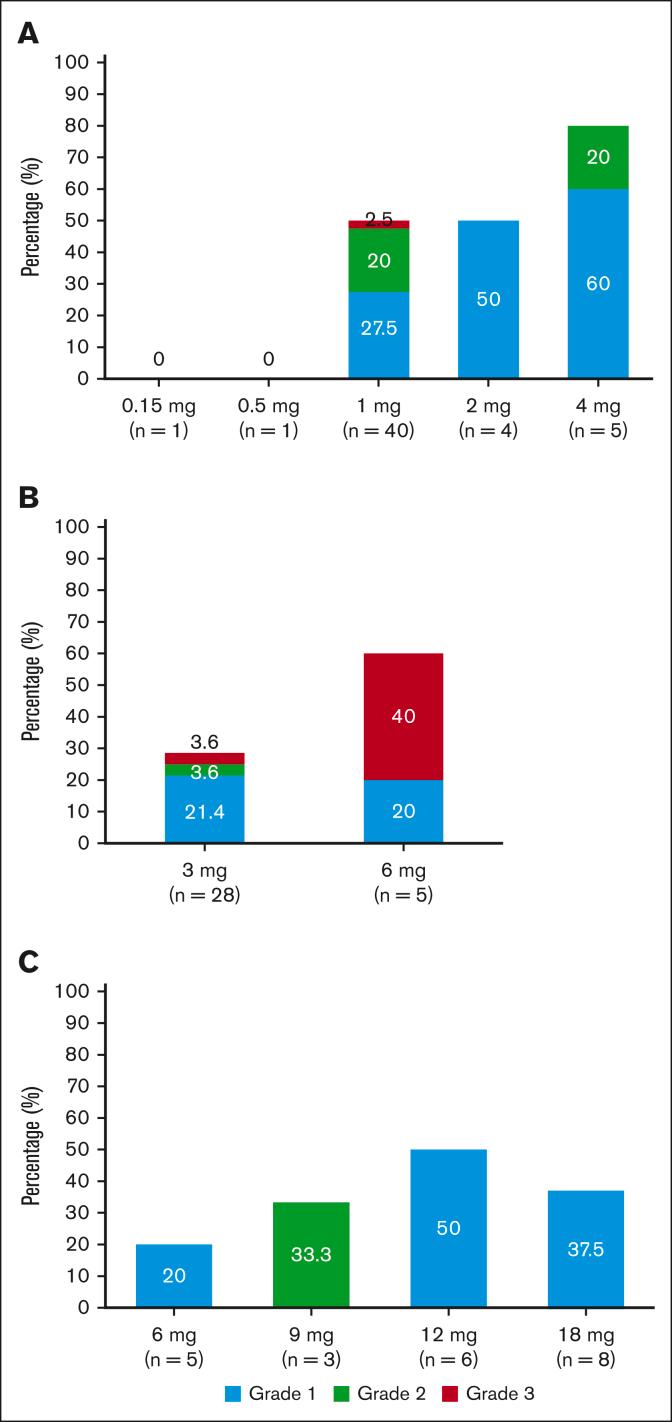
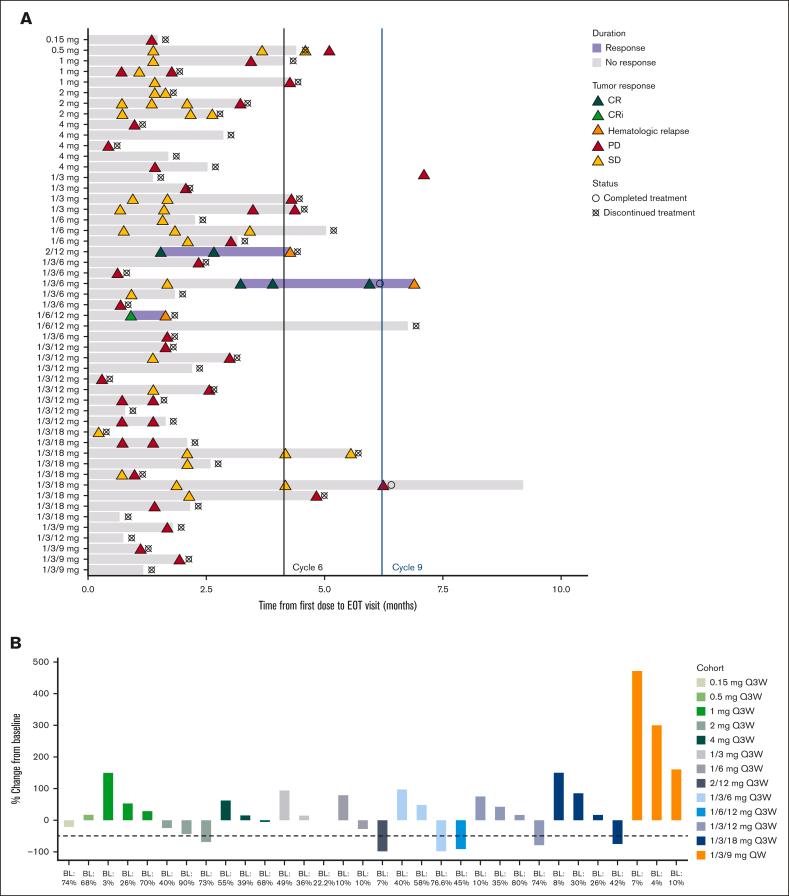
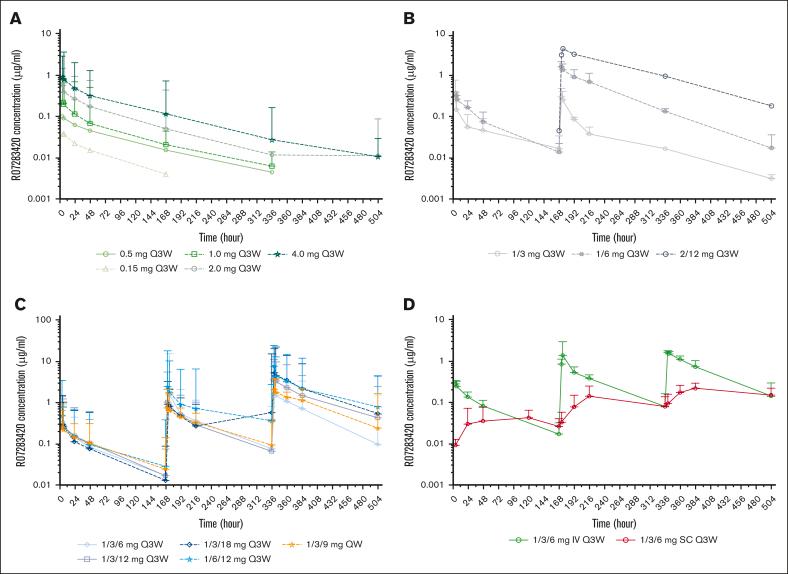
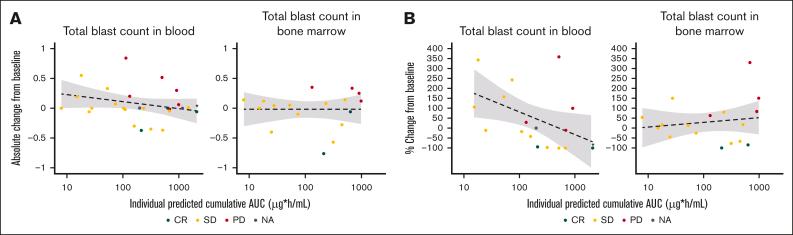
A novel T-cell bispecific antibody (TCB), RO7283420, engaging CD3 and the HLA-A2-Wilms tumor protein 1 complex, was evaluated in this phase 1 study to characterize safety and tolerability, determine the maximum tolerated dose (MTD), and recommend a phase 2 dose for patients with relapsed/refractory acute myeloid leukemia in 2 groups: hematologic (group I, n = 57) and molecular (group 2, n = 5) relapse. In group I, 51 received RO7283420 intravenously (IV) and 6 subcutaneously. The IV doses ranged from 0.15-4 mg (flat; n = 13), 3-18 mg (step-up; n = 34) every 3 weeks, or 9 mg weekly (step-up; n = 4). The MTD was 1/3/12 mg every 3 weeks. The most frequent adverse event in the overall population was cytokine release syndrome (61.3%) with grade ≥3 recorded in 9.7% of patients. Twelve dose-limiting toxicities were reported in 11 patients and 12 (19.4%) grade 5 adverse events, including 1 hemophagocytic lymphohistiocytosis case related to RO7283420. Among the 42 efficacy-evaluable IV patients in group I, 4.8% achieved complete remission (CR), and 2.4% achieved CR with incomplete hematologic recovery. RO7283420 induced pharmacodynamic changes in peripheral blood (PB) at doses ≥1 mg, including significant T-cell activation and expansion in the PB and bone marrow (BM). Significant associations were found between blast reduction and baseline immunophenotype, including lower regulatory T cells and higher non-exhausted CD8 T cells in BM. Although dose escalation was discontinued because of limited efficacy and lack of an exposure-BM response relationship, the observed pharmacodynamics underscore the promising potential of this class of TCBs targeting intracellular antigens. This trial was registered at www.clinicaltrials.gov as #NCT04580121.
在这项1期研究中,对一种新型T细胞双特异性抗体(TCB)RO7283420进行了评估,该抗体可结合CD3和HLA - A2 - 威尔姆斯肿瘤蛋白1复合物,以确定其安全性和耐受性,确定最大耐受剂量(MTD),并为复发/难治性急性髓系白血病患者推荐2期剂量,分为两组:血液学复发组(I组,n = 57)和分子复发组(2组,n = 5)。在I组中,51例接受静脉注射(IV)RO7283420,6例接受皮下注射。静脉注射剂量范围为每3周0.15 - 4 mg(固定剂量;n = 13)、3 - 18 mg(剂量递增;n = 34)或每周9 mg(剂量递增;n = 4)。MTD为每3周1/3/12 mg。总体人群中最常见的不良事件是细胞因子释放综合征(61.3%),9.7%的患者记录为≥3级。11例患者报告了12例剂量限制性毒性,12例(19.4%)5级不良事件,包括1例与RO7283420相关的噬血细胞性淋巴组织细胞增生症病例。在I组42例可评估疗效的静脉注射患者中,4.8%达到完全缓解(CR),2.4%达到伴有血液学不完全恢复的CR。RO7283420在剂量≥1 mg时可诱导外周血(PB)中的药效学变化,包括PB和骨髓(BM)中显著的T细胞活化和扩增。在原始细胞减少与基线免疫表型之间发现了显著关联,包括BM中较低的调节性T细胞和较高的未耗竭CD8 T细胞。尽管由于疗效有限和缺乏暴露 - BM反应关系而停止了剂量递增,但观察到的药效学强调了这类靶向细胞内抗原的TCB的潜在前景。该试验已在www.clinicaltrials.gov上注册,编号为#NCT04580121。


 Zotero 插件