
膀胱癌患者行尿液改道后肾功能改善以符合顺铂治疗条件。
Kidney function improvement after urinary diversion for cisplatin eligibility in bladder cancer patients.
作者信息
Korkes Fernando, Santiago José Henrique DallAcqua, Pinto André Marantes Masciarelli, Farias Artur da Silva, Timóteo Frederico, Martins Suelen Patricia Dos Santos, Glina Sidney
机构信息
Division of Urology, Centro Universitario FMABC, Santo Andre, São Paulo 09060-650, Brazil.
出版信息
Bladder (San Franc). 2025 Mar 3;12(1):e21200027. doi: 10.14440/bladder.2024.0034. eCollection 2025.
BACKGROUND
Muscle-invasive bladder cancer (MIBC) is an aggressive disease typically treated with radical cystectomy following neoadjuvant chemotherapy (NAC). However, the presence of hydronephrosis - a significant marker of advanced disease - can impair renal function, potentially precluding patients from receiving cisplatin-based NAC.
OBJECTIVE
The present study aimed to assess the role of urinary diversion in patients with MIBC, specifically in reversing renal function impairment and enabling eligibility for cisplatin-based therapy.
METHODS
A retrospective study was performed by evaluating a database of patients treated for urothelial MIBC from 2018 to 2021. Case notes were reviewed to identify patients with hydronephrosis who underwent urinary diversion. The types of urinary diversion recorded included percutaneous nephrostomy, ureteral stenting, or surgical obstruction release. Renal function was assessed retrospectively using the glomerular filtration rate (GFR), estimated from creatinine clearance.
RESULTS
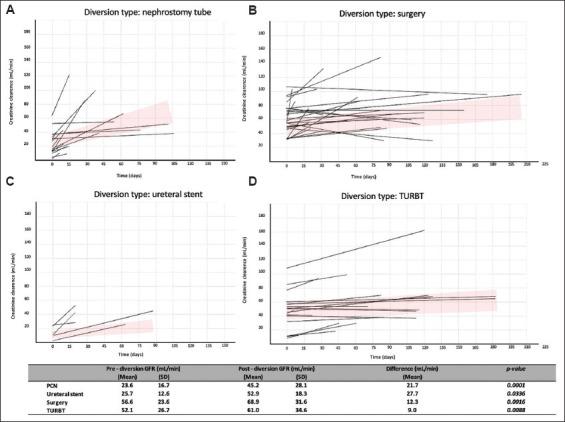
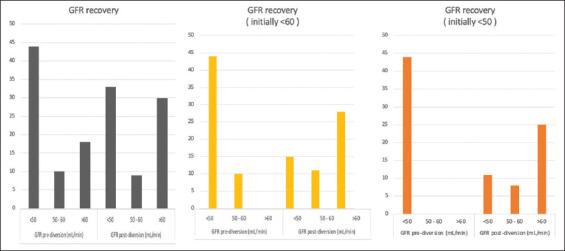
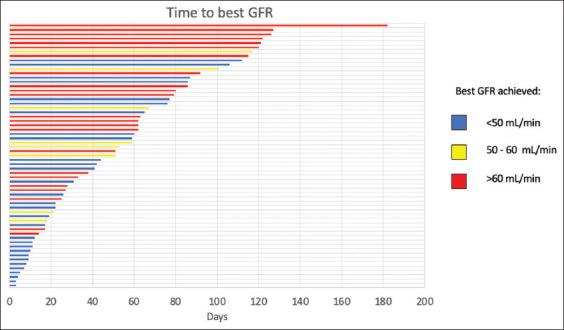
Records of a total of 72 patients were evaluated. The mean GFR before urinary diversion was 44.1 ± 26.4 mL/min, which improved to 59.1 ± 31.9 mL/min post-diversion, resulting in a mean GFR improvement of 15.0 ± 20.0 mL/min. Forty-four patients had an initial GFR below 50 mL/min, with 75% of them achieving a GFR >50 mL/min after urinary diversion. More than half of these patients ( = 25, 56%) experienced an improvement to a GFR exceeding 60 mL/min. The time to reach the best GFR varied widely (mean: 59 ± 33 days, range 9 - 165 days). Logistic regression analysis identified initial GFR as a significant predictor of GFR recovery (odds ratio = 1.11, 95% confidence interval = 1.02 - 1.21, = 0.012).
CONCLUSION
Urinary diversion can benefit patients with upper tract obstruction secondary to MIBC by improving renal function, thereby enabling eligibility for cisplatin-based chemotherapy. Notably, the time to GFR recovery following urinary diversion varied among individuals.
背景
肌层浸润性膀胱癌(MIBC)是一种侵袭性疾病,通常在新辅助化疗(NAC)后进行根治性膀胱切除术。然而,肾积水(晚期疾病的一个重要标志)的存在会损害肾功能,可能使患者无法接受基于顺铂的NAC。
目的
本研究旨在评估尿流改道在MIBC患者中的作用,特别是在逆转肾功能损害以及使患者有资格接受基于顺铂的治疗方面的作用。
方法
通过评估2018年至2021年接受尿路上皮MIBC治疗的患者数据库进行了一项回顾性研究。查阅病例记录以确定接受尿流改道的肾积水患者。记录的尿流改道类型包括经皮肾造瘘术、输尿管支架置入术或手术解除梗阻。使用根据肌酐清除率估算的肾小球滤过率(GFR)对肾功能进行回顾性评估。
结果
共评估了72例患者的记录。尿流改道前的平均GFR为44.1±26.4 mL/分钟,改道后提高到59.1±31.9 mL/分钟,平均GFR提高了15.0±20.0 mL/分钟。44例患者的初始GFR低于50 mL/分钟,其中75%的患者在尿流改道后GFR>50 mL/分钟。这些患者中超过一半(n = 25,56%)的GFR提高到超过60 mL/分钟。达到最佳GFR的时间差异很大(平均:59±33天,范围9 - 165天)。逻辑回归分析确定初始GFR是GFR恢复的重要预测因素(优势比 = 1.11,95%置信区间 = 1.02 - 1.21,P = 0.012)。
结论
尿流改道可通过改善肾功能使继发于MIBC的上尿路梗阻患者受益,从而使患者有资格接受基于顺铂的化疗。值得注意的是,尿流改道后GFR恢复的时间因人而异。


 Zotero 插件