
血清脂肪甘油三酯脂肪酶水平降低与2型糖尿病患者肾功能损害相关。
Decreased Serum Adipose Triglyceride Lipase Level Is Associated With Renal Function Impairment in Patients With Type 2 Diabetes.
作者信息
Wang Ying, Liu Tongtong, Li Nan, Zhao Tingting, Wu Xiai, Wang Yanmei, Dong Xi, Zhao Hailing, Liu Weijing, Li Ping
机构信息
Institute of Medical Science, China-Japan Friendship Hospital, Beijing, China.
Key Laboratory of Chinese Internal Medicine of Ministry of Education and Beijing, Dongzhimen Hospital Affiliated to Beijing University of Chinese Medicine, Beijing, China.
出版信息
J Diabetes Res. 2025 Jul 24;2025:9987648. doi: 10.1155/jdr/9987648. eCollection 2025.
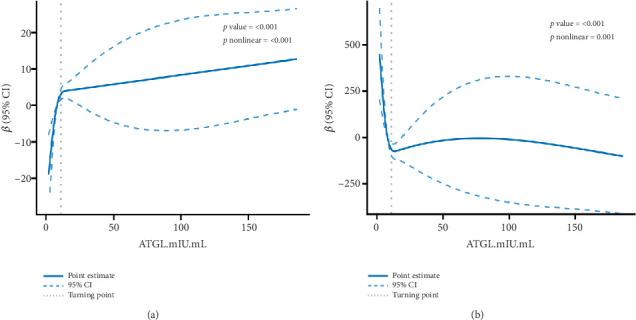
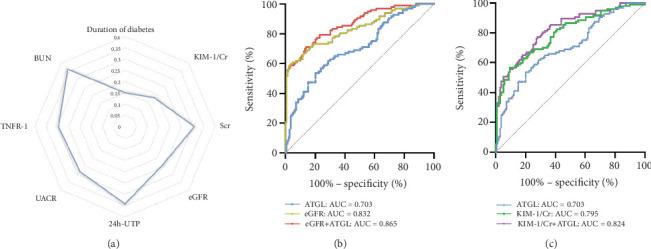
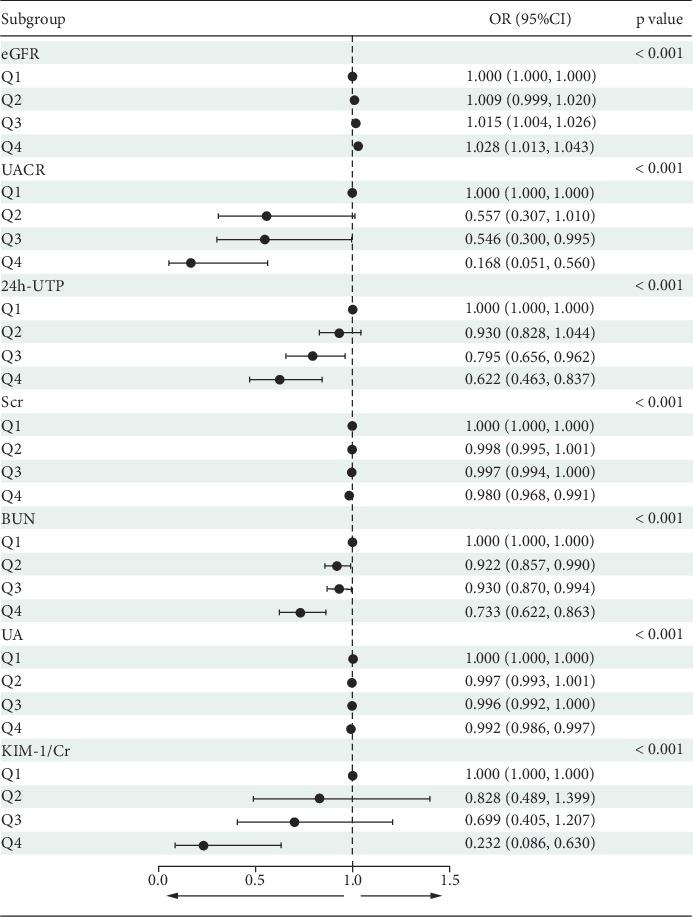
Diagnosing diabetic kidney disease (DKD) remains a significant challenge. Research has increasingly focused on kidney injury resulting from lipid metabolism disorders. Adipose triglyceride lipase (ATGL), a pivotal enzyme in lipolysis, is essential for maintaining lipid metabolism balance. The objective of this study was to assess whether serum ATGL could serve as an early biomarker for DKD. The study divided 236 participants into four groups: healthy controls ( = 59), Type 2 diabetes mellitus (T2DM) with albumin-to-creatinine ratio (ACR) < 30 mg/g ( = 80), microalbuminuria (L-DKD) with ACR 30-300 mg/g ( = 41), and macroalbuminuria (H-DKD) with ACR ≥ 300 mg/g ( = 56). Relevant clinical data were collected, and serum levels of ATGL, kidney injury molecule-1 (KIM-1), and tumor necrosis factor-1 (TNFR-1) were measured. Various statistical analyses, including Spearman's correlation test, receiver operating characteristic curve analysis, multivariate logistic regression, and restricted cubic spline (RCS), were employed to assess the relationship between serum ATGL levels and renal function impairment in DKD. Serum ATGL levels were notably lower in the T2DM, L-DKD, and H-DKD groups compared to healthy controls. Positive correlations were found between serum ATGL levels and estimated glomerular filtration rates (eGFR), while negative correlations were observed with diabetes duration, hypertension history, hyperlipidemia, urine ACR (UACR), 24-h urine total protein (UTP), serum creatinine (SCr), blood urea nitrogen, uric acid, TNFR-1, and KIM-1/creatinine (KIM-1/Cr) levels ( < 0.05). The receiver operating characteristic curve analysis demonstrated that the diagnostic performance of ATGL, when combined with traditional clinical markers, can enhance sensitivity. When participants were grouped by serum ATGL quartiles, it was observed that higher ATGL levels corresponded with lower UACR, 24 h-UTP, SCr, and TNFR-1 levels and higher eGFR. The odds ratios for elevated UACR and 24 h-UTP decreased, and eGFR increased with higher ATGL quartiles. Both univariate and multivariate logistic regression analyses indicated that serum ATGL is a protective factor against DKD development, even after adjusting for potential confounders. RCS analysis indicated a nonlinear dose-response association between serum ATGL levels and renal function metrics, specifically UACR and eGFR, in patients with DKD. Serum ATGL levels are linked to reduced renal function in T2DM patients. A decline in ATGL levels corresponded with a nonlinear rise in UACR and a drop in eGFR, suggesting that serum ATGL may serve as a potential biomarker for DKD development.
诊断糖尿病肾病(DKD)仍然是一项重大挑战。研究越来越多地聚焦于脂质代谢紊乱导致的肾损伤。脂肪甘油三酯脂肪酶(ATGL)是脂肪分解中的一种关键酶,对于维持脂质代谢平衡至关重要。本研究的目的是评估血清ATGL是否可作为DKD的早期生物标志物。该研究将236名参与者分为四组:健康对照组(n = 59)、2型糖尿病(T2DM)且白蛋白与肌酐比值(ACR)<30mg/g的患者(n = 80)、ACR为30 - 300mg/g的微量白蛋白尿患者(L - DKD,n = 41)以及ACR≥300mg/g的大量白蛋白尿患者(H - DKD,n = 56)。收集了相关临床数据,并测量了血清ATGL、肾损伤分子 - 1(KIM - 1)和肿瘤坏死因子 - 1(TNFR - 1)的水平。采用了各种统计分析方法,包括Spearman相关性检验、受试者工作特征曲线分析、多因素逻辑回归和限制性立方样条(RCS)分析,以评估血清ATGL水平与DKD患者肾功能损害之间的关系。与健康对照组相比,T2DM、L - DKD和H - DKD组的血清ATGL水平显著降低。血清ATGL水平与估计肾小球滤过率(eGFR)呈正相关,而与糖尿病病程、高血压病史、高脂血症、尿ACR(UACR)、24小时尿总蛋白(UTP)、血清肌酐(SCr)、血尿素氮、尿酸、TNFR - 1以及KIM - 1/肌酐(KIM - 1/Cr)水平呈负相关(P<0.05)。受试者工作特征曲线分析表明,ATGL与传统临床标志物联合使用时,诊断性能可提高敏感性。当按血清ATGL四分位数对参与者进行分组时,观察到ATGL水平越高,UACR、24小时UTP、SCr和TNFR - 1水平越低,eGFR越高。UACR和24小时UTP升高的比值比降低,eGFR随ATGL四分位数升高而增加。单因素和多因素逻辑回归分析均表明,即使在调整潜在混杂因素后,血清ATGL仍是预防DKD发生的保护因素。RCS分析表明,在DKD患者中,血清ATGL水平与肾功能指标(特别是UACR和eGFR)之间存在非线性剂量反应关系。血清ATGL水平与T2DM患者肾功能降低有关。ATGL水平下降与UACR非线性升高和eGFR下降相对应,表明血清ATGL可能是DKD发生的潜在生物标志物。


 Zotero 插件