
噬菌体vB_AbaSt_W16对耐碳青霉烯类细菌的药代动力学、治疗效果及免疫反应
pharmacokinetics, therapeutic efficacy and immune response of bacteriophage vB_AbaSt_W16 against carbapenem-resistant .
作者信息
Choi Yoon-Jung, Shamsuzzaman Md, Lee Jae-Eon, Jeon Yong Hyun, Kim Hyungjin, Yoon Young-Ran, Rana Md Shohel, Shin Joohun, Kim Shukho, Kim Jungmin
机构信息
Untreatable Infectious Disease Institute, Kyungpook National University, Daegu, Republic of Korea.
Department of Microbiology, School of Medicine, Kyungpook National University, Daegu, Republic of Korea.
出版信息
JAC Antimicrob Resist. 2025 Jul 31;7(4):dlaf121. doi: 10.1093/jacamr/dlaf121. eCollection 2025 Aug.
BACKGROUND
The increasing prevalence of carbapenem-resistant (CRAB) infections necessitates alternative therapeutic strategies. Bacteriophage therapy has emerged as a promising approach, yet its clinical implementation is hindered by limited pharmacokinetic (PK) and pharmacodynamic (PD) data.
METHODS
The PK and PD properties of phage vB_AbaSt_W16 were evaluated in a murine model. Systemic distribution, clearance kinetics and efficacy were assessed following oral (PO) and intraperitoneal (IP) administration. Conventional PK/PD analysis and real-time fluorescence imaging were used to examine phage dynamics.
RESULTS
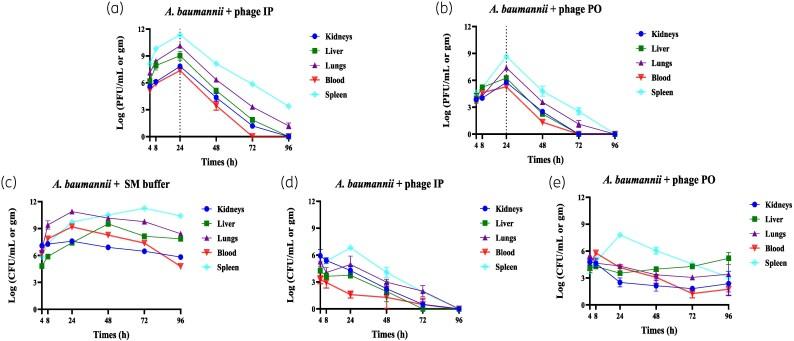
After administration, vB_AbaSt_W16 rapidly disseminated systemically within 1 h, reaching peak concentrations at 8 h. Most tissues cleared the phage within 72 h, though residual amounts persisted in the spleen for up to 92 h. In a murine infection model, vB_AbaSt_W16 demonstrated potent antibacterial activity, reducing CRAB bacterial loads by 4-7 log₁₀ cfu/mL within 24 h. Compared with PO administration, IP administration resulted in higher systemic bioavailability and bacterial clearance. Fluorescence imaging enabled non-invasive, real-time monitoring of phage distribution, demonstrating its utility as a PK assessment tool. Notably, phage treatment did not trigger significant pro-inflammatory cytokine release (TNF-α, IL-6) in healthy mice and effectively reduced CRAB-induced inflammation.
CONCLUSIONS
These findings highlight the therapeutic potential of vB_AbaSt_W16 and provide critical insights into its PK behaviour. The results support further clinical development of this phage for CRAB infections.
背景
耐碳青霉烯类鲍曼不动杆菌(CRAB)感染的患病率不断上升,因此需要替代治疗策略。噬菌体疗法已成为一种有前景的方法,但其临床应用受到有限的药代动力学(PK)和药效学(PD)数据的阻碍。
方法
在小鼠模型中评估噬菌体vB_AbaSt_W16的PK和PD特性。口服(PO)和腹腔注射(IP)后评估全身分布、清除动力学和疗效。使用传统的PK/PD分析和实时荧光成像来检查噬菌体动态。
结果
给药后,vB_AbaSt_W16在1小时内迅速全身扩散,在8小时达到峰值浓度。大多数组织在72小时内清除噬菌体,尽管脾脏中残留量可持续长达92小时。在小鼠感染模型中,vB_AbaSt_W16表现出强大的抗菌活性,在24小时内将CRAB细菌载量降低4-7 log₁₀ cfu/mL。与PO给药相比,IP给药导致更高的全身生物利用度和细菌清除率。荧光成像能够对噬菌体分布进行非侵入性实时监测,证明其作为PK评估工具的效用。值得注意的是,噬菌体治疗在健康小鼠中未引发显著的促炎细胞因子释放(TNF-α、IL-6),并有效减轻了CRAB诱导的炎症。
结论
这些发现突出了vB_AbaSt_W16的治疗潜力,并为其PK行为提供了关键见解。结果支持该噬菌体用于CRAB感染的进一步临床开发。



 Zotero 插件