
NeuroFANN:利用功能注释神经网络通过血浆蛋白鉴定痴呆症的神经病理学亚型。
NeuroFANN: identification of neuropathological subtypes in dementia with plasma proteins by using functionally annotated neural network.
作者信息
Park Sunghong, Kim Doyoon, Choi Ji-Hye, Hong Chang Hyung, Son Sang Joon, Roh Hyun Woong, Shin Hyunjung, Woo Hyun Goo
机构信息
Department of Physiology, Ajou University School of Medicine, Worldcup-ro 164, Yeongtong-gu, Suwon, 16499, Republic of Korea.
Department of Psychiatry, Ajou University School of Medicine, Worldcup-ro 164, Yeongtong-gu, Suwon, 16499, Republic of Korea.
出版信息
Brief Bioinform. 2025 Jul 2;26(4). doi: 10.1093/bib/bbaf366.
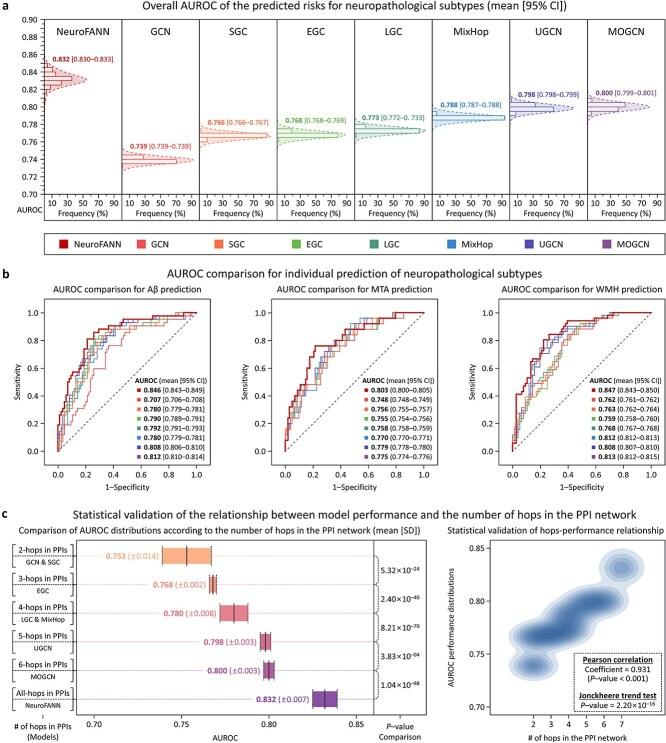
Dementia diagnosis relies on identifying neuropathological features, such as beta-amyloid (Aβ) deposition, medial temporal lobe atrophy (MTA), and white matter hyperintensity (WMH). Recently, plasma protein biomarkers have emerged as a cost-effective and less invasive tool for identifying neuropathological features, enhanced by machine learning (ML) for precise diagnosis. However, most ML studies fail to account for protein-protein interactions (PPIs) and synergetic effects between proteins, overlooking their collective contributions to disease mechanisms. Additionally, the lack of consideration for functional properties may result in the redundant and imbalanced representation of proteins and their functions, potentially limiting the effectiveness of dementia diagnosis. In this study, we propose NeuroFANN, a method designed to classify three neuropathological subtypes in dementia-positivity for Aβ, MTA, and WMH-using plasma protein biomarkers. A key feature of NeuroFANN is the combination of the PPI network-based synergetic effects with the functional annotation-based protein biomarker clustering. NeuroFANN extracts synergetic effects by propagating independent effects of proteins across the PPI network, which are then aggregated in functional protein clusters, thereby enabling global PPI awareness and capturing the biological properties of protein biomarkers. From a South Korean cohort, 54 proteins were identified as plasma protein biomarkers for dementia subtypes and grouped into 16 clusters. NeuroFANN outperformed comparison methods in classifying dementia subtypes, with its core components validated as key contributors to superior performance. Additionally, the risk scores predicted by NeuroFANN showed a strong association with longitudinal cognitive decline, demonstrating its potential as a valuable diagnostic tool in clinical settings.
痴呆症的诊断依赖于识别神经病理学特征,如β-淀粉样蛋白(Aβ)沉积、内侧颞叶萎缩(MTA)和白质高信号(WMH)。最近,血浆蛋白生物标志物已成为一种经济高效且侵入性较小的用于识别神经病理学特征的工具,并通过机器学习(ML)得到增强以实现精确诊断。然而,大多数ML研究未能考虑蛋白质-蛋白质相互作用(PPI)以及蛋白质之间的协同效应,从而忽略了它们对疾病机制的共同贡献。此外,缺乏对功能特性的考虑可能导致蛋白质及其功能的冗余和不平衡表示,这可能会限制痴呆症诊断的有效性。在本研究中,我们提出了NeuroFANN,这是一种旨在使用血浆蛋白生物标志物对痴呆症阳性患者中的三种神经病理学亚型(Aβ、MTA和WMH)进行分类的方法。NeuroFANN的一个关键特征是基于PPI网络的协同效应与基于功能注释的蛋白质生物标志物聚类相结合。NeuroFANN通过在PPI网络中传播蛋白质的独立效应来提取协同效应,然后将这些效应聚集在功能性蛋白质簇中,从而实现对全局PPI的认知并捕捉蛋白质生物标志物的生物学特性。从一个韩国队列中,54种蛋白质被鉴定为痴呆症亚型的血浆蛋白生物标志物,并被分为16个簇。NeuroFANN在痴呆症亚型分类方面优于比较方法,其核心组件被验证为卓越性能的关键贡献因素。此外,NeuroFANN预测的风险评分与纵向认知衰退显示出强烈关联,证明了其在临床环境中作为有价值诊断工具的潜力。

 Zotero 插件