
美国国立癌症研究所指定癌症中心的癌症负担差异与当前资金状况
Differences in the Cancer Burden and Current Funding of NCI-Designated Cancer Centers.
作者信息
Burus Todd, McAfee Caree R, Hull Pamela C
机构信息
Markey Cancer Center, University of Kentucky, Lexington.
Department of Behavioral Science, College of Medicine, University of Kentucky, Lexington.
出版信息
JAMA Netw Open. 2025 Aug 1;8(8):e2524564. doi: 10.1001/jamanetworkopen.2025.24564.
IMPORTANCE
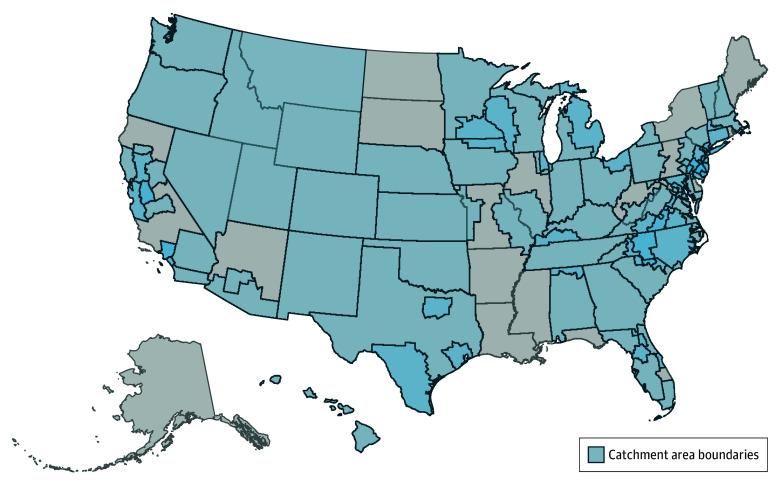
National Cancer Institute (NCI)-designated clinical and comprehensive cancer centers are required to define a geographic catchment area (CA) in which they focus research, outreach, and engagement efforts for the purposes of reducing cancer burden, particularly among certain vulnerable populations. A comprehensive analysis of the cancer burden of these catchment areas and their association with cancer center funding through the Cancer Center Support Grant (CCSG) has not been performed.
OBJECTIVE
To examine CA cancer burden indicators and cancer center CCSG funding during the 2023 federal fiscal year (FY23).
DESIGN, SETTING, AND PARTICIPANTS: This population-based cross-sectional study assessed cancer center cancer rates, sociodemographic variables, and reported CCSG funding. Participants included NCI-Designated Clinical and Comprehensive Cancer Centers as of FY23. Data were analyzed from August to December 2024.
EXPOSURES
Race and ethnicity, socioeconomic status, disability status, urbanicity.
MAIN OUTCOMES AND MEASURES
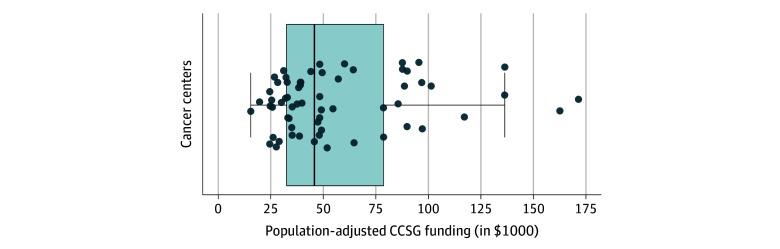
Main outcomes included CA cancer rates with 95% CI and various population percentage estimates, as well as cancer center CCSG direct costs for FY23. Adjusted CCSG funding by CA population size was also assessed. The association between cancer burden indicators and population-adjusted CCSG funding was estimated using Spearman rank correlation.
RESULTS
This study included 64 NCI-Designated Cancer Centers (11 clinical [17.2%], 53 comprehensive [82.8%]) with CAs covering 297 040 253 people. Individual CA populations ranged from 1.4 million to 29.9 million people, with substantial variation in sociodemographic compositions. CA cancer incidence ranged from 369.2 (95% CI, 367.5 to 370.8) to 518.7 (95% CI, 514.2 to 523.2) cases per 100 000 persons. Cancer mortality ranged from 115.2 (95% CI, 114.3 to 116.1) to 181.1 (95% CI, 179.5 to 182.7) deaths per 100 000 persons. Population-adjusted CCSG funding showed no association with cancer rates, but was positively associated with rural populations (r = 0.356; 95% CI, 0.119 to 0.555) and persons living with a disability (r = 0.378; 95% CI, 0.143 to 0.572) and negatively associated with populations belonging to a racial or ethnic minority group (r = -0.354; 95% CI, -0.553 to -0.116).
CONCLUSIONS AND RELEVANCE
In this cross-sectional study of NCI-Designated Cancer Centers, there were substantial disparities in cancer burden across catchment areas. CCSG funding did not align well with this distribution, raising questions about whether funding allocations effectively support cancer centers serving high-need CAs. In addition to existing criteria, consideration of CA cancer burden and vulnerable populations in determining CCSG funding amounts could enhance efforts to reduce cancer burden and disparities.
重要性
美国国立癌症研究所(NCI)指定的临床和综合癌症中心需要确定一个地理服务区域(CA),在该区域内,它们集中开展研究、推广和参与工作,以减轻癌症负担,尤其是在某些弱势群体中。尚未对这些服务区域的癌症负担及其通过癌症中心支持拨款(CCSG)与癌症中心资金的关联进行全面分析。
目的
研究2023财年(FY23)期间服务区域的癌症负担指标和癌症中心的CCSG资金情况。
设计、设置和参与者:这项基于人群的横断面研究评估了癌症中心的癌症发病率、社会人口统计学变量以及报告的CCSG资金。参与者包括截至FY23的NCI指定临床和综合癌症中心。数据于2024年8月至12月进行分析。
暴露因素
种族和民族、社会经济地位、残疾状况、城市化程度。
主要结局和测量指标
主要结局包括95%置信区间的服务区域癌症发病率和各种人群百分比估计值,以及FY23的癌症中心CCSG直接成本。还评估了按服务区域人口规模调整后的CCSG资金。使用Spearman等级相关性估计癌症负担指标与人口调整后的CCSG资金之间的关联。
结果
本研究纳入了64个NCI指定癌症中心(11个临床中心[17.2%],53个综合中心[82.8%]),其服务区域覆盖297040253人。各个服务区域的人口从140万到2990万不等,社会人口统计学构成差异很大。服务区域癌症发病率为每10万人369.2例(95%置信区间,367.5至370.8)至518.7例(95%置信区间,514.2至523.2)。癌症死亡率为每10万人115.2例(95%置信区间,114.3至116.1)至181.1例(95%置信区间,179.5至182.7)。人口调整后的CCSG资金与癌症发病率无关联,但与农村人口呈正相关(r = 0.356;95%置信区间,0.119至0.555),与残疾人士呈正相关(r = 0.378;95%置信区间,0.143至0.572),与种族或少数民族群体呈负相关(r = -0.354;95%置信区间,-0.553至-0.116)。
结论和意义
在这项对NCI指定癌症中心的横断面研究中,各服务区域的癌症负担存在显著差异。CCSG资金与这种分布情况不太相符,这引发了关于资金分配是否有效支持服务于高需求服务区域的癌症中心的疑问。除现有标准外,在确定CCSG资金数额时考虑服务区域癌症负担和弱势群体,可能会加强减轻癌症负担和差异的努力。


 Zotero 插件