
死亡是作为一种特定的分子进程发生的,而不是非特异性的生理崩溃。
Dying occurs as a defined molecular progression in rather than as nonspecific physiological collapse.
作者信息
Scott Andrew W, Wodrich Andrew P K, Chaouhan Hitesh S, Shukla Arvind K, Johnson Kory, McQueen Philip G, Giniger Edward
机构信息
National Institutes of Health, National Institute of Neurological Disorders and Stroke, Bethesda, MD 20892, USA.
Interdisciplinary Program in Neuroscience, Georgetown University, Washington, DC 20057, USA.
出版信息
iScience. 2025 Jul 14;28(8):113115. doi: 10.1016/j.isci.2025.113115. eCollection 2025 Aug 15.
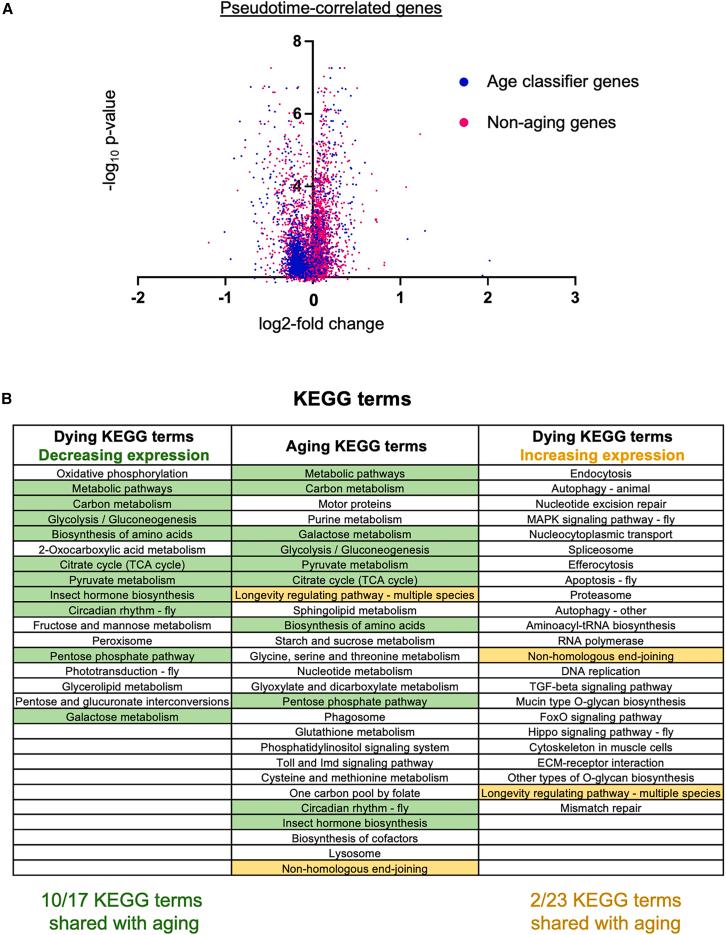
While we know much about aging, dying remains mysterious. Here, we show that old-age death in is an orderly process that follows, but is distinguishable from, aging itself. We apply pseudotime trajectory analysis to transcriptomic data from individual flies as they approach death. This uncovers a reproducible progression of molecular events that accompany dying, as revealed by systematic changes in gene expression, including both continuation of some processes of early- and mid-life aging, but also activation of processes that are not associated with aging but instead define progression toward death. Finally, we reanalyze an existing dataset and find that many processes we observe in dying flies also vary among dying worms, suggesting that features of dying have been maintained across 600 Myr of evolution. These data challenge the idea that dying is simply a collapse of physiology that is the inherent conclusion to the dysfunctions of aging.
虽然我们对衰老了解颇多,但死亡仍然神秘莫测。在此,我们表明,果蝇的老年死亡是一个有序的过程,它紧跟衰老过程,但又与衰老本身有所区别。我们将伪时间轨迹分析应用于个体果蝇临近死亡时的转录组数据。这揭示了伴随死亡的分子事件的可重复进展,正如基因表达的系统性变化所显示的那样,其中包括一些早期和中年衰老过程的延续,同时也有与衰老无关但却定义了走向死亡进程的过程的激活。最后,我们重新分析了一个现有的数据集,发现我们在濒死果蝇中观察到的许多过程在濒死线虫中也存在差异,这表明死亡特征在6亿年的进化过程中得以保留。这些数据挑战了这样一种观点,即死亡仅仅是生理机能的崩溃,是衰老功能失调的必然结果。



 Zotero 插件