
解读骨髓微环境在多发性骨髓瘤免疫治疗耐药中的作用
Deciphering the bone marrow microenvironment's role in multiple myeloma immunotherapy resistance.
作者信息
Iannozzi Nicolas Thomas, Giuliani Nicola, Storti Paola
机构信息
Department of Medicine and Surgery, University of Parma, Parma, Italy.
Hematology, Azienda Ospedaliero-Universitaria di Parma, Parma, Italy.
出版信息
Front Immunol. 2025 Jul 18;16:1613265. doi: 10.3389/fimmu.2025.1613265. eCollection 2025.
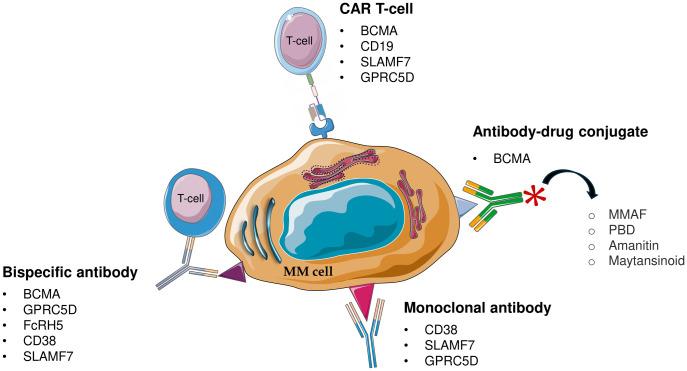
Multiple Myeloma (MM) is a malignant monoclonal gammopathy characterized by the proliferation of plasma cells (PC) in the bone marrow (BM). The tight cross-talk between the BM microenvironment and PC is the hallmark of MM. The BM microenvironment comprises a cellular compartment, consisting of hematopoietic and non-hematopoietic cells. The first includes myeloid cells, T- and B-lymphocytes, natural killer (NK) cells, macrophages, and osteoclasts (OCs). In contrast, non-hematopoietic cell types include BM-derived mesenchymal stromal cells (MSCs), osteoblasts, adipocytes and endothelial cells. Besides the cellular compartment, there is a non-cellular compartment that includes extracellular matrix, growth factors, chemokines, and several cytokines. All these members play distinctive but interacting roles in the progression of MM and the drug response. MM remains an incurable disease, but in the last years immunotherapy has emerged as an important tool in the treatment of MM. The involvement of the BM microenvironment is a relevant barrier in the response to immunotherapy and in generating resistance. In this review, we provide an overview of the BM microenvironment perturbation in MM patients and how it can determine the possible resistance to immunotherapy, including monoclonal antibodies (mAbs), antibody-drug conjugates, chimeric antigen receptor T-cell (CAR-T), and bispecific T-cell engagers (BsAbs).
多发性骨髓瘤(MM)是一种恶性单克隆丙种球蛋白病,其特征是骨髓(BM)中的浆细胞(PC)增殖。BM微环境与PC之间紧密的相互作用是MM的标志。BM微环境由一个细胞区室组成,该细胞区室由造血细胞和非造血细胞组成。前者包括髓样细胞、T淋巴细胞和B淋巴细胞、自然杀伤(NK)细胞、巨噬细胞和破骨细胞(OC)。相比之下,非造血细胞类型包括BM来源的间充质基质细胞(MSC)、成骨细胞、脂肪细胞和内皮细胞。除了细胞区室,还有一个非细胞区室,包括细胞外基质、生长因子、趋化因子和几种细胞因子。所有这些成分在MM的进展和药物反应中发挥着独特但相互作用的作用。MM仍然是一种无法治愈的疾病,但在过去几年中,免疫疗法已成为治疗MM的重要工具。BM微环境的参与是免疫疗法反应和产生耐药性的一个相关障碍。在本综述中,我们概述了MM患者中BM微环境的扰动以及它如何决定对免疫疗法的可能耐药性,包括单克隆抗体(mAb)、抗体药物偶联物、嵌合抗原受体T细胞(CAR-T)和双特异性T细胞衔接器(BsAb)。

 Zotero 插件