
用于预测精神分裂症30天非计划再入院风险的机器学习与可解释性研究:一项回顾性研究
Machine Learning and Interpretability Study for Predicting 30-Day Unplanned Readmission Risk of Schizophrenia: A Retrospective Study.
作者信息
Tan Yuting, Chen Guiling, Wang Shuge, Zhan Xingxin, Cheng Rong, Qiao Linru, Zhang Zhixia, Liu Yaping
机构信息
Department of Nursing, Tianyou Hospital Affiliated to Wuhan University of Science and Technology, Wuhan, Hubei, People's Republic of China.
Institute of Nursing Research, Hubei Province Key Laboratory of Occupational Hazard Identification and Control, School of Medicine,Wuhan University of Science and Technology, Wuhan, Hubei, People's Republic of China.
出版信息
Neuropsychiatr Dis Treat. 2025 Jul 28;21:1509-1521. doi: 10.2147/NDT.S522675. eCollection 2025.
PURPOSE
To build a 30-day unplanned readmission (UPR) risk prediction model based on machine learning (ML) and SHapley Additive exPlanation (SHAP) with data obtained from the electronic medical records (EMRs) of patients with schizophrenia, so as to provide support for early intervention in clinical treatment.
PATIENTS AND METHODS
This retrospective study selected 1,123 patients with schizophrenia who were hospitalized at least once from January 1, 2021 to June 30, 2024 according to their EMRs. Models were constructed after screening variables using the multiple linear regression and feature importance methods. The model was constructed using five ML algorithms: logistic regression (LR), decision tree (DT), random forest (RF), support vector machine (SVM), and extreme gradient boosting (XGB). The area under the receiver operating characteristic curve (AUC) and SHAP were applied to verify the predictive power and interpretability, respectively, of the five models.
RESULTS
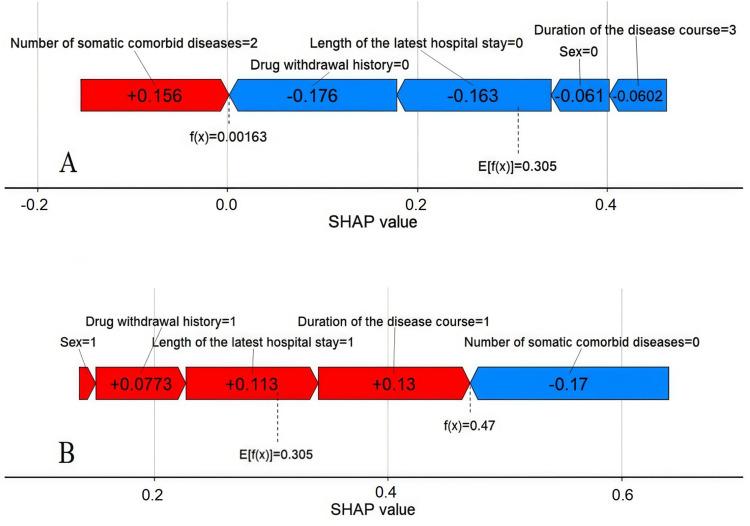
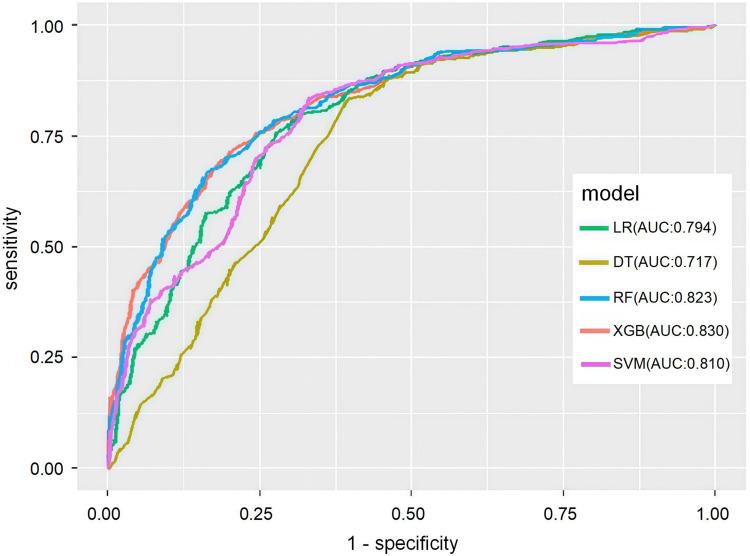
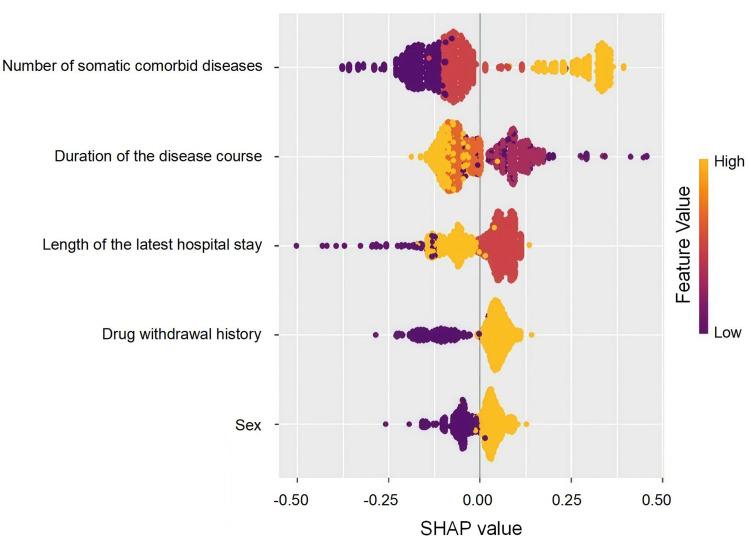
The 30-day UPR rate was 30.54% (343/1,123). The important risk factors were number of somatic comorbid diseases, duration of the disease course, length of the latest hospital stay, drug withdrawal history, and sex. The AUC values of the LR, DT, RF, XGB, and SVM models for predicting the 30-day UPR in the testing set were 0.794, 0.717, 0.823, 0.830, and 0.810, respectively.
CONCLUSION
An XGB risk prediction model can accurately evaluate the 30-day UPR of patients with schizophrenia. Combined with SHAP, it can provide patients with personalized risk predictions, thereby assisting medical staff in achieving early discharge plans and transitional care.
目的
基于机器学习(ML)和夏普利值加法解释(SHAP),利用精神分裂症患者电子病历(EMR)数据构建30天非计划再入院(UPR)风险预测模型,为临床治疗中的早期干预提供支持。
患者与方法
本回顾性研究根据电子病历,选取了2021年1月1日至2024年6月30日期间至少住院一次的1123例精神分裂症患者。使用多元线性回归和特征重要性方法筛选变量后构建模型。采用逻辑回归(LR)、决策树(DT)、随机森林(RF)、支持向量机(SVM)和极端梯度提升(XGB)五种机器学习算法构建模型。分别应用受试者操作特征曲线下面积(AUC)和SHAP来验证五个模型的预测能力和可解释性。
结果
30天UPR率为30.54%(343/1123)。重要危险因素包括躯体合并症数量、病程时长、最近一次住院时间、停药史和性别。测试集中LR、DT、RF、XGB和SVM模型预测30天UPR的AUC值分别为0.794、0.717、0.823、0.830和0.810。
结论
XGB风险预测模型可准确评估精神分裂症患者的30天UPR。结合SHAP可为患者提供个性化风险预测,从而协助医护人员制定早期出院计划和过渡性护理。

 Zotero 插件