
丛枝菌根真菌的协同效益:可持续植物防御系统的发展
Synergistic benefits of AMF: development of sustainable plant defense system.
作者信息
Boyno Gökhan, Rezaee Danesh Younes, Çevik Rojbin, Teniz Necmettin, Demir Semra, Demirer Durak Emre, Farda Beatrice, Mignini Amedeo, Djebaili Rihab, Pellegrini Marika, Porcel Rosa, Mulet José M
机构信息
Department of Plant Protection, Faculty of Agriculture, Van Yuzuncu Yil University, Van, Türkiye.
Department of Agricultural Biotechnology, Faculty of Agriculture, Van Yuzuncu Yil University, Van, Türkiye.
出版信息
Front Microbiol. 2025 Jul 21;16:1551956. doi: 10.3389/fmicb.2025.1551956. eCollection 2025.
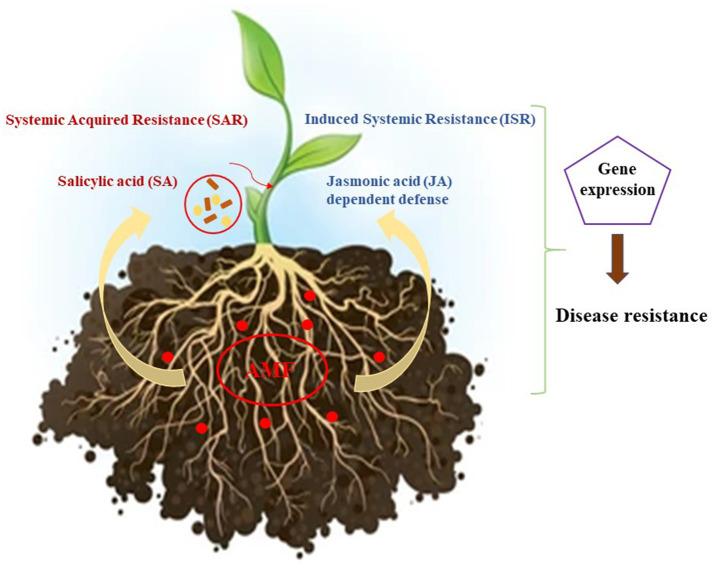
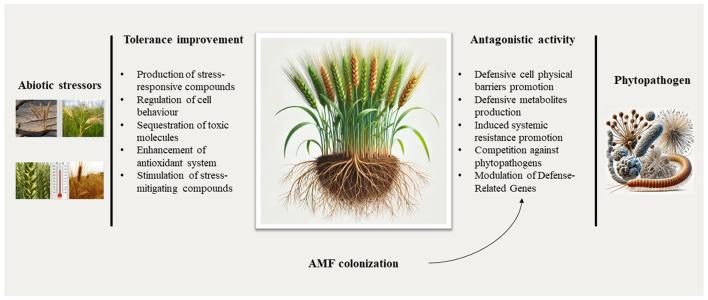
Arbuscular mycorrhizal fungi (AMF) are a ubiquitous group of soil microorganisms that form symbiotic relationships with the roots of over 80% of terrestrial plant species. These beneficial fungi are crucial in plant growth, nutrition enhancement, and abiotic and biotic stress resilience. This review explores the AMF synergistic benefits including their capacity to interact with plant roots system to enhance nutrient absorption, improve stress resilience, and confer disease resistance, and their potential applications in sustainable agriculture. The Review integrates recent insights illustrating the molecular processes responsible for improving plant defense mechanisms by AMF, including the modulation of signaling pathways. It highlights the importance of AMF-induced systemic resistance in enhanced abiotic and biotic stress resistance. Moreover, the article provides an integrative perspective on applying AMF toward sustainable plant protection. Within this context, we discussed how these fungi improve plant performance, including enhanced nutrient acquisition, increased tolerance to environmental stressors, and enhanced protection against pathogens by improving plant resistance to biotic stress through the activation of the plant immune system. We also examine the ecological significance of AMF in maintaining soil health and fertility and highlight the importance of incorporating their management into sustainable agricultural practices. Future research directions and innovative applications are also presented. The literature survey demonstrated these fungi's versatility in improving plant tolerance to several biotic and abiotic stresses. At the scientific level, these abilities are supported by several open-field experiments on different plant species. Available commercial formulations and positive ongoing research of AMF, in combination with other sustainable tools, highlight the solid research outline on these beneficial fungi.
丛枝菌根真菌(AMF)是一类广泛存在的土壤微生物,与超过80%的陆生植物物种的根系形成共生关系。这些有益真菌对植物生长、营养增强以及非生物和生物胁迫抗性至关重要。本综述探讨了AMF的协同效益,包括它们与植物根系系统相互作用以增强养分吸收、提高胁迫抗性和赋予抗病性的能力,以及它们在可持续农业中的潜在应用。该综述整合了近期的见解,阐述了AMF改善植物防御机制的分子过程,包括信号通路的调节。它强调了AMF诱导的系统抗性在增强非生物和生物胁迫抗性方面的重要性。此外,本文提供了一个关于应用AMF实现可持续植物保护的综合观点。在此背景下,我们讨论了这些真菌如何改善植物性能,包括增强养分获取、提高对环境胁迫的耐受性,以及通过激活植物免疫系统提高植物对生物胁迫的抗性来增强对病原体的保护。我们还研究了AMF在维持土壤健康和肥力方面的生态意义,并强调将其管理纳入可持续农业实践的重要性。还提出了未来的研究方向和创新应用。文献调查表明这些真菌在提高植物对多种生物和非生物胁迫的耐受性方面具有多功能性。在科学层面,这些能力得到了针对不同植物物种的多个田间试验的支持。AMF现有的商业制剂和正在进行的积极研究,与其他可持续工具相结合,突出了对这些有益真菌的坚实研究轮廓。
 Zotero 插件