
肠道微生物群为心理心脏病学疾病提供的新型治疗机会。
Novel opportunity of treatment for psycho-cardiologic disease by gut microbiome.
作者信息
Lai Yurui, Fang Chenli, Jiang Yuang, Yang Chengying, Zhou Qiao, Cai Yihua, Wei Yan, Fan Xinrong
机构信息
Department of Cardiology, The Affiliated Hospital, Southwest Medical University, Luzhou, Sichuan, China.
Key Laboratory of Medical Electrophysiology, Ministry of Education & Medical Electrophysiological Key Laboratory of Sichuan Province, (Collaborative Innovation Center for Prevention of Cardiovascular Diseases), Institute of Cardiovascular Research, Southwest Medical University, Luzhou, Sichuan, China.
出版信息
Front Cardiovasc Med. 2025 Jul 22;12:1604962. doi: 10.3389/fcvm.2025.1604962. eCollection 2025.
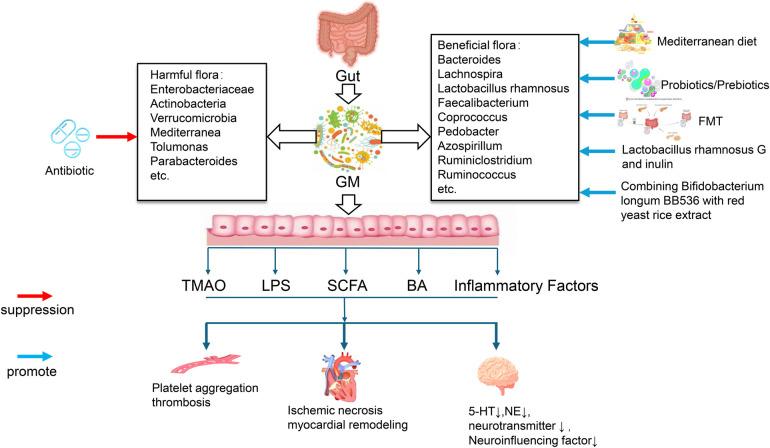
Cardiovascular disease (CVD) patients combined with depression, anxiety, and other psychiatric disorders are becoming a common occurrence. There are many comorbid mechanisms, and CVD patients with psychiatric disorders have poor prognosis. Several studies have shown that dysbiosis and metabolite alterations in the gut were major risk factors for CVD and psychosomatic disorders. This review aims to summarize the mechanisms of gut microbiota and its metabolites in psycho-cardiologic disease, and the therapeutic effects of gut microbiota interventions. It is very useful to propose a new direction for the treatment of psycho-cardiologic disease.
心血管疾病(CVD)患者合并抑郁症、焦虑症和其他精神障碍的情况日益常见。存在多种共病机制,患有精神障碍的CVD患者预后较差。多项研究表明,肠道微生物群失调和代谢物改变是CVD和心身疾病的主要危险因素。本综述旨在总结肠道微生物群及其代谢物在心理心脏病学疾病中的作用机制,以及肠道微生物群干预的治疗效果。这对于为心理心脏病学疾病的治疗提出新方向非常有用。
 Zotero 插件