
植被、盐度和潮汐驱动红树林质膜体中的氮循环。
Vegetation, salinity, and tides drive nitrogen cycling in Mangrove plastispheres.
作者信息
Li Huan-Qin, Wang Wen-Lei, Shen Ying-Jia, Su Jian-Qiang
机构信息
Xiamen Key Laboratory of Marine Biomedicine Resources, Xiamen Medical College, Xiamen, 361023, China.
State Key Laboratory for Ecological Security of Regions and Cities, Institute of Urban Environment, Chinese Academy of Sciences, 1799 Jimei Road, Xiamen, 361021, China.
出版信息
Sci Rep. 2025 Aug 6;15(1):28792. doi: 10.1038/s41598-025-13149-2.
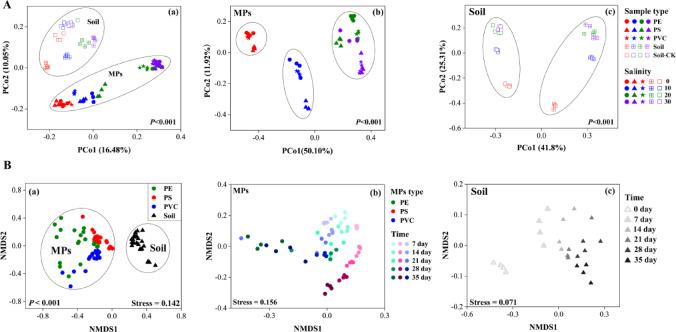
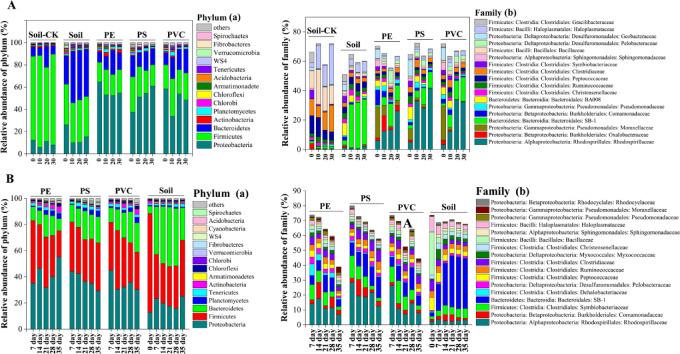
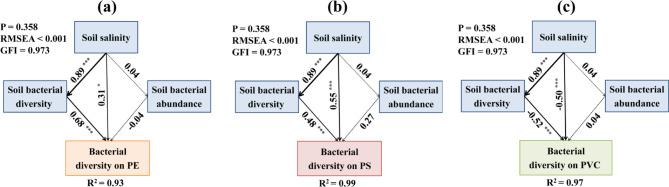
Microplastics (MPs) are emerging pollutants in mangrove ecosystems, with significant implications for microbial communities and nitrogen (N) cycling. However, the ecological processes shaping MP-associated microbial assemblages across environmental gradients remain poorly understood. Here, we conducted in situ and microcosm experiments to investigate microbial community composition and N-cycling gene abundance on three MP types-polyethylene (PE), polystyrene (PS), and polyvinyl chloride (PVC)-across salinity gradients (0-30 ppt) and under simulated tidal fluctuations over 35 days. High-throughput sequencing revealed distinct microbial communities on MPs compared to surrounding soils, dominated by Proteobacteria, Firmicutes, and Bacteroidetes. Bacterial diversity in PE and PS peaked at moderate salinity (10 ppt), while PVC-associated diversity declined with salinity. Structural equation modeling showed that salinity directly and indirectly influenced MP-associated diversity via soil microbial communities. During tidal cycling, microbial diversity on MPs increased over time, contrasting with declining diversity in soils. PS biofilms exhibited the fastest community turnover (R² = 0.79). MPs harbored significantly higher abundances of 15 N-cycling genes (except hao) than soils (P < 0.05), with PS and PE supporting the highest gene levels under salinity gradients and tidal exposure. Denitrification and nitrification gene abundances peaked at intermediate salinity (20 ppt) and day 14 of tidal simulation, respectively. These findings demonstrate that MP type, vegetation, salinity, and hydrological dynamics jointly regulate plastisphere development and microbial N cycling, highlighting the multifaceted ecological impacts of MPs in mangrove ecosystems.
微塑料(MPs)是红树林生态系统中新兴的污染物,对微生物群落和氮(N)循环具有重大影响。然而,目前对跨环境梯度塑造与MP相关的微生物群落的生态过程仍知之甚少。在此,我们进行了原位和微观实验,以研究在盐度梯度(0-30 ppt)下以及在35天的模拟潮汐波动条件下,三种MP类型——聚乙烯(PE)、聚苯乙烯(PS)和聚氯乙烯(PVC)上的微生物群落组成和N循环基因丰度。高通量测序显示,与周围土壤相比,MPs上存在独特的微生物群落,主要由变形菌门、厚壁菌门和拟杆菌门主导。PE和PS中的细菌多样性在中等盐度(10 ppt)时达到峰值,而与PVC相关的多样性则随盐度下降。结构方程模型表明,盐度通过土壤微生物群落直接和间接地影响与MP相关的多样性。在潮汐循环期间,MPs上的微生物多样性随时间增加,这与土壤中多样性下降形成对比。PS生物膜表现出最快的群落周转(R² = 0.79)。MPs中15种N循环基因(除hao外)的丰度显著高于土壤(P < 0.05),在盐度梯度和潮汐暴露条件下,PS和PE支持最高的基因水平。反硝化和硝化基因丰度分别在中等盐度(20 ppt)和潮汐模拟的第14天达到峰值。这些发现表明,MP类型、植被、盐度和水文动态共同调节塑料球的发育和微生物N循环,突出了MPs在红树林生态系统中的多方面生态影响。


 Zotero 插件