
扑克牌/麻将与老年人全因死亡率的关联:一项队列研究。
Association of playing cards/mahjong with all-cause mortality in older adults: a cohort study.
作者信息
Dai Miao, Jie Wei, Shi Jianbang, Zhao Weiyun, Zou Jinbing, Li Ying, Wang Xiang
机构信息
Department of Geriatrics and Jiujiang City, Key Laboratory of Cell Therapy, Jiujiang NO. 1 People's Hospital, Jiujiang, Jiangxi, 332000, China.
Chronic Disease Management Center, Jiujiang NO.1 People's Hospital, Jiujiang, Jiangxi, 332000, China.
出版信息
BMC Geriatr. 2025 Aug 6;25(1):596. doi: 10.1186/s12877-025-06263-3.
BACKGROUND
Engagement in leisure activities such as playing cards or mahjong has been linked to cognitive and physical benefits among older adults. However, the relationship between playing cards/mahjong and all-cause mortality remains unclear. This study aims to explore the association between playing cards/mahjong and all-cause mortality in a cohort of older Chinese adults.
METHODS
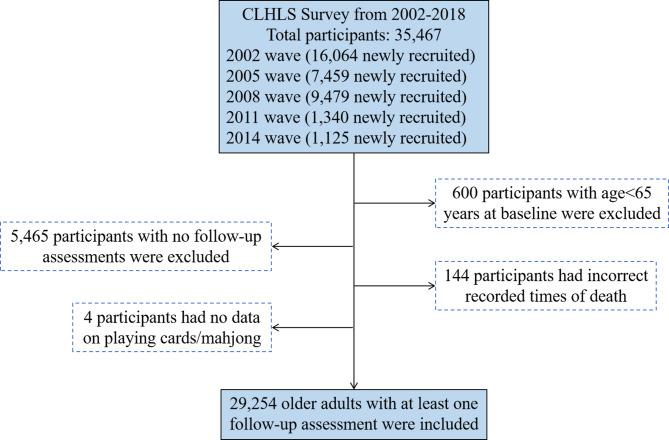
We analyzed data from the Chinese Longitudinal Healthy Longevity Survey (CLHLS) collected between 2002 and 2018. A total of 29,254 participants aged 65 or older were included in the study. Participants were categorized based on their frequency of playing cards/mahjong: almost every day, at least once a week, at least once a month or sometimes, and never. Cox proportional hazards models were applied to assess the association between playing cards/mahjong and all-cause mortality. Interaction and sensitivity analyses were conducted to explore potential effect modifications and the robustness of the findings.
RESULTS
During a mean follow-up of 4.6 years, 7,651 participants died. Compared to participants who never played cards/mahjong, those who played almost every day had a significantly lower risk of all-cause mortality (HR = 0.88; 95% CI, 0.82–0.95). Participants who played at least once a week (HR = 0.84; 95% CI, 0.78–0.91) similarly demonstrated reduced mortality. Participants who consistently played cards/mahjong at least once a week at both baseline and follow-up had a significantly lower all-cause mortality risk compared to never-players (HR = 0.67; 95% CI: 0.52–0.86). Interaction analysis revealed that the protective effect of playing cards/mahjong was more pronounced in participants aged 80 or older (P-interaction < 0.001). Sensitivity analyses confirmed the robustness of these associations.
CONCLUSION
Older adults who regularly play cards/mahjong have a lower risk of all-cause mortality, especially in the oldest groups. These leisure activities may promote longevity, but further research is needed to understand why.
SUPPLEMENTARY INFORMATION
The online version contains supplementary material available at 10.1186/s12877-025-06263-3.
背景
参与诸如打牌或打麻将等休闲活动已被证明与老年人的认知和身体益处有关。然而,打牌/打麻将与全因死亡率之间的关系仍不明确。本研究旨在探讨中国老年人群体中打牌/打麻将与全因死亡率之间的关联。
方法
我们分析了2002年至2018年期间收集的中国健康与养老追踪调查(CLHLS)的数据。共有29254名65岁及以上的参与者纳入本研究。参与者根据其打牌/打麻将的频率进行分类:几乎每天、至少每周一次、至少每月一次或偶尔、从不。采用Cox比例风险模型评估打牌/打麻将与全因死亡率之间的关联。进行交互作用和敏感性分析以探讨潜在的效应修饰因素和研究结果的稳健性。
结果
在平均4.6年的随访期间,7651名参与者死亡。与从不打牌/打麻将的参与者相比,几乎每天打牌/打麻将的参与者全因死亡率风险显著更低(风险比[HR]=0.88;95%置信区间[CI],0.82 - 0.95)。每周至少打牌/打麻将一次的参与者(HR = 0.84;95% CI,0.78 - 0.91)同样显示死亡率降低。在基线和随访时均持续每周至少打牌/打麻将一次的参与者与从不打牌/打麻将者相比,全因死亡率风险显著更低(HR = 0.67;95% CI:0.52 - 0.86)。交互作用分析显示,打牌/打麻将的保护作用在80岁及以上的参与者中更为明显(交互作用P值<0.001)。敏感性分析证实了这些关联的稳健性。
结论
经常打牌/打麻将的老年人全因死亡率风险较低,尤其是在年龄最大的群体中。这些休闲活动可能有助于延年益寿,但需要进一步研究以了解其原因。
补充信息
在线版本包含可在10.1186/s12877 - 025 - 06263 - 3获取的补充材料。

 Zotero 插件