
雾化腺病毒载体新冠疫苗和肌肉注射mRNA疫苗二价加强针的安全性和免疫原性:一项随机开放标签临床试验。
Safety and Immunogenicity of aerosolized adenovirus-vectored COVID-19 vaccine and intramuscular mRNA vaccine bivalent boosters: a randomized open-label clinical trial.
作者信息
Wu Shipo, Huang Jianying, Wang Busen, Li Jianhua, Wu Jianyuan, Zhang Zhe, Luo Lin, Zhang Jinlong, Huo Nan, Long Jianglan, Huang He, Chen Zhengshan, Zhang Mengyao, Zhao Zhenghao, Dan Junyan, Song Xiaohong, Mao Haiyan, Huo Shengyuan, Yan Hao, Zhang Yanjun, Wang Xinghuan, Hou Lihua
机构信息
Laboratory of Advanced Biotechnology, Beijing Institute of Biotechnology, Beijing, China.
Clinical Trial Center, Zhongnan Hospital of Wuhan University, Wuhan, China.
出版信息
Nat Commun. 2025 Aug 7;16(1):7281. doi: 10.1038/s41467-025-62698-7.
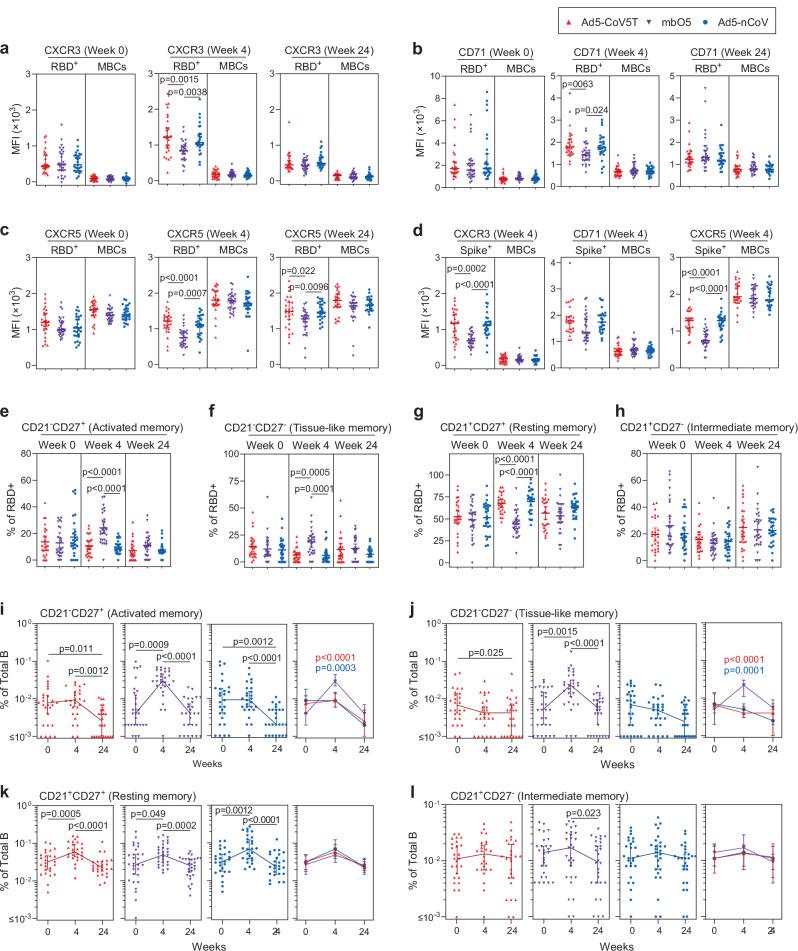
Both SARS-CoV-2 mRNA and mucosal vaccines induce protective immunity against COVID-19 but showed different immune profiles. We conducted a longitudinal head-to-head analysis of the safety and immunogenicity of the aerosolized adenovirus-vectored and mRNA COVID-19 vaccines. 450 participants were enrolled and randomly assigned into three groups to be vaccinated with an aerosolized Ad5-vectored bivalent vaccine (wild-type and BA.5, Ad5-CoV5T), an intramuscular bivalent mRNA vaccine (mbO5), and an aerosolized wild-type Ad5-vectored vaccine (Ad5-nCoV). The primary outcomes were adverse reactions within 28 days and anti-XBB.1.5-specific neutralizing antibody titers at day 28 after vaccination. The secondary outcome assessed safety within 30 min, serious adverse event within 6 months, and the persistence of anti-XBB.1.5/BA.5-specific neutralizing antibodies during the 6 months. Both the vaccines were well tolerated, but participants vaccinated with mbO5 reported more adverse reactions (73.3% mbO5 vaccinees vs. 28.7% aerosol vaccinees). No serious adverse events were recorded. The Ad5-CoV5T vaccine induced a superior anti-XBB.1.5-specific neutralizing titer than Ad5-nCoV at day 28 (geometric mean titer ratio of 1.48, 95% CI 1.12-1.97), while the mbO5 vaccine induced the highest antibody titer. The neutralizing antibodies were declined at month 6 and were similar across the three groups. In the pre-specified exploratory analysis, the mbO5 and the aerosolized vaccines induced comparable antigen-specific memory B cells but the latter stimulated higher frequency of IgA isotype and higher expression of CXCR3. This trial met the main hypothesis; the findings may provide insights for the development of the next-generation COVID-19 vaccines. Clinical Trials.gov identifier: NCT05886790.
严重急性呼吸综合征冠状病毒2(SARS-CoV-2)信使核糖核酸(mRNA)疫苗和黏膜疫苗均可诱导针对新型冠状病毒肺炎(COVID-19)的保护性免疫,但二者呈现出不同的免疫特征。我们对雾化腺病毒载体COVID-19疫苗和mRNA COVID-19疫苗的安全性和免疫原性进行了纵向的直接比较分析。招募了450名参与者并将其随机分为三组,分别接种雾化的Ad5载体二价疫苗(野生型和BA.5,Ad5-CoV5T)、肌肉注射二价mRNA疫苗(mbO5)和气雾化野生型Ad5载体疫苗(Ad5-nCoV)。主要结局为接种后28天内的不良反应以及接种后第28天的抗XBB.1.5特异性中和抗体滴度。次要结局评估了接种后30分钟内的安全性、6个月内的严重不良事件以及6个月内抗XBB.1.5/BA.5特异性中和抗体的持久性。两种疫苗耐受性均良好,但接种mbO5的参与者报告的不良反应更多(mbO5疫苗接种者为73.3%,雾化疫苗接种者为28.7%)。未记录到严重不良事件。在第28天,Ad5-CoV5T疫苗诱导产生的抗XBB.1.5特异性中和滴度高于Ad5-nCoV(几何平均滴度比值为1.48,95%置信区间为1.12至1.97),而mbO5疫苗诱导产生的抗体滴度最高。中和抗体在第6个月时下降,且三组之间相似。在预先设定的探索性分析中,mbO5疫苗和雾化疫苗诱导产生的抗原特异性记忆B细胞相当,但后者刺激产生的IgA同种型频率更高且CXCR3表达更高。本试验符合主要假设;研究结果可能为下一代COVID-19疫苗的研发提供见解。临床试验注册号:NCT05886790。


 Zotero 插件